
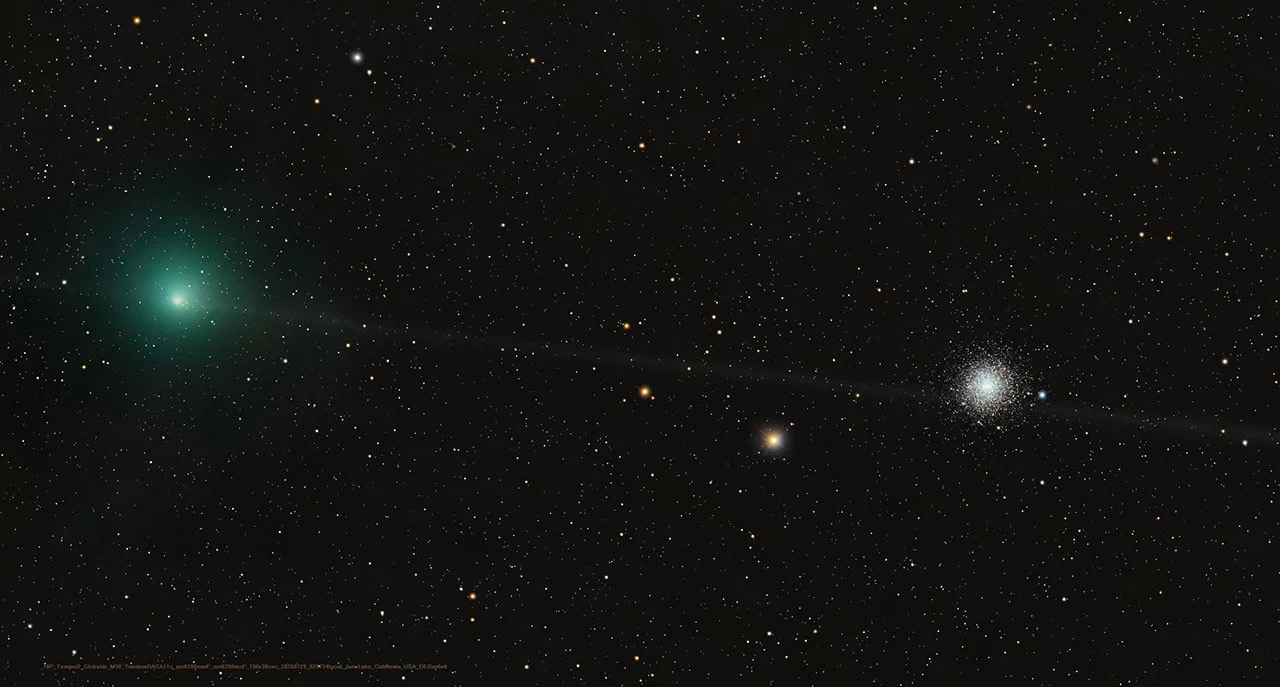
A striking telescopic image taken on July 29 showcases periodic comet 10P/Tempel 2 passing near the globular star cluster Messier 30 (M30), an event captured and confirmed by astronomers and featured in the Astronomy Picture of the Day (APOD).
What Happened
The image highlights the transient celestial proximity of comet Tempel 2 to Messier 30 as the comet swept close in the sky. This close apparent approach is an observational alignment rather than a physical interaction, with the comet’s faint, greenish coma visible on the left and the distant star cluster on the right. Although the dust trail of Tempel 2 seems to intersect the cluster in the image, they remain vastly separated in space.
Key Facts
Periodic comet 10P/Tempel 2 was recorded at a distance of approximately 3.5 light-minutes from Earth during this observation, while Messier 30 lies about 28,000 light-years away. M30 is cataloged as the 30th entry in the famous Messier Catalogue, compiled by 18th-century astronomer Charles Messier to distinguish non-cometary fuzzy objects from actual comets. The comet’s orbital dust trail is discernible in the image as a narrow, faint feature seemingly piercing through the star cluster.
What This Means
This visual juxtaposition provides a compelling demonstration of how vastly different astronomical objects can appear close when viewed from Earth, despite existing at radically different distances. The contrast between Tempel 2’s proximity within the solar system and the ancient, distant stellar population of Messier 30 illustrates the richness and scale of the universe accessible through modern telescopic technology. For observers and astronomers alike, such events offer opportunities to study cometary materials up close and appreciate the structure of our galaxy’s globular clusters simultaneously.
Capturing periodic comets like Tempel 2 as they loop through the inner solar system advances understanding of their compositions and orbital dynamics, which in turn informs knowledge about the early solar system. At the same time, maintaining the historical legacy of Messier’s catalog aids in identifying and categorizing deep-sky objects, continuing the tradition of astronomical observation that bridges centuries.
Background
Comet 10P/Tempel 2 is a well-known periodic comet that has been observed during multiple returns to the inner solar system. Charles Messier’s catalog, created in the 18th century, lists objects that could be mistaken for comets but are actually fixed nebulae or star clusters. Messier 30 is a dense and old globular cluster located in the constellation Capricornus, notable for its compact core and rich stellar population.
What Remains Unclear
This observation focused on the comet’s apparent position relative to M30. Further analysis of Tempel 2’s dust trail composition, activity levels, and any changes observed during its orbit will require detailed data processing still underway by mission scientists.
Sources
This article is based on reporting and publicly available information from the following sources:
Read more Space & NASA stories on Goka World News.