
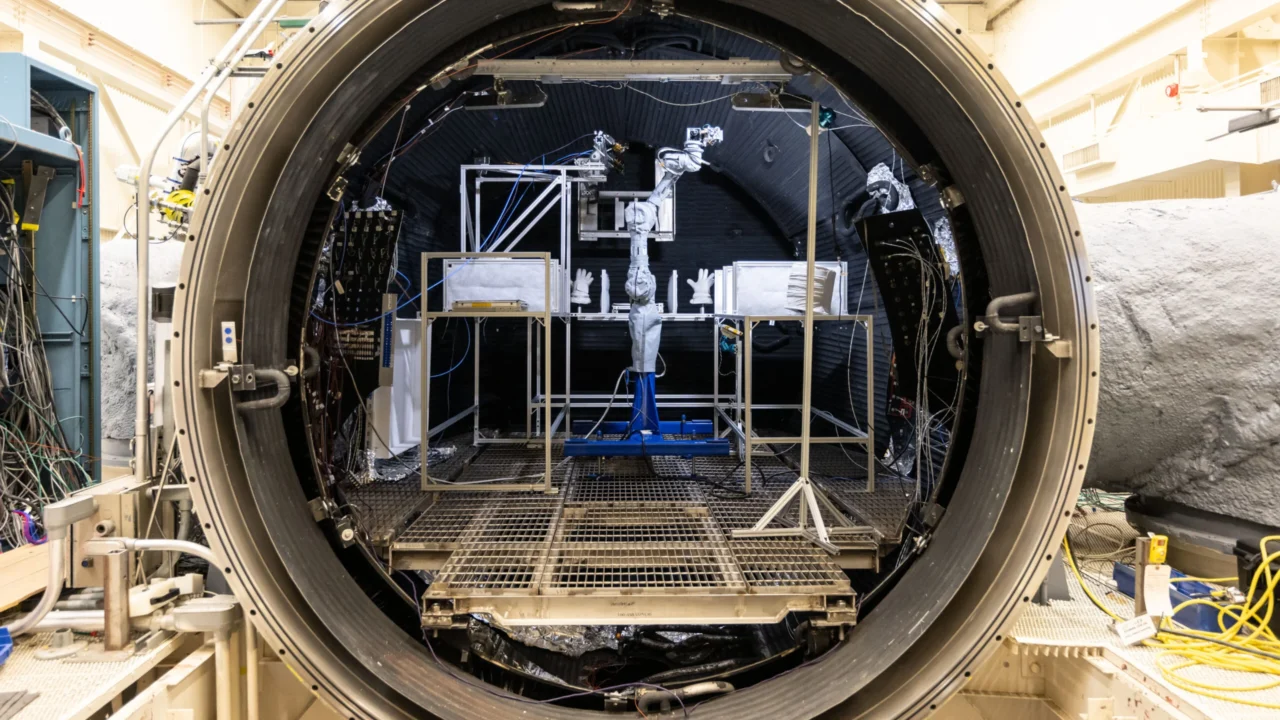
Before NASA’s Artemis program returns astronauts to the Moon, mission-critical hardware must undergo rigorous testing to ensure it can endure the Moon’s harsh environment. At NASA’s Johnson Space Center in Houston, the Lunar Development and Test Facility specializes in simulating lunar conditions, focusing especially on the challenges posed by abrasive lunar dust.
What Happened
NASA engineers at the Lunar Development and Test Facility are conducting tests on Artemis program hardware within vacuum chambers designed to mimic the Moon’s surface environment. These chambers utilize lunar regolith simulant to replicate the properties of Moon dust—an extremely fine, sharp, and clingy material known to pose risks to equipment and astronaut health. The facility features a dust containment and preparation laboratory, a 3-foot cube vacuum chamber for smaller-scale tests, and a 15-foot thermal vacuum chamber for larger hardware. Using a closed-loop nitrogen system, these chambers recreate the vacuum and thermal extremes characteristic of the lunar surface to assess how spacesuits, spacecraft parts, and mechanical systems perform under such conditions. The work includes evaluating moving parts and joints that will be exposed to lunar dust during future Artemis missions.
Key Facts
The Lunar Development and Test Facility is situated within the Energy Systems Test Area at the Johnson Space Center and managed by NASA’s Propulsion and Power Division. The facility’s vacuum chambers enable realistic lunar simulations using high-fidelity lunar soil analogs. These tests are critical for verifying the durability and functionality of equipment before deployment on the Moon. Additionally, engineers are advancing methods to extract resources from lunar regolith, such as oxygen for breathing and liquid oxygen for rocket propellant, supporting long-duration exploration objectives. The facility’s exterior now features a large-scale mural, completed in 2024 by artist Sebastian Boileau, celebrating the spirit of exploration embodied in this pioneering work. NASA also offers a 3D virtual tour of the facility, allowing public access to this cutting-edge testing environment.
What This Means
NASA’s focus on rigorously testing hardware in simulated lunar conditions addresses one of the most daunting obstacles for Moon missions: lunar dust. Unlike Earth sand, lunar dust is abrasive and electrically charged, clinging stubbornly to surfaces and potentially damaging equipment vital for astronaut survival. By understanding how dust affects hardware and spacesuit joints, NASA can develop more resilient designs and mitigation strategies, reducing mission risks and ensuring astronaut safety. This testing is fundamental to supporting Artemis goals of sustainable human presence on the Moon, not merely brief visits. Moreover, advancing resource extraction from lunar soil could transform the economics and logistics of deep space missions, enabling astronauts to produce life support consumables and propellant in situ rather than transporting them across space. These developments pave the way for future Moon bases and deeper space exploration, ultimately laying groundwork for manned journeys to Mars and beyond.
Background
The Artemis program aims to land the first woman and the next man on the Moon by the mid-2020s and establish a sustainable lunar presence by the end of the decade. The Lunar Development and Test Facility is an integral part of NASA’s preparation, tasked with mitigating environmental challenges unique to lunar exploration. Past missions like Apollo encountered the hazards of lunar dust firsthand, leading to equipment wear and astronaut discomfort, lessons that inform the current rigorous testing protocols.
What Comes Next
NASA engineers will continue to refine testing procedures and hardware designs at the facility to ensure readiness for Artemis mission hardware deployment. The ongoing analysis of test results will inform improvements to spacesuit materials, mechanical systems, and resource extraction technologies. The agency is scheduled to update the public with progress on Artemis hardware testing as launch windows for upcoming missions approach, maintaining transparency in this foundational phase of lunar exploration.
Sources
This article is based on reporting and publicly available information from the following sources:
Read more Space & NASA stories on Goka World News.