
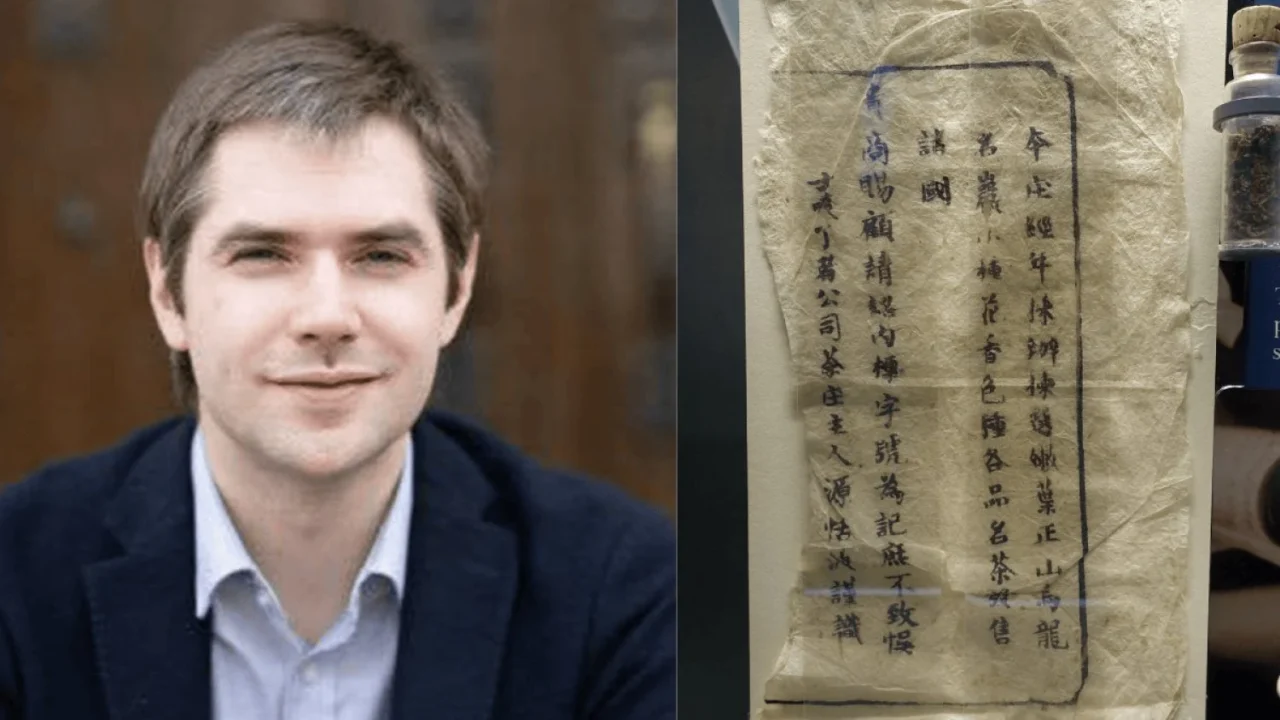
A Chinese tea chest label, long believed to be a relic from the 1773 Boston Tea Party, has been definitively dated to the mid-19th century, according to research conducted by MIT historian Tristan Brown. Published in the American Historical Review in June 2026, Brown’s study untangles the label’s origins and reveals new insights about how objects are used to shape historical memory.
What Happened
Tristan Brown embarked on the investigation after the label, donated to Boston’s Old South Meeting House in 1987 by descendants of blacksmith Thomas Wells, was assumed to be an artifact from the pivotal colonial protest against British taxation. The label’s Chinese text initially resisted clear interpretation due to attempts to read it in Mandarin, China’s official language. However, after a year of archival research and linguistic analysis, Brown identified that the label’s characters were used phonetically in Cantonese, a dominant commercial dialect in East Asia during the 19th century. This phonetic sequence spelled out “Smith, Archer,” pointing to Smith, Archer & Co., a New York-based trading firm operating in China and Japan in the 1860s and 1870s.
The label also named a Cantonese merchant, Yuan Tianbo, linked to the firm’s network in Yokohama, Japan. These linguistic and documentary clues placed the label solidly in the 19th century, not the 18th-century Boston Tea Party era. Brown traced the artifact’s likely route into the Wells family through John Milton Wells, a relative engaged in the California Gold Rush and later a Michigan grocer operating the “California Tea Store,” which specialized in imported Asian teas.
Key Facts
The research findings were published July 3, 2026, in the American Historical Review. The study combined linguistic analysis, archival sources, and family histories associated with the Wells family from Michigan. The label’s text was analyzed through Cantonese phonetics, contrasting earlier interpretations based on Mandarin. The provenance work involved census data, business directories, and historical newspapers, establishing a mid-19th-century date consistent with Smith, Archer & Co.’s trading activity in East Asia’s Pacific ports like Canton and Yokohama.
What This Means
Brown’s discovery reframes the label’s significance from a direct revolutionary-era artifact to a symbol of America’s evolving relationship with global trade and collective memory. The label illustrates how American families and institutions shaped narratives of national identity by appropriating objects linked to distant historical events. This process, especially during the 19th-century centennial commemorations, helped produce tangible “relics” that reinforced connection to the founding era, even if those objects originated in a later period.
The findings highlight a broader interplay between Pacific trade, Chinese migration, and American cultural storytelling that enriched revolutionary memory beyond its immediate historical context. For readers, this underscores the complexities in how history is constructed and the importance of scrutinizing the origins of seemingly authentic artifacts. It also sheds light on the longstanding economic and cultural ties between America and East Asia, embodied in the global tea trade which supplied the very commodity at the heart of the protest.
Background
The Boston Tea Party of 1773 was a seminal protest by American colonists against British taxation policies, involving the destruction of tea shipments in Boston Harbor. Few physical artifacts from the event survive due to its illicit nature and participants’ need for anonymity. Prior examinations by institutions like the British Museum and Harvard had neither confirmed nor dismissed the label’s Revolutionary origins, though it remained a rare material link to this key event.
Analysis
Brown emphasizes that the label’s linguistic features, previously overlooked by scholars reading it in Mandarin, were the key to its correct dating and historical context. His research also points to how global commercial networks of the 19th century, such as those operated by Smith, Archer & Co., facilitated the exchange of goods—and artifacts—that later gained new cultural meanings when repurposed by American families and museums. He described the Wells family as active partners in the inquiry, highlighting their embrace of historical truth over family mythologizing.
What Remains Unclear
The study leaves open questions about the full scope of Smith, Archer & Co.’s operations and the precise circumstances under which the label entered the Wells family collection. It remains undetermined how much the family’s 19th-century tea business contributed to shaping the label’s mistaken Revolutionary War association at the local and museum levels over time.
What Comes Next
Brown’s work serves as a model for reexamining other historical artifacts with new tools like digitized trade records and enhanced linguistic approaches. Future research may further explore overlapping histories of trade, migration, and memory construction. The Old South Meeting House and related institutions may consider revising exhibits to reflect the updated provenance and broader significance of artifacts like this label.
Sources
This article is based on reporting and publicly available information from the following sources:
Read more Science Discoveries stories on Goka World News.