
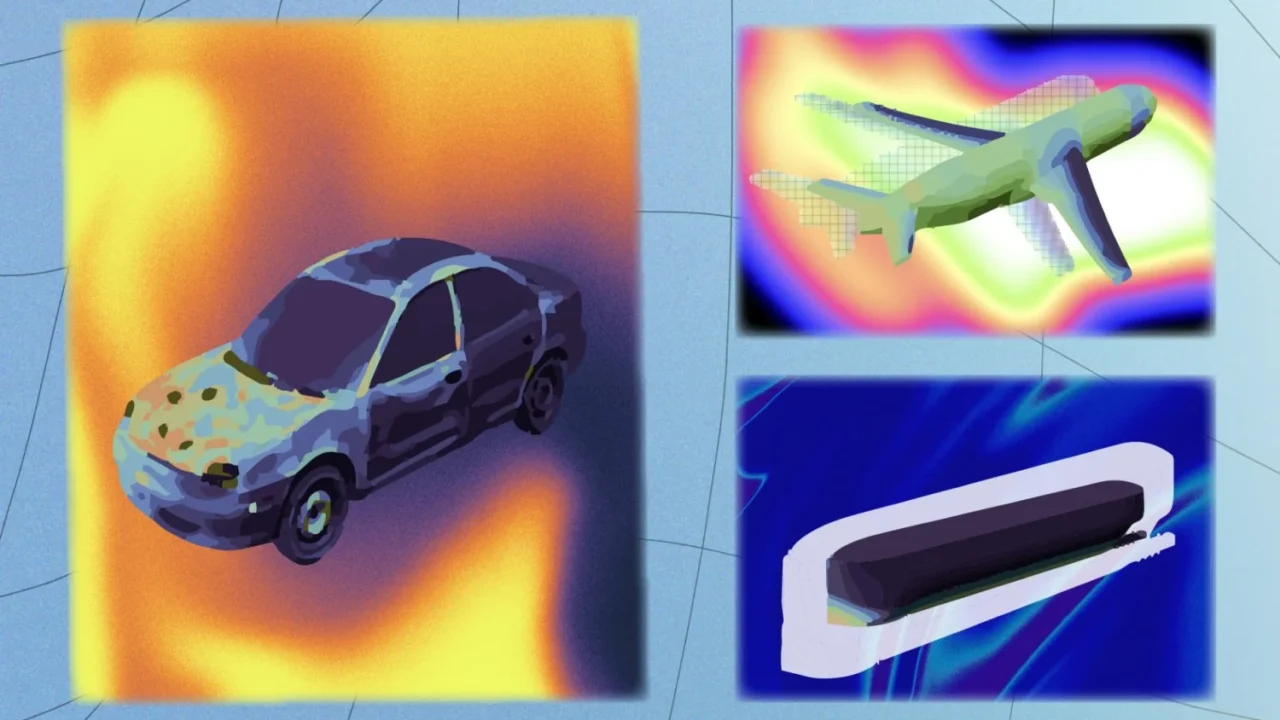
Researchers at MIT’s Computer Science and Artificial Intelligence Laboratory (CSAIL), in collaboration with a principal investigator from Google DeepMind, have developed an artificial intelligence model called GeoPT that can simulate a wider range of real-world physics scenarios with improved speed and efficiency. This innovation aims to enhance the testing of complex physical interactions in engineering designs and robotics, using significantly less data than current state-of-the-art models.
What Happened
The MIT-CSAIL and Google DeepMind research team introduced GeoPT, a novel pre-training approach designed to endow AI models with a robust understanding of physics by virtually reenacting mechanical interactions in three dimensions. The model uses “synthetic dynamics,” simulating interactions between particles and complex 3D shapes to learn physical behaviors such as how particles stop when they encounter an object’s surface.
GeoPT’s training involved 1.3 million samples of these synthetic dynamics, providing it with a foundational “feel” for physics before performing more traditional supervised learning. This approach allowed the model to reach peak accuracy in physical simulations twice as fast as leading baselines, while requiring up to 60 percent less labeled data. The research team presented these findings at the International Conference on Machine Learning in July.
Key Facts
GeoPT was developed by a team including MIT PhD student and CSAIL researcher Minghao Guo, postdoc Haixu Wu, CSAIL principal investigator Wojciech Matusik, and Google DeepMind distinguished scientist and associate professor Kaiming He. The project is a collaboration with Tsinghua University and supported in part by Neural Modular Physics Twin for Robotics funding.
The model demonstrated superior performance on complex industrial simulation benchmarks, including aerodynamic simulations on plane designs, vehicle deformation in collisions, and boat hull responses to wind and waves. GeoPT produced high-fidelity simulations involving over 100 million mesh points with enhanced speed and accuracy using substantially less training data than previous models.
What This Means
GeoPT’s ability to simulate diverse physics scenarios with less data and higher speed promises to transform engineering workflows by reducing the reliance on costly and time-consuming physical experiments. For automakers, aerospace engineers, and robotics developers, this could mean faster prototype testing and improved product safety assessments early in the design process.
Moreover, by building a strong foundational physics understanding, GeoPT represents a step toward AI “foundation models” that can generalize across numerous tasks, much like text- and image-based AI have done. This capacity to model physics across varied applications lays groundwork for future innovations such as advanced weather simulation, complex material testing, and the generation of realistic videos involving physical phenomena.
With AI increasingly integrated into engineering and scientific tools, this advance also signals a shift toward multimodal AI systems that combine textual, visual, and physical reasoning abilities, potentially enabling smarter, more versatile AI agents in multiple industries.
Background
Prior AI models have excelled in interpreting text and images but struggled with physical simulations due to the computational complexity and data scarcity inherent in modeling physics. Traditional numerical solvers used in engineering are accurate but often prohibitively slow, limiting the scale of data available to train AI models effectively.
GeoPT’s approach of pre-training on synthetic dynamic data to “understand” physics offers a new paradigm, enabling a model to learn from a vast range of simulated particle-object interactions without the need for extensive labeled datasets.
Analysis
Fei Sha, an AI research scientist at Meta unaffiliated with the project, remarked on the significance of GeoPT’s methodology, noting that it overturns the assumption that physics and geometry are inseparably complex and costly to model. Sha called the team’s success across multiple application domains a signal that the field is now ready to build large-scale physics foundation models rapidly.
Co-lead author Haixu Wu emphasized GeoPT’s industrial relevance, highlighting its capacity to simulate extremely detailed scenarios within seconds, which could drastically reduce the number of physical prototypes and experiments needed, thus accelerating engineering innovation cycles.
What Remains Unclear
The researchers note that GeoPT is a preliminary step toward a comprehensive physics foundation model and will require scaling to incorporate more complex shapes and phenomena, including advanced weather systems and diverse material properties. Details on commercial deployment timelines or integration into existing engineering software are not yet disclosed.
What Comes Next
The team plans to continue expanding GeoPT’s capabilities by training it on larger and more varied datasets, aiming to simulate broader physical phenomena. Their next public dissemination of progress will likely be seen in follow-up academic conferences and journals as they refine the approach.
Sources
This article is based on reporting and publicly available information from the following sources:
Read more Artificial Intelligence stories on Goka World News.