
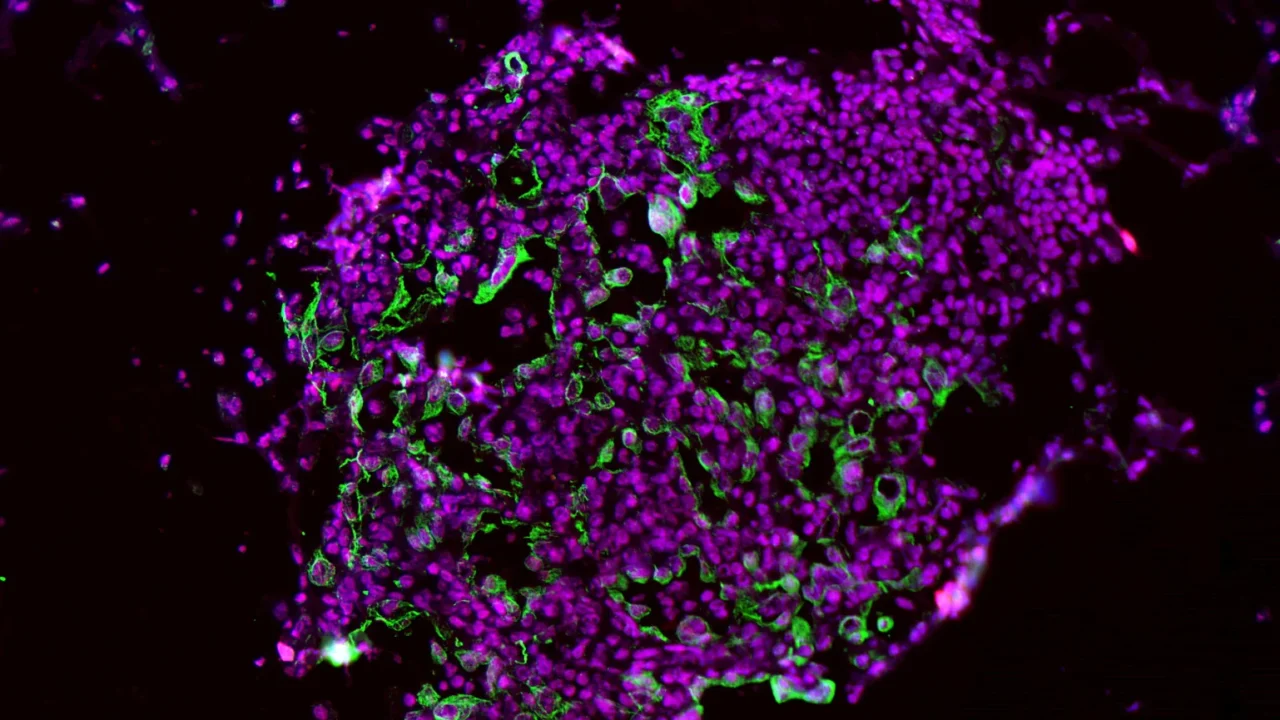
Scientists at the Massachusetts Institute of Technology have discovered that inhibiting an inflammatory enzyme called caspase-1 can significantly reduce the development of lung tumors in mice. Their findings, published in Science Advances, suggest this enzyme as a promising target for preventing lung cancer in individuals at elevated risk.
What Happened
The research led by Professor Sangeeta Bhatia at MIT investigated the role of the enzyme caspase-1 in lung tumor formation using a genetically engineered mouse model known as KPS. These mice carry cancer-causing mutations in the p53 and Kras genes, along with a peptide that induces lung inflammation, replicating conditions of increased cancer risk before tumor detection. After inducing the mutations, some mice were treated with an antibody blocking the inflammatory cytokine IL-1 beta, while others were left untreated. Using nanosensors designed by Bhatia’s lab to detect protease activity, the team found heightened caspase-1 activity localized to lung tumors in untreated mice.
Further experiments administered a small-molecule caspase-1 inhibitor orally to at-risk mice before tumors developed, either alone or combined with the IL-1 beta antibody. Both treatments reduced tumor size and number, but the combination prevented tumor formation in nearly 20 percent of the mice. The study also included initial human data showing higher caspase-1 activity in lung fluid samples from lung cancer patients compared to healthy donors.
Key Facts
The study was published in Science Advances and involved MIT’s Koch Institute for Integrative Cancer Research and the Institute for Medical Engineering and Science. The lead author was Cathy Wang, PhD ’26. The mouse model used was developed by Tyler Jacks, a fellow at MIT’s Koch Institute. The research employed nanosensors that detect protease activity by cleaving peptide-modified nanoparticles. Caspase-1 inhibition was achieved through a small molecule drug already tested for rheumatoid arthritis in clinical trials. The related CANTOS trial previously demonstrated that targeting the IL-1 beta pathway reduced lung cancer rates, inspiring this deeper exploration of protease involvement. Human lung fluid samples were analyzed in collaboration with Harvard Medical School and Mass General Brigham researchers. Funding was provided by Johnson & Johnson, Upstage Lung Cancer, the Virginia and D.K. Ludwig Fund, and various National Cancer Institute and environmental health grants.
What This Means
This discovery highlights inflammation’s crucial role in lung cancer initiation and progression, providing a tangible therapeutic target long before tumors develop. Since lung cancer remains the leading cause of cancer deaths globally—with smoking as a primary risk factor but also affecting non-smokers—new preventive strategies are urgently needed.
By identifying caspase-1’s specific activity in early tumor formation and demonstrating the efficacy of an orally administrable drug already proven safe in humans, the study offers a practical path toward cancer interception. This approach differs from traditional treatments focused on established tumors, aiming instead to prevent or delay cancer onset entirely in high-risk populations. If translated to clinical use, such prophylactic therapies could reduce lung cancer incidence and save many lives.
Moreover, the use of protease-activated nanosensors introduces a powerful diagnostic tool that could help stratify patients by risk and monitor response to preventive therapy, personalizing interventions. This precision medicine aspect enhances the relevance of the findings beyond lung cancer alone, potentially influencing future cancer prevention strategies across multiple tumor types.
Background
The study builds upon previous clinical findings such as the 2017 CANTOS trial, which revealed that patients treated with an IL-1 beta-blocking antibody experienced lower lung cancer rates even when the trial’s primary goal was cardiovascular disease prevention. However, subsequent studies showed limited benefit for patients with established lung cancer, emphasizing the importance of early intervention.
Sangeeta Bhatia’s laboratory has a history of developing nanoparticles and nanosensors to detect protease activity in various diseases, recognizing proteases’ dual role in tumor growth and immune response modulation. Proteases facilitate cancer progression by remodeling tissue and enabling cancer cells to migrate, while also guiding inflammatory cells that influence tumor dynamics. This research uncovers which proteases are active during lung cancer initiation.
What Remains Unclear
While the data demonstrate caspase-1’s involvement in early lung tumor development, the full range of cellular mechanisms by which it promotes tumorigenesis requires further elucidation. The exact pathways linking caspase-1 activation to cancer onset, and how they interact with various immune and stromal cells, remain to be fully mapped.
Additionally, the applicability of these mouse model findings to the human population at large, including variability in genetic and environmental factors, needs validation. The small human sample size analyzed so far cannot yet confirm caspase-1 as a definitive biomarker or preventive target for diverse patient groups.
What Comes Next
The researchers plan to pursue clinical trials testing caspase-1 inhibitors as preventive agents in individuals at elevated risk of lung cancer. They aim to integrate recently identified biomarkers that predict patient response to IL-1 beta-targeted therapies, refining patient selection and improving trial outcomes.
Further studies will also investigate caspase-1 activity in larger human cohorts and explore optimal dosing regimens for preventive treatment. The team’s nanosensor technology could be adapted for non-invasive early detection of inflammatory protease activity, potentially complementing preventive therapy monitoring.
Sources
This article is based on reporting and publicly available information from the following sources:
Read more Science Discoveries stories on Goka World News.