
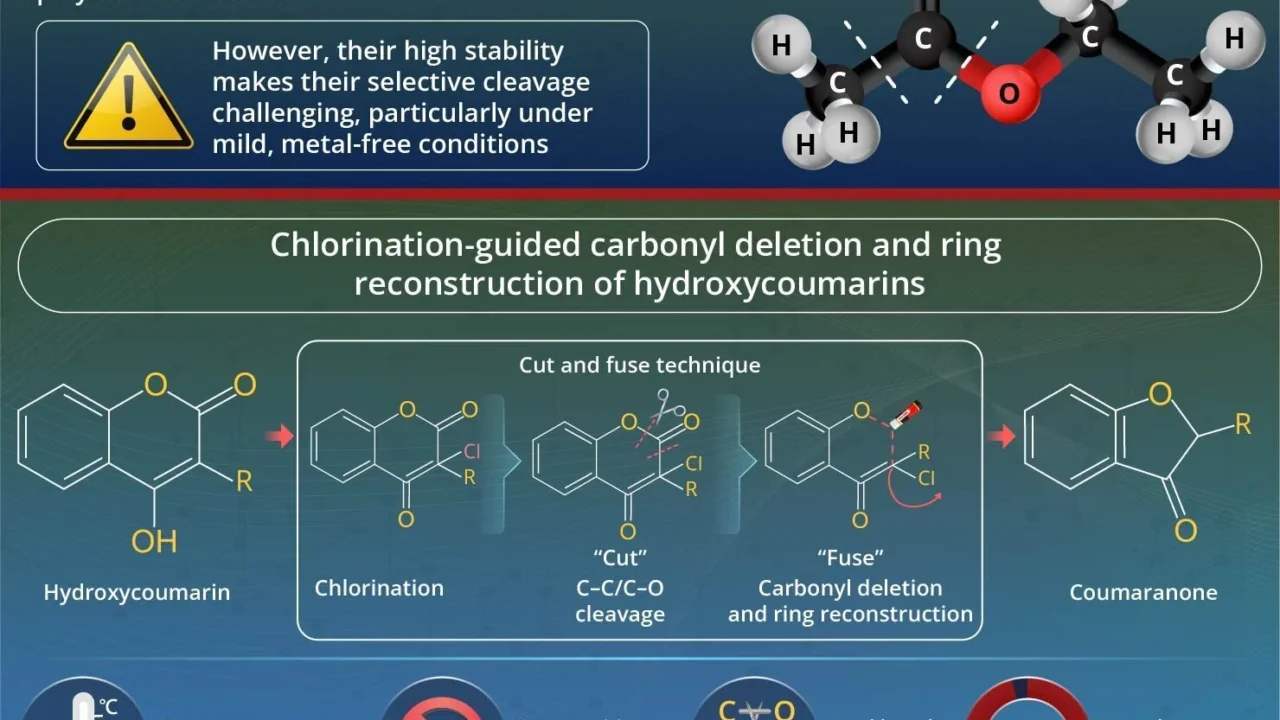
A team led by Professor Toshifumi Dohi at Ritsumeikan University has introduced a novel molecular skeletal editing method inspired by natural biosynthesis processes that enables selective modification of hydroxycoumarins. This approach, using a “cut-to-fuse” strategy involving chlorination, triggers carbonyl deletion and reconstructs molecules into coumaranones under mild, nonenzymatic conditions without requiring transition-metal catalysts.
What Happened
The researchers published their findings on July 26, 2026, in the peer-reviewed journal JACS Au, detailing a new chemical transformation that remodels hydroxycoumarins by selectively breaking challenging carbon–carbon and carbon–oxygen bonds. The process begins with chlorination using N-chlorosuccinimide (NCS), which cleaves bonds to form a reactive intermediate. This intermediate then undergoes decarbonylative reconstruction, ultimately yielding a coumaranone framework. The reactions take place at room temperature under near-neutral conditions, marking a significant departure from the harsh environments traditionally necessary for such transformations.
Key Facts
The optimized procedure involves treating hydroxycoumarins with NCS, water, sodium acetate in ethyl acetate, followed by potassium phosphate, achieving over 99% yield of the target coumaranone. The method tolerates a wide range of functional groups including methoxy, halogen, azide, phenol, carboxylic acid, and boron derivatives, as well as various aromatic and aliphatic substrates. Notably, the reaction can be scaled up to gram quantities, producing coumaranones in 91% yield. Additionally, the coumaranone products can be further modified via transformations such as palladium-catalyzed coupling and quaternary carbon center formation, demonstrating synthetic versatility.
What This Means
This new “cut-to-fuse” strategy presents a practical and milder alternative to conventional ester bond cleavage, which typically requires harsh reagents or conditions that can limit functional group compatibility. By enabling simultaneous cleavage and reconstruction of molecular skeletons without transition metals or extreme temperatures, the method streamlines synthetic pathways for complex molecules. This can accelerate medicinal chemistry projects by facilitating rapid structural diversification of scaffolds critical for drug development. The ability to selectively remove a carbonyl unit and build a new heterocyclic framework also opens avenues for exploring molecular architectures previously difficult to access, potentially impacting the design of pharmaceuticals and functional materials.
Background
Skeletal editing aims to restructure molecules through selective bond cleavage and formation without resynthesizing entire compounds, a growing focus to improve synthetic efficiency. However, functional groups like esters, with strong carbon–carbon and carbon–oxygen bonds, have remained challenging targets due to their resistance to mild cleavage. The team’s approach draws inspiration from halogenation reactions in natural product biosynthesis, which guide selective bond transformations in complex molecules.
Analysis
Professor Dohi noted that initial attempts using fluorination led to undesired fragmentation, but chlorination altered the mechanism, enabling controlled reconstruction rather than decomposition. Mechanistic studies confirmed that selective chlorination is essential, as omission of the chlorinating agent resulted in no reaction. The sequence includes chlorination, decarbonylation, and intramolecular cyclization, showcasing the importance of designing reaction pathways that leverage subtle electronic and structural effects.
What Remains Unclear
The study has yet to explore scalability beyond gram scale or application to more structurally complex and diverse natural product derivatives. The long-term stability and practical utility of the resulting coumaranones in various medicinal or industrial contexts remain to be rigorously tested. Also, while the reaction conditions are mild and metal-free, potential environmental impacts or synthesis costs related to chlorinating reagents have not been fully assessed.
What Comes Next
The researchers anticipate expanding the substrate scope and refining the method’s applicability to additional classes of cyclic esters. Ongoing work is focused on developing further modifications of coumaranone scaffolds, including more complex functionalizations and coupling strategies, which will be reported in future publications.
Sources
This article is based on reporting and publicly available information from the following source:
Read more Science Discoveries stories on Goka World News.