
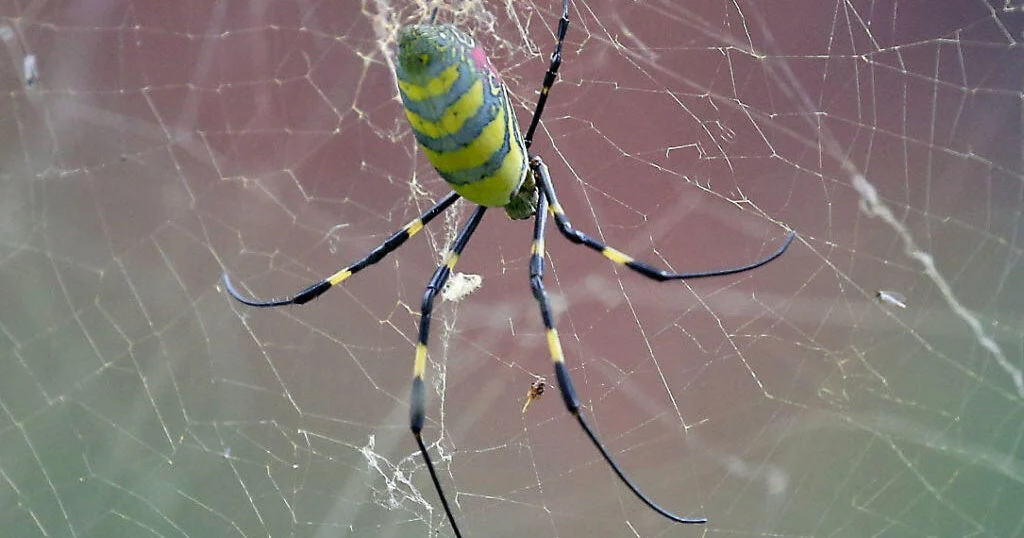
The invasive Joro spider, originally from East Asia, continues its slow expansion across multiple states in the Southeastern United States, according to researchers tracking its spread. While their large size and vivid coloration may cause alarm, studies show that they pose minimal risk to humans and their ecological impact remains under investigation.
What Happened
First identified in Georgia in 2014, the Joro spider (Trichonephila clavata) has since been reported in over a dozen states, predominantly in the Southeastern region. In 2026, sightings have been confirmed in Georgia, the Carolinas, Tennessee, and Alabama. The Great Smoky Mountains National Park, located along the Tennessee-North Carolina border, publicly acknowledged the growing presence of Joro spiders, asking visitors to assist in monitoring their distribution by reporting any encounters. This initiative supports researchers at the University of Tennessee in mapping the species’ regional spread.
Key Facts
Adult female Joro spiders are notably large, with bodies reaching up to one inch in length and leg spans extending to four inches. They possess distinctive yellow bodies accented with bluish-green stripes and black and yellow legs, whereas males are smaller and mainly brown. The spiders weave massive orb-shaped webs that can span up to ten feet in diameter, often appearing on the exteriors of homes and other structures.
Research published in the 2025 edition of the Journal of Medical Entomology documented interactions between humans and Joro spiders, concluding that bites are extremely rare, typically occurring only when spiders are forcibly handled. When bites did happen, symptoms were mild and short-lived. The spiders mainly avoid human contact and are unlikely to enter homes.
Young Joro spiders employ a dispersal technique known as ballooning, releasing silk threads to catch the wind and travel long distances, contributing to their gradual regional spread.
What This Means
The ongoing spread of Joro spiders raises important ecological questions. As a large and visually striking orb-weaver, the species could affect native spider populations through competition or predation, but the full ecological consequences remain uncertain. University of Tennessee graduate student Caitlin Jones is currently researching their impact on native orb-weavers within the Great Smoky Mountains National Park. Until more is known, scientists advise against disturbing or killing these spiders, both to comply with regulations in protected areas and to avoid compromising scientific research.
For residents living in affected areas, the appearance of large webs near homes might be unsettling. However, experts recommend gently relocating the spiders or their webs away from occupied spaces using a broom or stick rather than attempting eradication. Understanding and tracking the Joro spider’s expansion allows scientists to develop informed management practices and contributes to broader efforts to monitor invasive species’ impacts on biodiversity and ecosystem health.
Background
The Joro spider is native to East Asia, where it is a common orb-weaving species. Its accidental introduction to the U.S. was first documented in Georgia in 2014. Since then, the spider has been gradually moving into neighboring states, facilitated partly by its ballooning dispersal method used by juvenile individuals. The Great Smoky Mountains National Park’s recent public outreach reflects an increasing awareness of its establishment in natural and residential habitats.
What Remains Unclear
There is currently limited scientific understanding of the Joro spider’s ecological impact in North America. It is unclear whether the species disrupts native spider communities or broader ecological networks. Further study is also needed to confirm long-term population dynamics and potential effects on insect populations.
What Comes Next
Researchers at the University of Tennessee continue to collect data through citizen science reports submitted via the iNaturalist app and direct email submissions. The ongoing monitoring and study will help clarify the species’ distribution patterns and ecological interactions. The Great Smoky Mountains National Park encourages visitors to participate in reporting efforts while respecting park wildlife regulations that prohibit disturbing animals.
Sources
This article is based on reporting and publicly available information from the following sources:
Read more Science Discoveries stories on Goka World News.