
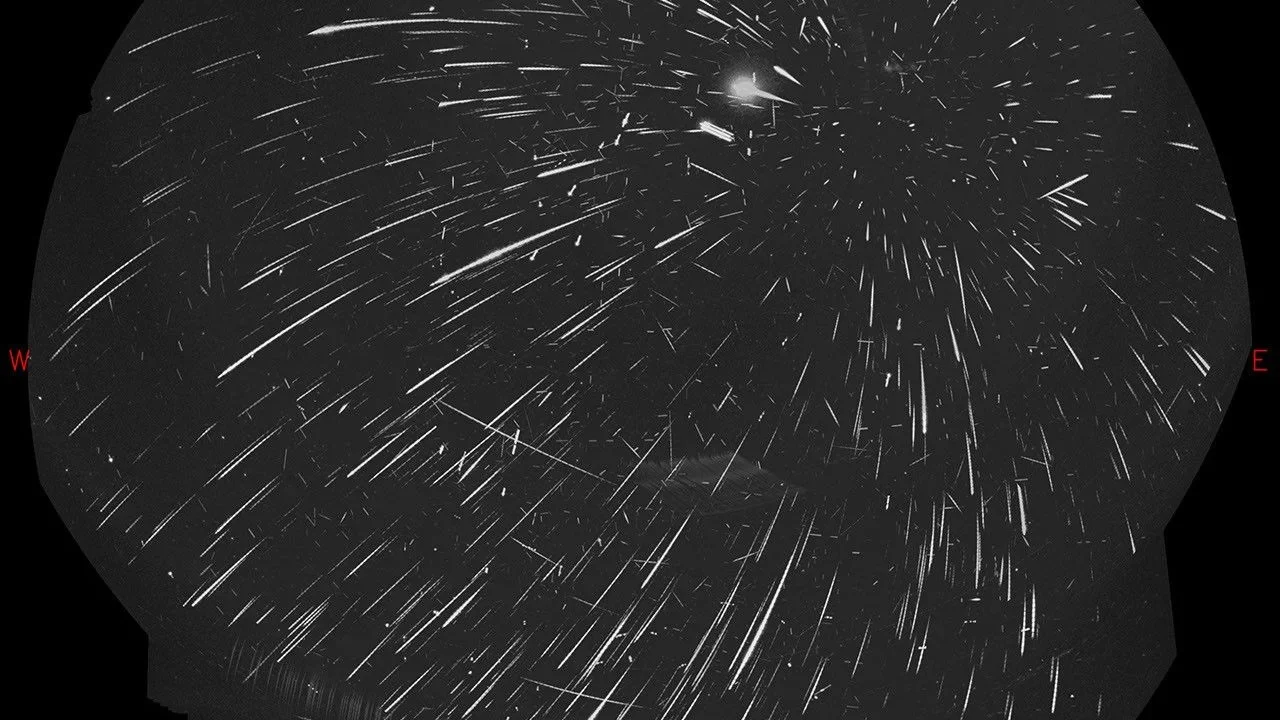
On the night of August 12 to 13, 2026, a dedicated astronomical observatory in Czechia documented the peak of the Perseid Meteor Shower with remarkable clarity, capturing a total of 1,706 meteors in a single, combined all-sky image. This extensive observation highlights the Perseids as the dominant meteor activity during this annual celestial event.
What Happened
Images from four meteor-monitoring cameras were aligned and merged to produce an all-sky, all-night composite view of the meteor activity on the peak night of the 2026 Perseid shower. The event was recorded from a single location in Czechia, enabling astronomers to track and count the meteors visible throughout the night. The overwhelming majority traced back to a radiant point situated in the constellation Perseus, confirming their origin as Perseid meteors. Additional meteor showers were also detected intersecting the Perseid trails during this observation.
Key Facts
The combined image captured 1,706 meteors, mostly Perseids, during the peak night of the 2026 shower. The radiant for these meteors was visually confirmed in the upper right portion of the sky, within the Perseus constellation. Meteors from the less active Kappa Cygnids shower, whose radiant lies in Cygnus, were also detected crossing the Perseid trajectories. Further complexity was added by meteors from the antihelion complex, a weaker source near the constellation Aquarius and opposite the Sun in the sky.
What This Means
This comprehensive recording of the Perseid Meteor Shower underscores the reliability and scientific value of ground-based meteor-monitoring networks. By capturing thousands of meteors in a single night, astronomers can better analyze meteor shower radiants and origins with precise spatial correlation. For the public and stargazers, the Perseid shower continues to stand out as one of the most accessible and visually spectacular annual meteor events, often inspiring a renewed interest in astronomy. Understanding the presence of intersecting minor showers like the Kappa Cygnids and the antihelion complex enriches knowledge of the complex debris environment within Earth’s orbit and highlights the diversity of meteoroid streams crossing Earth’s path.
Background
The Perseid Meteor Shower is an annual meteor shower associated with the comet Swift-Tuttle. It typically peaks every mid-August as Earth passes through dense debris left by the comet. This event is renowned for its high meteor counts and bright trails, making it one of the most observed meteor showers worldwide. The use of multiple synchronized meteor cameras at observatories allows astronomers to verify meteor counts, trajectories, and shower origins with increased accuracy.
What Comes Next
Following this peak observation, astronomers will analyze the wealth of data and images collected to refine models of Perseid meteoroid stream dynamics and to map the trajectories of minor showers intersecting with it. Public interest in the Perseids typically resurges annually, with the next peak expected around mid-August 2027. Continued monitoring efforts will help track changes in activity levels and radiant positions year to year.
Sources
This article is based on reporting and publicly available information from the following sources:
Read more Space & NASA stories on Goka World News.