
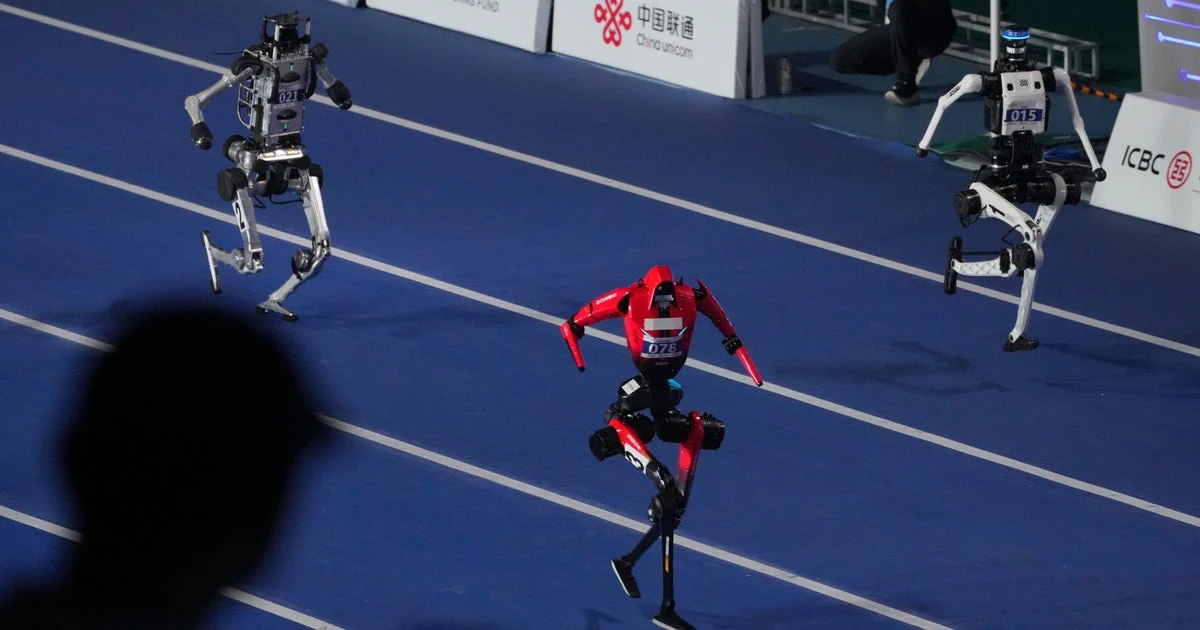
A humanoid robot developed by the Beijing-based company X-Humanoid stunned the world by beating Usain Bolt’s 100-meter sprint world record at the World Humanoid Robot Games held in Beijing, China. This milestone underscores China’s fast-paced progress in robotics, attracting global attention to its technological capabilities.
What Happened
On August 22, 2026, at the second edition of the World Humanoid Robot Games in Beijing, a humanoid robot completed the 100-meter dash in 9.39 seconds, surpassing the 2009 human record of 9.58 seconds set by Jamaican sprinter Usain Bolt. The competition, resembling an Olympics for robots, featured more than 2,000 humanoid participants competing in events including running, table tennis, and soccer.
During the sprint event, the robot stopped abruptly by slamming into a cushion and fell to the ground before being carried off on a stretcher as footage showed. Additionally, another robot manufactured by X-Humanoid broke the standing high jump world record by reaching 2.88 meters, exceeding the previous human record of 2.45 meters set by Cuba’s Javier Sotomayor in 1993.
Despite these successes, many robots in the competition experienced difficulties such as tripping, falling apart, or even catching fire, highlighting the challenges still inherent in the technology. The event showcased not only performance but also the fragility of humanoid robotics in demanding physical tasks.
Key Facts
The record-breaking sprint time of 9.39 seconds was achieved by the X-Humanoid robot, while the standing high jump record reached 2.88 meters. More than 2,000 humanoid robots participated in the games, according to the event organizers. This robotics event took place in Beijing on August 22, 2026.
In recent related developments, the U.S. Federal Communications Commission imposed a ban on imports of foreign-made humanoid robots last month citing national security concerns, a move widely understood to target China. Concurrently, the Pentagon designated China’s Unitree among companies with military ties, further heightening tensions.
Chinese manufacturers report receiving thousands of orders for humanoid robots from both government and commercial sectors, establishing China as the global leader in humanoid robot production.
What This Means
This breakthrough signals China’s ambition to lead the field of advanced robotics, a sector with broad implications for industry, national security, and labor markets worldwide. The humanoid robots’ ability to outpace human athletic records is a symbolic milestone that could accelerate investment in robotics for practical applications like manufacturing, logistics, and services.
However, the event also revealed the current technological limitations, with frequent malfunctions underscoring that widespread deployment outside controlled demonstrations remains a challenge. For global observers, China’s advances serve as both a showcase of technological prowess and a prompt to assess the future role of robots in economic competition and military strategy.
The tension with the United States, which recently enacted export controls and blacklists targeted at Chinese robotics firms, reflects broader geopolitical stakes over emerging technologies. The competition in humanoid robotics is thus linked not just to innovation but to national security concerns and international rivalry in technological dominance.
Background
The World Humanoid Robot Games, launched to foster competition and demonstration of robotic capabilities, are held in China and gather thousands of robots competing in human-like sports. The event aims to spotlight China’s swift progress in robotics technology on an international stage.
The US government’s recent restrictions on Chinese robots stem from fears over military applications and technology transfer, with Beijing rejecting allegations of military ties. China currently leads in numbers of humanoid robots produced but faces skepticism about the maturity of their real-world use.
What Remains Unclear
While the sprint and high jump records were clearly announced, the long-term practicality and reliability of these robots in everyday or industrial environments remain uncertain. The sources do not confirm how soon these humanoid robots might transition from specialized competitions to widespread real-world applications.
Details about how the robots’ technological advancements might impact international regulations or further escalate trade and security tensions were also not confirmed.
What Comes Next
The World Humanoid Robot Games will continue their program with competitions in table tennis and soccer, as part of an effort to push humanoid robotics development further. Meanwhile, China’s robotics industry expects to fulfill thousands of orders, and international scrutiny of its technology and military links is likely to intensify.
Sources
This article is based on reporting and publicly available information from the following sources:
Read more Science & Technology stories on Goka World News.