
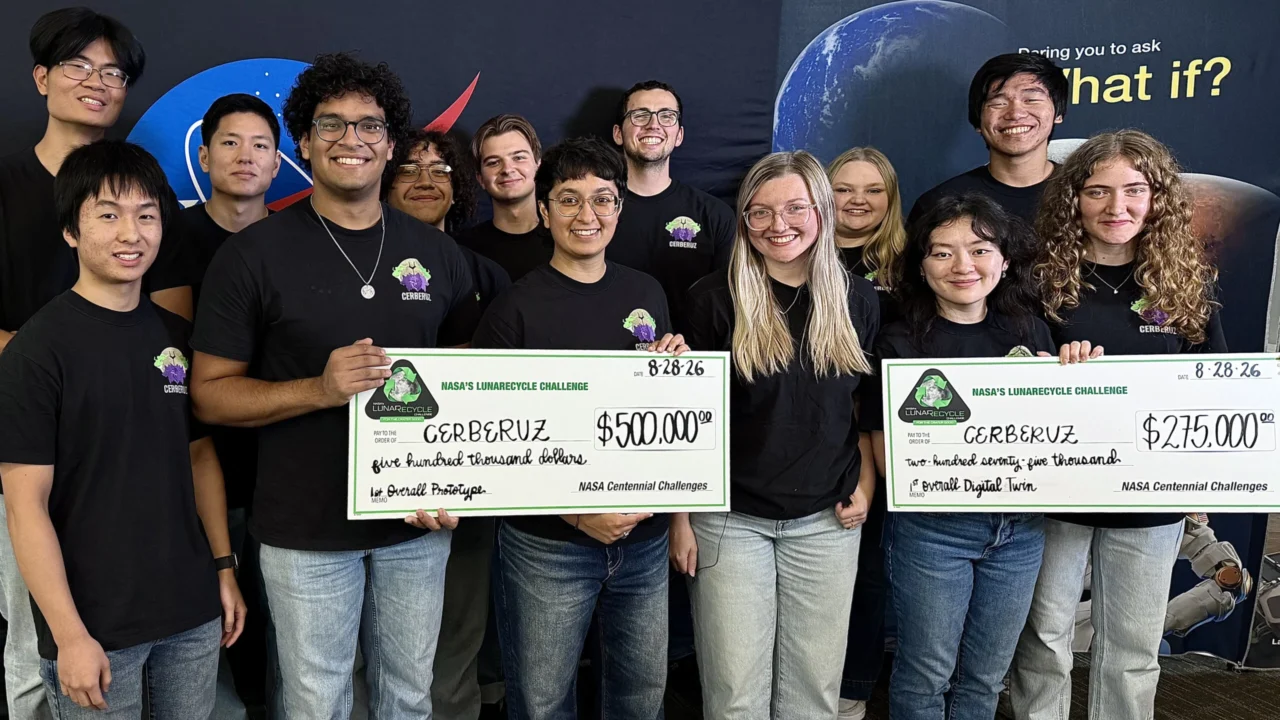
NASA has awarded the Massachusetts Institute of Technology (MIT) first prize in Phase 2 of its LunaRecycle Challenge, recognizing the team’s development of a pioneering recycling system designed to reduce waste during lunar and deeper space missions. The winning solution converts mixed trash materials into valuable resources, marking a critical step toward sustainable space exploration.
What Happened
The LunaRecycle Challenge, managed by NASA’s Marshall Space Flight Center along with The University of Alabama’s Lee J. Styslinger Jr. College of Engineering, reached its Phase 2 conclusion with a demonstration event at the University of Alabama from August 24 to August 28. Fourteen finalist teams showcased their prototypes and optional digital twins—virtual models of their recycling systems. The CERBERUZ team from MIT, composed of undergraduate, graduate, and doctoral students, won first prize for their innovative prototype that grinds mixed space mission waste into a fine powder, allowing materials like Zotek foam to be repurposed as reinforcement rather than discarded as contamination.
The powder produced by this process can then be used as feedstock for injection-molded finished parts or as filament for 3D printing, offering a versatile solution for resource reuse on the Moon and beyond. The MIT team uniquely captured both the prototype development track and the digital twin track, earning a total $775,000 in awards.
Key Facts
The LunaRecycle Challenge is a $3 million competition conducted over two phases to stimulate technological innovations for recycling materials commonly produced during space missions, such as fabrics, plastics, foam, and metals. Phase 1, concluded in 2025, attracted over 1,200 participants globally—setting a record for NASA’s Centennial Challenges program and culminating in 17 winning teams from five countries. Phase 2 required teams to develop and demonstrate functioning prototypes, with 14 finalists participating. The competition encourages solutions not only for extraterrestrial use but also for terrestrial applications.
Other notable winners included Terasynth from Orlando, Florida, awarded $225,000 for the Lunar Re-Forge System, and Penn State University’s RECLAIM system, which won the Most Innovative award in both prototype and digital twin categories. The LunaRecycle Challenge is supported by NASA centers including Kennedy, Ames, and Langley, with oversight from the Centennial Challenges program, which operates within NASA’s Research and Technology Mission Directorate.
What This Means
The MIT team’s success in the LunaRecycle Challenge highlights a pivotal advancement in addressing a critical logistical challenge for future human space exploration: managing and repurposing waste in environments where resupply is prohibitively expensive and resource conservation is vital. By converting mixed lunar waste into usable materials for manufacturing and repair, this technology could significantly reduce mission costs and reliance on Earth-based supplies.
For ordinary readers, this breakthrough underlines NASA’s commitment to sustainability and circular economy principles extending beyond Earth, which can eventually influence technologies and recycling methods for terrestrial industries. The demonstration of effective digital twins alongside physical prototypes also emphasizes how virtual modeling accelerates innovation cycles and mission readiness.
Moreover, technologies matured through such challenges bolster NASA’s Artemis program goals of sustainable lunar presence and pave the way for sustained deep space missions, including Mars exploration, by equipping astronauts with the means to adapt and reuse materials in situ.
Background
The LunaRecycle Challenge builds on NASA’s two-decade tradition of Centennial Challenges, public prize competitions designed to stimulate innovation in areas critical to NASA’s missions, such as robotics, additive manufacturing, energy, and materials. The challenge specifically targets waste reduction and recycling technologies that would enable longer, more sustainable missions in space.
Phase 1’s global engagement demonstrated widespread interest and underscored the innovative potential of combining academic researchers, entrepreneurs, and space technology enthusiasts to confront NASA’s logistical challenges.
What Comes Next
Following the award ceremony, NASA and challenge partners will analyze the data and performance of the prototypes and digital twins, aiming to identify components and systems suitable for further development or integration into upcoming lunar missions. The technologies that prove scalable and reliable may be incorporated into NASA’s broader lunar logistics architecture as Artemis program milestones unfold.
Sources
This article is based on reporting and publicly available information from the following sources:
Read more Space & NASA stories on Goka World News.