
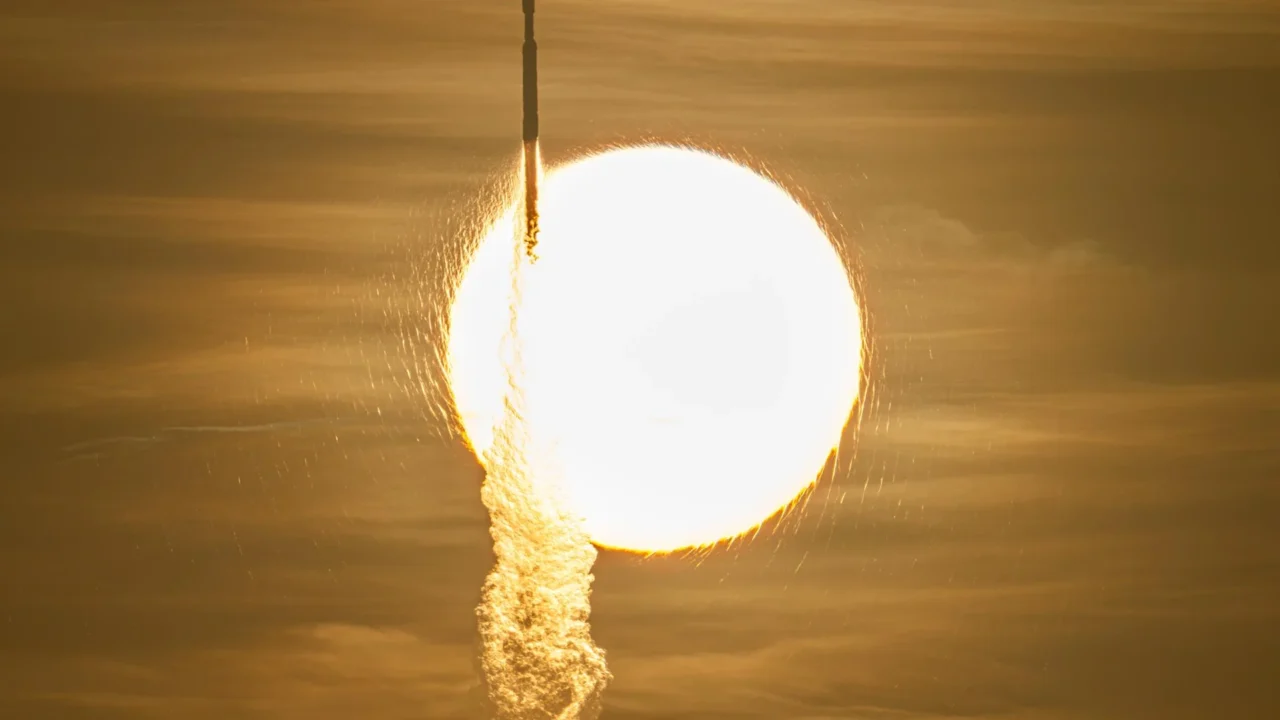
NASA’s Nancy Grace Roman Space Telescope embarked on a critical three-month journey to its final orbit after launching aboard a SpaceX Falcon Heavy rocket from Kennedy Space Center in Florida. This mission aims to deepen our understanding of dark matter, dark energy, and distant exoplanets using advanced infrared observations of the cosmos.
What Happened
The telescope launched at 7:26 a.m. EDT from Launch Complex 39A, initiating its million-mile trek toward the Sun-Earth Lagrange point 2 (L2), roughly 1 million miles from Earth. The Falcon Heavy performed flawlessly during ascent, separating from the observatory 31 minutes after liftoff. Its boosters returned safely for refurbishment. Ground control at NASA’s Goddard Space Flight Center began receiving telemetry data within seven minutes of launch.
Following launch, Roman completed deployment of its solar panels and the instrument sunshade approximately 83 minutes into flight. Over the next days, the spacecraft will activate key components including the high-gain antenna and deployable aperture cover, and perform its first course correction. The Coronagraph Instrument, designed to test technologies for imaging exoplanets, will also power on shortly. Several weeks in, Roman’s primary Wide Field Instrument infrared camera—equipped with eighteen 4K detectors offering expansive and detailed cosmic imaging—will be activated.
Key Facts
The Roman Space Telescope’s Wide Field Instrument boasts a 300-megapixel infrared camera capable of surveying the sky roughly a thousand times faster than the Hubble Space Telescope. It will relay 1.4 terabytes of data daily, the highest data rate ever recorded by a NASA astrophysics mission. Communications will transition among NASA’s Near Space Network and Deep Space Network stations in Australia, Spain, and California during its journey to L2.
Roman’s mission operations involve collaborations across NASA’s Goddard Space Flight Center, Jet Propulsion Laboratory, Caltech/IPAC, the Space Telescope Science Institute, and international partners including ESA, JAXA, France’s CNES, and Germany’s Max Planck Institute for Astronomy. Industrial partners include BAE Systems, L3Harris, and Teledyne Scientific & Imaging.
What This Means
The launch of the Nancy Grace Roman Space Telescope marks a pivotal advancement in cosmic exploration. Its unprecedented infrared survey capability will allow astronomers to map large swaths of the universe swiftly and with exceptional clarity, offering fresh insights into dark energy—the mysterious force accelerating cosmic expansion—and the elusive dark matter that shapes galactic structures. By dramatically increasing survey speed and data volume, Roman will open new avenues to study the universe’s evolution and help identify planets beyond our solar system, some of which may be habitable.
Beyond its core science goals, Roman’s rich data stream will engage not only researchers but also citizen scientists and AI technologies in detecting and analyzing cosmic phenomena. This democratization of discovery could accelerate breakthroughs in understanding fundamental cosmic questions, directly benefiting humanity’s broader quest to comprehend its place in the universe. Furthermore, the mission’s success demonstrates effective collaboration between NASA and commercial launch providers, bolstering confidence in future ambitious scientific endeavors.
What Comes Next
Roman’s commissioning phase will continue over the next three months as mission teams perform instrument calibrations and validation tests. The first scientific images and data releases are anticipated by early 2027. Meanwhile, the Coronagraph Instrument will demonstrate exoplanet imaging technology that could inform future missions searching for Earth-like worlds. Throughout its operational lifetime, Roman will conduct comprehensive surveys to probe cosmic mysteries and expand our celestial atlas.
Background
The Nancy Grace Roman Space Telescope is NASA’s fourth flagship astrophysics mission launched on a Falcon Heavy rocket, with its launch schedule accelerated due to early completion. Named after NASA’s first chief astronomer, Roman aims to build on the legacy of past space telescopes like Hubble by vastly increasing survey speed and field of view, particularly in the infrared spectrum. Its survey strategy and technological instruments are designed to tackle key open questions in astrophysics, cosmology, and planetary science.
Sources
This article is based on reporting and publicly available information from the following sources:
Read more Space & NASA stories on Goka World News.