
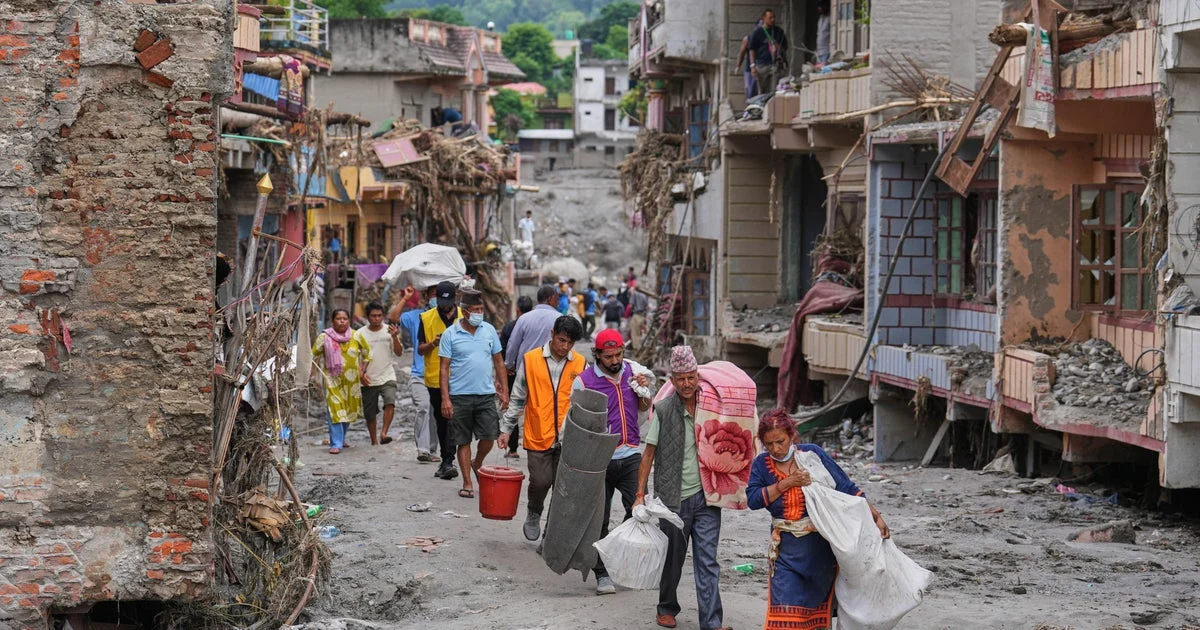
Flash floods triggered by a glacier collapse in the Himalayan region have caused widespread devastation in Nepal and the Tibet Autonomous Region of China, resulting in nearly 700 deaths and over 3,000 people unaccounted for. Rescue operations confronted severe weather and treacherous terrain, complicating efforts to reach survivors and provide aid.
What Happened
On August 26, 2026, sudden flash floods swept through parts of Nepal and Tibet following the collapse of bedrock beneath a glacier high in the Hindu Kush Himalayan region. The ensuing floods devastated multiple districts, including Nepal’s Nuwakot, Rasuwa, Dhading, and Chitwan, as well as adjacent areas in Tibet. Authorities in Nepal and China have been conducting search and rescue operations as the disaster’s scale became clear over several days.
Chinese officials reported 16 fatalities and 546 missing in Tibet, while Nepal’s disaster agency confirmed 675 deaths and 2,498 missing persons as of late August 29. Rescue teams resumed helicopter operations and engaged specialized tunnel rescue units to free over 100 workers trapped in hydropower project tunnels. Nepal’s National Disaster Risk Reduction and Management Authority also issued flood warnings for rising waters in affected river valleys.
Key Facts
- The combined death toll in Nepal and Tibet stands at 691, with more than 3,000 people missing, according to official figures as of August 29, 2026.
- More than 3,700 people have been rescued in Nepal to date.
- Hundreds of missing are foreign nationals, including about 90 Americans, some of whom were pilgrims or trekkers at the time of the floods.
- Rescue operations involve Nepali, Chinese, and Indian tunnel rescue teams, addressing those trapped in mud-filled hydropower tunnels.
- Flooding followed a magnitude 5.2 seismic event caused by a rockfall and glacier collapse, rapidly swelling rivers downstream, officials reported.
- The U.S. State Department announced over $3.6 million in humanitarian aid, including emergency food support for up to 10,000 households in Nepal.
- The Red Cross estimates about 90,000 people have been impacted by the floods across the affected areas.
- Authorities remain cautious of further flooding risks from a new high-altitude lake formed by the glacier collapse.
What This Means
The scale of the flooding disaster underscores the growing vulnerability of Himalayan communities to climate and geological disruptions. The immediate humanitarian crisis affects thousands of families left searching for missing relatives amid destroyed infrastructure and hampered rescue efforts. The presence of foreign nationals among the missing highlights the global nature of the impact, affecting tourism, pilgrimage, and international workers.
Rescue teams’ reliance on multinational cooperation, including specialized mountain and tunnel rescue units, reflects the complex challenges posed by the rugged Himalayan terrain. This disaster is a stark reminder of how environmental changes in sensitive mountain regions can rapidly escalate into transboundary emergencies requiring coordinated responses across borders.
The continuation of flood risks due to unstable glacier lakes adds urgency to monitoring and preparedness efforts. The event may prompt Nepal and its neighbors, especially China and India, to strengthen collaborative disaster management and early warning systems critical for protecting vulnerable mountain populations.
Background
Scientists identified that the flooding was triggered when a section of bedrock beneath a glacier gave way, releasing enormous volumes of rock and meltwater, creating a seismic event equivalent to magnitude 5.2. This rockfall surged into river valleys popular with trekkers and pilgrims, causing sudden and catastrophic flash floods.
The Hindu Kush Himalayan region has been experiencing rapid warming, contributing to glacier retreat and unstable mountain conditions. Experts cited in the report described the event as a potential “new normal” for the area, with worsening risks expected without intensified research and adaptation measures.
What Comes Next
Rescue efforts remain focused on locating and extracting those trapped in tunnels beneath flood debris, with Indian and Chinese specialized rescue teams actively involved. Nepal continues to coordinate increased relief supplies from neighboring countries and international donors, responding to urgent needs for food, shelter, and medical aid.
Authorities have committed to enhanced real-time data sharing on hydrological conditions between Nepal and China to improve early warning capabilities. Assessments for ongoing humanitarian requirements and environmental monitoring are underway to mitigate further risks.
Sources
This article is based on reporting and publicly available information from the following source:
Read more World News stories on Goka World News.