
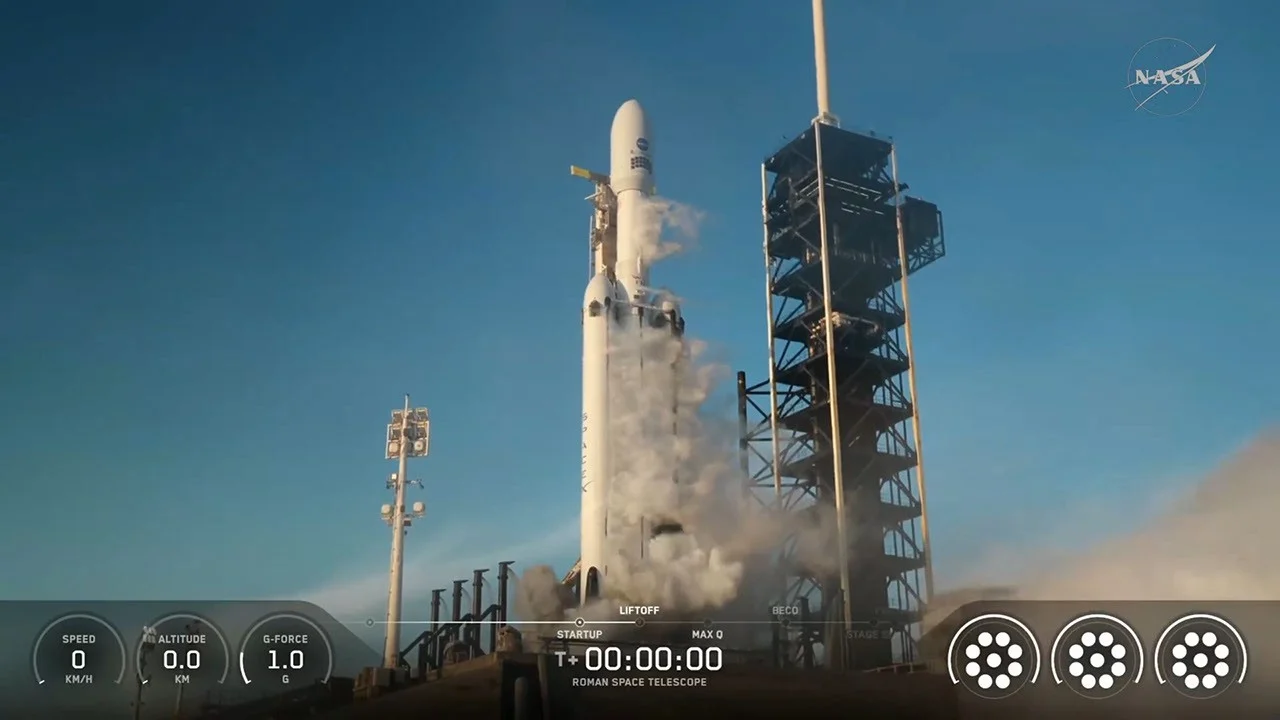
NASA’s Nancy Grace Roman Space Telescope (RST) embarked on its mission to explore the cosmos on August 30, 2026, when it was launched from Kennedy Space Center, Florida, aboard a SpaceX Falcon Heavy rocket. This new observatory is designed to study large swaths of the infrared sky with a field of view 100 times larger than the Hubble Space Telescope, despite featuring a main mirror of the same size.
What Happened
The Roman Space Telescope, named after NASA’s first Chief of Astronomy Nancy Grace Roman, successfully lifted off aboard SpaceX’s Falcon Heavy rocket from Florida. Unlike the Hubble Space Telescope, which orbits Earth, RST will journey in an orbit around the Sun. Its larger camera and refined optics enable it to capture expansive sections of the sky in infrared with remarkable efficiency. The launch marks a key milestone in NASA’s effort to deepen understanding of dark energy, exoplanets, and the large-scale structure of the universe.
Key Facts
The Roman Space Telescope carries a primary mirror that matches the size of Hubble’s but is engineered with a more curved shape and a closer secondary mirror arrangement. These design improvements, combined with a significantly larger main camera, allow RST to observe 100 times more sky area per image than Hubble. Its orbit around the Sun differs from that of the James Webb Space Telescope, which orbits Earth. The launch occurred at Kennedy Space Center and was conducted by SpaceX’s Falcon Heavy, the most powerful operational rocket in use today.
What This Means
The Roman Space Telescope’s combination of Hubble-sized optics and an exceptionally wide field of view represents a major advance in astronomical surveying. It is poised to dramatically increase the discovery rate of distant supernovas, which are critical to measuring the universe’s expansion and composition. Additionally, Roman’s capabilities will enhance the search for exoplanets by detecting many more worlds orbiting other stars. This will improve understanding of planetary systems beyond our own and the potential for life elsewhere in the cosmos.
For the scientific community, RST offers a powerful tool for mapping dark energy’s effects and mapping the universe on the largest scales. For the public, the mission may reveal spectacular new cosmic phenomena and provide fresh insights into the fundamental workings of the universe—all through images and discoveries far beyond previous capabilities.
Background
The Roman Space Telescope builds upon decades of space-based observatories such as Hubble and the more recent James Webb Space Telescope. While Hubble revolutionized astronomy via exquisite, high-resolution images of narrow sky patches, Roman prioritizes wide-field imaging to capture enormous cosmic volumes quickly. This approach complements Webb’s deep but narrow infrared observations. Roman represents NASA’s continuation of exploring cosmic mysteries including dark matter, dark energy, and exoplanet demographics through next-generation infrared astronomy.
What Comes Next
Following its solar orbit insertion, mission scientists will begin calibrating the telescope’s instruments and verifying their performance. Data collection campaigns targeting supernovas, exoplanets, and large-scale cosmic structures will commence once calibration is complete. The mission is expected to span several years, providing high-impact science and contributing to the broader astrophysics community’s goals of unraveling the universe’s most profound questions.
Sources
This article is based on reporting and publicly available information from the following sources:
Read more Space & NASA stories on Goka World News.