
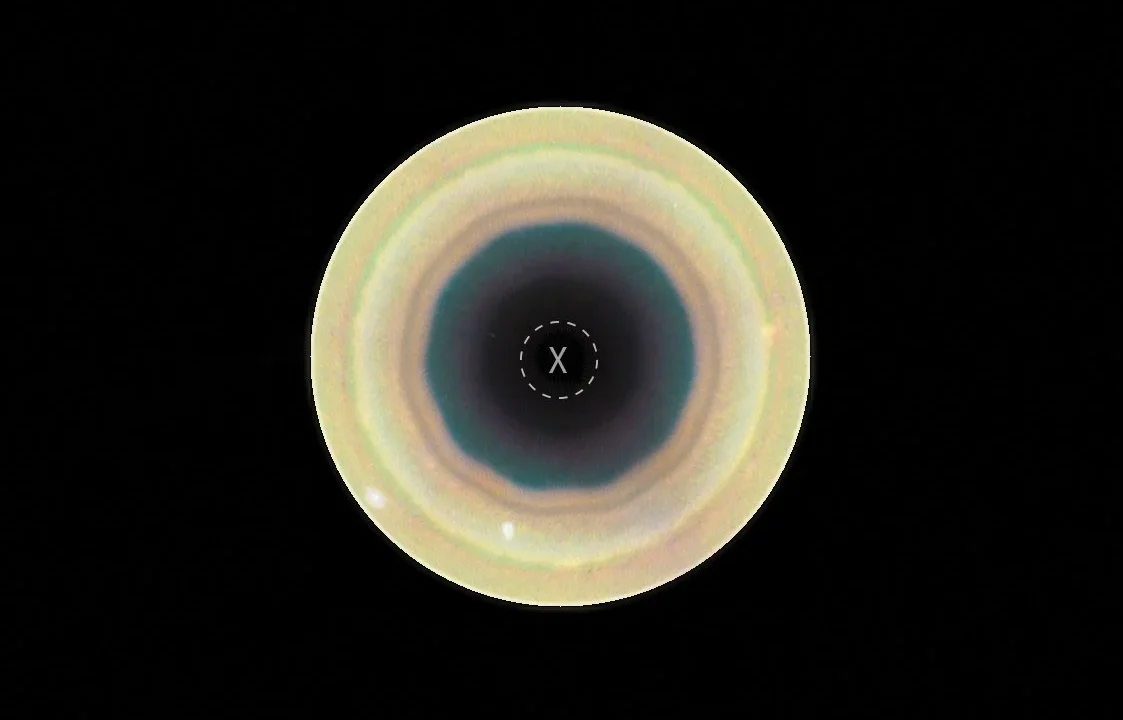
New imagery from NASA’s Hubble Space Telescope has captured an intriguing decagon-shaped cloud pattern surrounding Saturn’s South Pole, offering fresh insight into the ringed planet’s complex atmospheric dynamics. This ten-sided geometric structure contrasts with the well-known hexagonal cloud formation at Saturn’s North Pole that has been stable for over four decades.
What Happened
Hubble observed Saturn in 2025, producing composite images that revealed a pronounced decagonal cloud outline encircling the planet’s South Pole. The data show a ten-sided figure formed by dark inner cloud regions, marked by circulating bands of gas clouds centered around the pole, which is indicated by an X in the imagery. This decagon differs markedly from the geometric shape first discovered at Saturn’s North Pole by NASA’s Voyager spacecraft in the early 1980s, which was identified as a stable hexagon.
Key Facts
The geometric cloud shapes are thought to arise from the interaction of atmospheric waves generated by the velocity difference between fast-moving polar gas and slower-moving gas nearer to the equator. The northern hexagonal cloud formation has been confirmed as stable for more than 40 years since its discovery by Voyager, while the southern decagon was documented by Hubble’s recent observations last year. The decagon appears most prominently within darker inner cloud bands surrounding Saturn’s South Pole. The data and images were released by NASA’s Astronomy Picture of the Day (APOD) program.
What This Means
The discovery of a decagonal cloud pattern at Saturn’s South Pole deepens our understanding of atmospheric phenomena on gas giants, highlighting how fluid dynamics and wave interactions can form precise geometric shapes under planetary conditions. Such stable, long-lasting polygonal cloud formations challenge traditional models of planetary atmospheres, showing that complex wave structures can produce distinct, symmetric boundaries in rapidly rotating gaseous planets.
For planetary scientists, these observations could inform comparative studies of gas giant atmospheres, including Jupiter’s, and refine theoretical models that describe how winds and jet streams interact on large scales. For the broader public, the sight of geometric patterns on another planet underscores nature’s surprising capacity for order amid chaos, stimulating curiosity about how atmospheres function under extreme conditions and what that might mean for planetary weather beyond Earth.
Background
Saturn’s northern hexagon was first discovered in 1987 using data from the Voyager missions that flew past Saturn in the early 1980s. Since then, the hexagonal pattern has remained a subject of scientific interest due to its unusual geometric precision and stability. The appearance of a southern decagon adds a new dimension to understanding Saturn’s polar meteorology, showing that the planet exhibits striking geometric patterns in both hemispheres, albeit with different numbers of sides.
What Remains Unclear
Although the decagon’s shape and prominence have been confirmed, scientists have not yet determined whether this southern polygonal cloud formation will be as stable or long-lasting as the northern hexagon. Further observations and analysis are required to understand its formation mechanism fully and its evolution over time. The exact role of polar atmospheric waves and their interaction with Saturn’s jet streams also remains under study.
What Comes Next
Future observing campaigns with Hubble and other space telescopes, along with data from ongoing and upcoming planetary missions, are planned to monitor Saturn’s polar atmospheres. Researchers aim to track changes in the decagon’s structure, analyze atmospheric dynamics, and compare these with the well-documented northern hexagon. These studies will help clarify the stability and physical conditions that produce such polygonal cloud boundaries.
Sources
This article is based on reporting and publicly available information from the following sources:
Read more Space & NASA stories on Goka World News.