
NASA’s Curiosity rover reached an important milestone on August 29, 2026, marking 5,000 Martian sols since its landing on Mars in 2012. During this period, the rover also achieved a significant climbing feat, surpassing 1,000 meters in elevation above its Gale Crater landing site while conducting detailed investigations of Martian geological features on the slopes of Mount Sharp.
What Happened
The Curiosity rover, part of NASA’s Mars Science Laboratory mission, observed its 5,000th Martian day, or sol, on August 29, 2026. This milestone represents over 5,137 Earth days of continuous operations on the Martian surface since its landing. At the same time, Curiosity crossed the 1-kilometer elevation threshold, climbing higher than any previous Mars rover, surpassing the Spirit rover’s 106-meter ascent at Husband Hill in 2005.
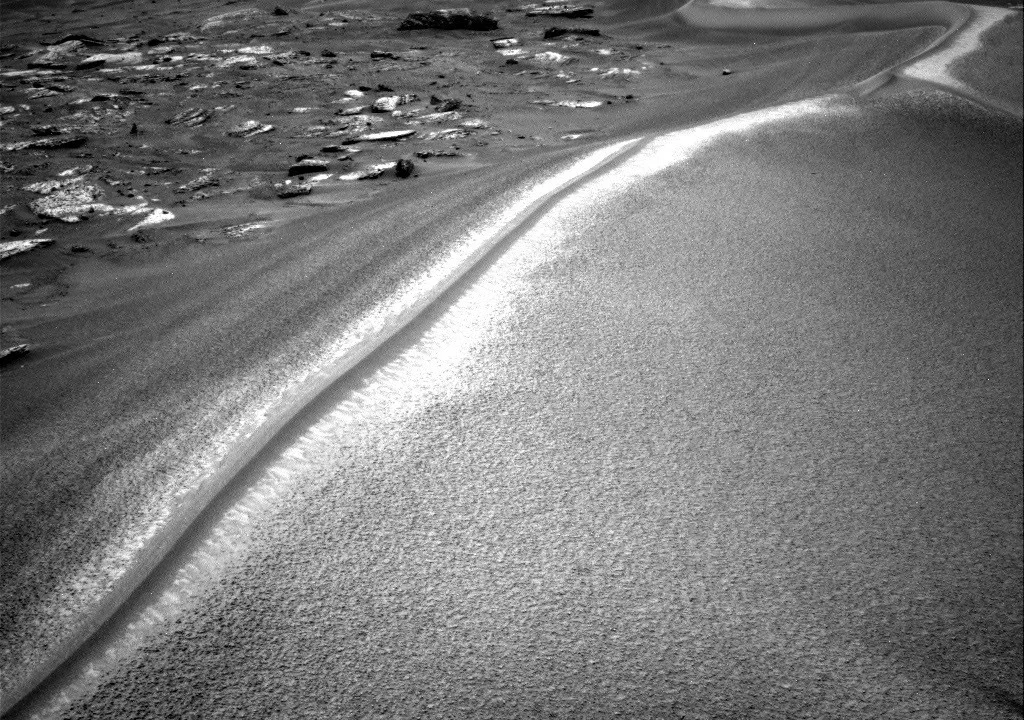
In recent mission activities, Curiosity focused on studying a prominent, wind-formed sand ripple called “Chocolatal” located on Mount Sharp’s slopes. The ripple is believed to be a transverse aeolian ridge (TAR), a type of feature oriented perpendicular to prevailing wind directions and widespread across Mars. The rover approached Chocolatal carefully, conducting chemical and imaging analyses using its suite of instruments, including ChemCam’s Laser Induced Breakdown Spectroscopy (LIBS), Mastcam visual mosaics, and the Mars Hand Lens Imager (MAHLI).
Key Facts
- Curiosity marked Sol 5000 on August 29, 2026, after landing in Gale Crater on August 6, 2012.
- The rover has climbed over 1,000 meters (0.62 miles) in elevation from its landing site.
- Chocolatal is a large, long, narrow sand ripple under study, categorized as a candidate transverse aeolian ridge.
- Scientific instruments used for the investigation include ChemCam LIBS for chemical analysis, Mastcam and ChemCam RMI for detailed mosaics, and MAHLI for close-up imaging of layering and grain size.
- The MAHLI mosaics of the ripple’s trench are dedicated to the late Paul Geissler, a Martian TAR specialist.
- Observations aimed to determine ripple composition, formation, activity, migration, and stability.
What This Means
Reaching 5,000 Martian sols and crossing a 1-kilometer elevation speaks to Curiosity’s extraordinary durability and the engineering success of NASA’s Mars Science Laboratory. This endurance allows unprecedented long-term geological and climatological studies, deepening our understanding of Mars’s environmental history.
The climb on Mount Sharp positions Curiosity to explore a vertical cross-section of ancient rock layers, shedding light on how conditions on Mars evolved from a wetter past to the dry present. Examining features like Chocolatal informs scientists about Martian wind patterns and sediment transport mechanisms. By analyzing TARs at higher elevations, researchers can compare them with ripples lower on the mountain and evaluate how Martian surface processes vary with altitude and terrain.
These insights have broader implications for understanding Mars’s habitability over time and help guide future missions, including potential sample return efforts and human exploration planning.
Background
Curiosity landed inside Gale Crater in August 2012, with a primary goal of assessing past habitability by studying rock and soil composition. The rover’s exploration of Mount Sharp, a central peak inside Gale Crater, began after years of traversing the crater floor. Previous rovers like Spirit and Opportunity had far shorter operational lifetimes and elevations climbed. The study of transverse aeolian ridges using orbital imagery has been ongoing, but in-situ examination by Curiosity provides valuable ground truth.
What Comes Next
Following the detailed investigation of Chocolatal, the Curiosity team plans further contact science studies, including APXS (Alpha Particle X-Ray Spectrometer) measurements of ripple material and continued LIBS chemical analyses. Ongoing imaging surveys with Mastcam and Navcam will monitor dust, atmospheric conditions, and the local environment. The team continues to plan exploration of layered bedrock in buttes ahead, advancing the geological investigation of Mount Sharp’s stratigraphy.
Sources
This article is based on reporting and publicly available information from the following sources:
Read more Space & NASA stories on Goka World News.