
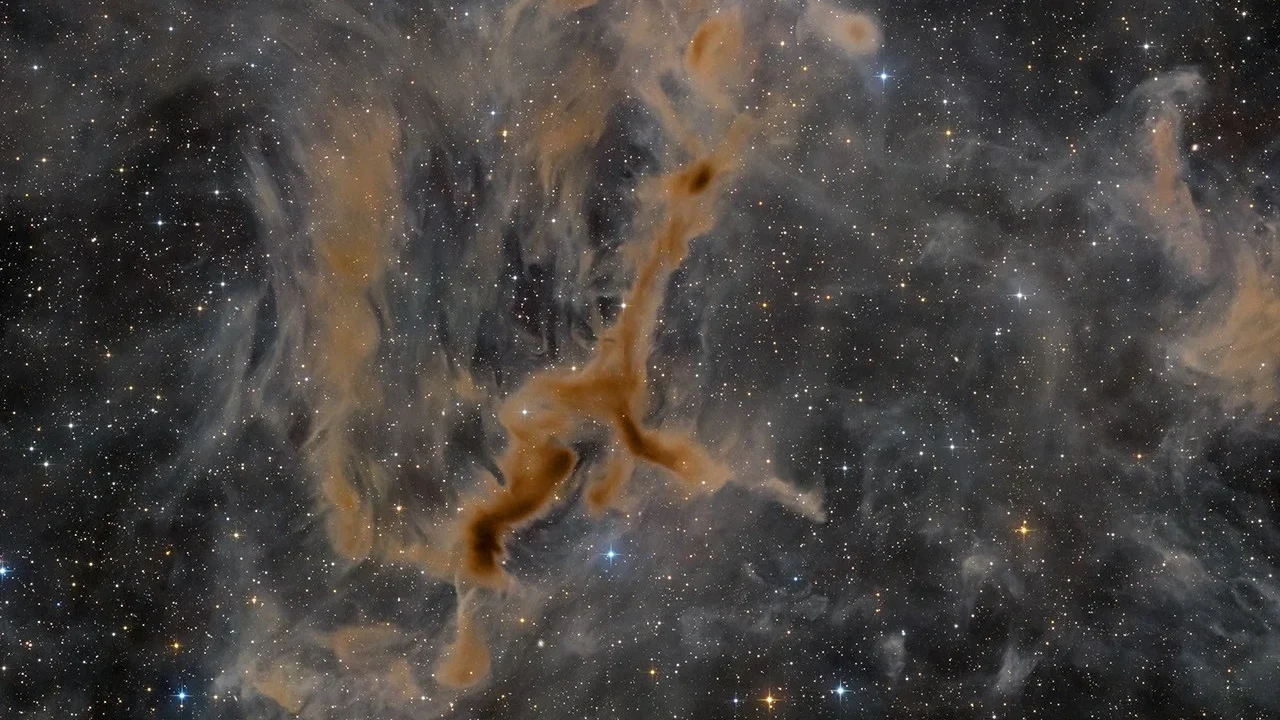
The Giraffe Nebula, formally catalogued as LDN 1295, has been featured in NASA’s Astronomy Picture of the Day, presenting striking imagery of this dark nebula located in the constellation Cassiopeia. It has gained attention not only for its scientific interest but also its resemblance to a giraffe stretching its neck amid the stars.
What Happened
On September 10, 2026, NASA’s Astronomy Picture of the Day showcased an image of LDN 1295, a dark nebula within Cassiopeia. This nebula, part of the Lynds Catalogue of Dark Nebulae, appears as an obscuring cloud of cosmic dust and gas blocking the light of stars behind it. The image highlights LDN 1295’s silhouette, which many observers perceive as the shape of a giraffe, though some viewers interpret it differently—such as a squirrel.
Key Facts
LDN 1295 was catalogued in 1962 by American astronomer Beverly Lynds, who contributed significantly to inventorying dark nebulae. These objects are dense clouds of interstellar dust and gas that absorb and scatter visible light, creating distinct dark patches against the clearer background of stars. Cassiopeia, the host constellation, is traditionally associated with a mythical queen of Aethiopia, enriching the cultural context of this stellar region.
What This Means
Dark nebulae like LDN 1295 offer valuable insights into the dense interstellar medium—the birthplace of new stars. By studying such clouds, astronomers better understand the processes governing star formation and the distribution of interstellar material. The distinctive shape of the Giraffe Nebula also demonstrates human perception’s role in astronomy, where visual pattern recognition, or pareidolia, often guides how observers interpret celestial appearances. This intersection of science and perception helps engage the public, connecting them more personally to cosmic phenomena.
Furthermore, images highlighting dark nebulas encourage astrophotographers and professional researchers alike to refine techniques to study these challenging objects. Observing the Giraffe Nebula expands knowledge of dark cloud morphology and how such regions influence the broader dynamics of our galaxy.
Background
The Lynds Catalogue, compiled in the early 1960s by Beverly Lynds, remains a foundational reference for identifying dark nebulae in the Milky Way. These nebulas are notoriously difficult to image because they emit little to no visible light, instead seen as shadows against star fields. Cassiopeia, prominently visible in the northern sky, includes numerous such dark clouds, making it a frequent object of interest for astronomers studying galactic structure.
What Remains Unclear
The precise physical dimensions and density variations within LDN 1295 still require detailed data analysis using multiwavelength observations, such as infrared imaging, which penetrates dense dust. Such studies can reveal whether parts of the nebula are collapsing to form stars and the detailed chemistry within the cloud.
What Comes Next
Continued observation campaigns using both ground-based telescopes and space observatories are expected to target LDN 1295 and similar dark nebulas. These efforts will provide more comprehensive data to unravel their internal structures and roles in star formation. NASA’s ongoing support for the Astronomy Picture of the Day will also keep such noteworthy cosmic features in the public eye.
Sources
This article is based on reporting and publicly available information from the following sources:
Read more Space & NASA stories on Goka World News.