
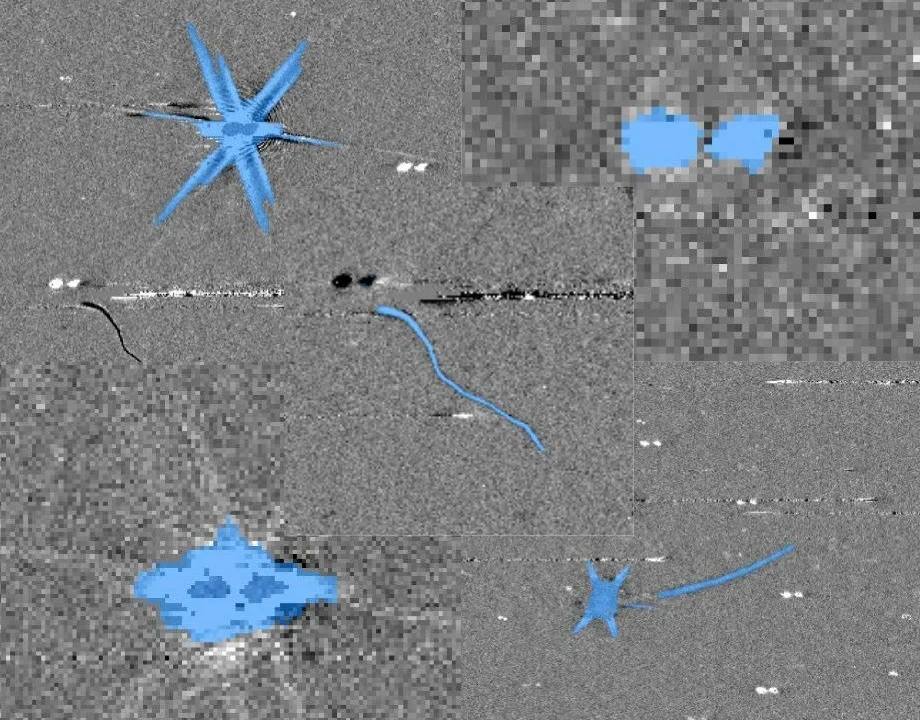
NASA has introduced Artifact InSPECtor, a new citizen science initiative that invites people of all ages to assist in refining data from space telescopes by training artificial intelligence (AI) systems to identify and remove artifacts—false signals that interfere with astronomical observations.
What Happened
Artifact InSPECtor uses real telescope data collected by ESA’s Euclid space observatory, with NASA’s critical involvement, and will soon incorporate data from NASA’s upcoming Nancy Grace Roman Space Telescope once it begins science operations in early 2027. These observatories capture detailed light spectra from millions of distant galaxies to help answer profound scientific questions about cosmic expansion and the nature of dark energy.
Participants access the project via smartphones, tablets, or computers, learning how to spot artifacts—such as light reflections, cosmic ray impacts on detectors, or electronic quirks—that can contaminate telescope measurements. Their classifications improve AI algorithms designed to distinguish real astronomical signals from these spurious artifacts, enhancing the quality of data used by researchers.
Key Facts
The Euclid mission, operated by the European Space Agency with NASA contributions, collects light from millions of galaxies and uses a spectrograph to split their light into spectra. This technique is critical for measuring galaxy distances and properties. Following Euclid, the Nancy Grace Roman Space Telescope will survey a similar number of galaxies, but at different distances and sky densities, complementing Euclid’s observations.
Artifacts within telescope data originate from multiple sources, including reflections within the spacecraft, cosmic rays, or instrument electronics, complicating accurate data interpretation. AI tools currently struggle to perfectly differentiate these artifacts due to the novelty of the instruments and complexities in the data.
Artifact InSPECtor leverages volunteer input to train and refine these AI tools, helping improve the reliability of data for the missions’ scientific objectives on cosmic expansion and dark energy.
What This Means
This public-driven initiative represents a significant step in harnessing human pattern recognition alongside artificial intelligence to boost the fidelity of data from cutting-edge space telescopes. By engaging volunteers in artifact identification, NASA effectively crowdsources a critical quality-control task that accelerates data processing and enhances scientific outcomes. This collaboration helps ensure that the measurements feeding cosmological studies are as accurate as possible, reducing errors that could mislead analysis about the universe’s expansion rate or the properties of dark energy.
Beyond aiding specific missions like Euclid and Roman, the project exemplifies how citizen science can empower the public to contribute meaningfully to frontier space research, fostering broader interest and education in astronomy and AI technologies. The hands-on role that participants gain also exemplifies how next-generation data challenges in astronomy will increasingly rely on partnerships between advanced algorithms and human expertise.
Background
Euclid, launched by ESA with NASA support, focuses on measuring the geometry of the dark universe through precise observations of distant galaxies. The Nancy Grace Roman Space Telescope, NASA’s next major astrophysics mission, aims to measure dark energy and exoplanets with state-of-the-art instrumentation starting around 2027. Both missions rely heavily on spectrographic analysis, demanding pristine data quality.
Artifacts are a longstanding challenge in astronomy, where faint signals from galaxies can be masked or mimicked by instrument or environmental effects. Previous missions have developed AI tools for artifact detection but improving their accuracy depends on training with well-identified examples, which Artifact InSPECtor provides through volunteer participation.
What Comes Next
As the Nancy Grace Roman Space Telescope prepares for its science operations commencing in early 2027, Artifact InSPECtor will expand to include its data, scaling up the public’s role in enhancing artifact detection. Meanwhile, ongoing volunteer contributions to Euclid data analysis continue to support current mission outputs.
NASA encourages everyone with internet access—from casual astronomy enthusiasts to students—to visit Artifact InSPECtor online to participate in this unique collaboration between humans and AI in advancing space science.
Sources
This article is based on reporting and publicly available information from the following sources:
Read more Space & NASA stories on Goka World News.