
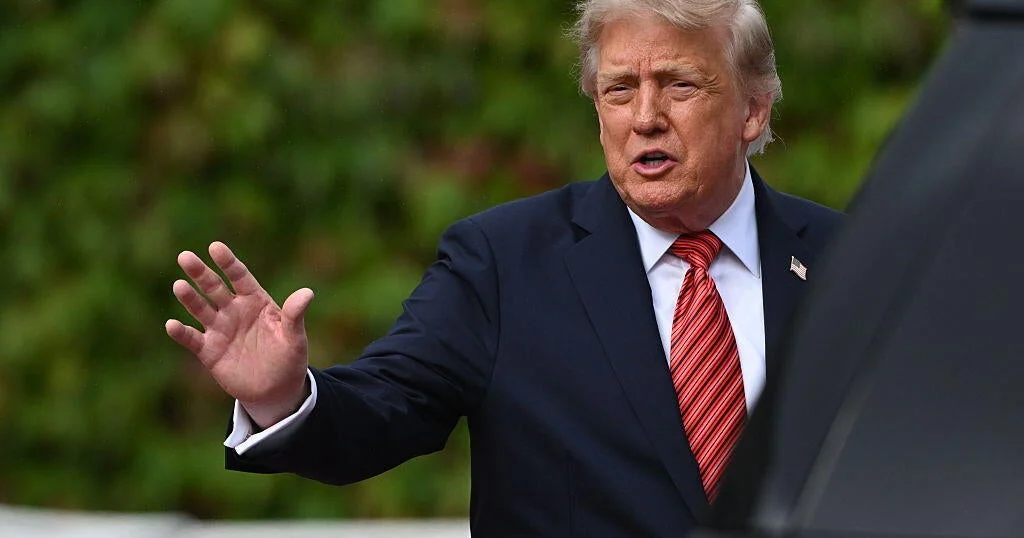
Former U.S. President Donald Trump expressed strong support for a unified Ireland during his visit to Dublin in September 2026, sparking debate amid ongoing political sensitivities surrounding Northern Ireland’s status. His remarks came alongside key meetings with Irish government leaders and participation in the Irish Open golf tournament at one of his own clubs.
What Happened
On September 12, 2026, Donald Trump arrived in Dublin, Ireland, where he met with Irish Prime Minister Micheál Martin and President Catherine Connolly. During talks with Martin, Trump said he would “love” to see the unification of the Republic of Ireland with Northern Ireland — a region currently part of the United Kingdom. He acknowledged that the UK would have strong opinions on the matter but suggested the reunification “may as well happen now.” After his diplomatic meetings, Trump addressed U.S. and Irish business leaders before traveling to his oceanfront golf club in Doonbeg to watch the Irish Open golf tournament. The visit combined diplomatic engagement with sporting interests tied to Trump’s business holdings.
Key Facts
The division between the Republic of Ireland and six counties in Northern Ireland dates back roughly a century, when the predominantly Catholic Irish Free State became self-governing, leaving the mainly Protestant Northern Ireland as part of the UK. Historically, Protestant unionists desire to remain British, while Catholic nationalists favor unification with Ireland. This conflict led to decades of violence until the 1998 Good Friday Agreement, a peace accord heavily supported by the United States, which largely ended the violence but left Northern Ireland’s constitutional future unresolved.
UK Prime Minister Andy Burnham recently stated that a referendum on Irish unity is “off the table,” a stance challenged by Sinn Féin, the main pro-unity party in Northern Ireland. In response to Trump’s comments, Gavin Robinson, leader of the Democratic Unionist Party (DUP), a pro-British party, publicly rejected the idea of Irish unification, emphasizing unionist opposition to dissolving the UK’s presence in Northern Ireland.
What This Means
Trump’s public endorsement of Irish unification during an official visit carries symbolic weight in a region where the question of national identity remains critically sensitive. His remarks could reignite political debate over the future of Northern Ireland, a pivotal issue affecting relations between Ireland, the UK, and the U.S.—a key backer of the peace process. While Trump does not hold political office, his prominence gives international visibility to an issue where local consensus is deeply divided.
His visit also illustrates the complex intersection of diplomacy and business interests, as he combined official meetings with attendance at a tournament held at his golf property. Reactions in Ireland were mixed: some residents expressed frustration over disruptions caused by the visit and criticized Trump’s political stances, while various opposition groups planned protests in Dublin.
The event highlights enduring challenges in maintaining peace and political stability in Northern Ireland and the wider region, where unification remains a topic of dispute rather than resolution.
Background
The island of Ireland has been divided since the early 20th century, with Northern Ireland remaining part of the United Kingdom despite a Catholic majority in the south seeking self-rule and eventual unification. The Troubles—a period of ethno-nationalist conflict from the late 1960s to the late 1990s—left deep scars on society. The Good Friday Agreement of 1998, supported by the U.S., UK, and Irish governments, created a power-sharing government and called for a referendum on unification only if a majority in Northern Ireland wished it.
The region remains politically fragile, with unionists and nationalists maintaining opposing visions. The UK government under Prime Minister Burnham has rejected calls for a unification referendum, fearing destabilization.
Reactions
Pro-British unionist leader Gavin Robinson condemned Trump’s support for unification as “destruction of our country.” Meanwhile, protesters and critics in Dublin lamented the president’s visit, citing his broader political views and disruption caused to the city. Left-leaning parties, anti-military, pro-Palestinian, and environmental groups organized demonstrations against the visit.
What Remains Unclear
It remains unconfirmed if Trump’s comments will influence any imminent political moves toward holding a referendum on Irish unification. There is also no indication from either the Irish or UK governments that the remarks will affect official policy. The UK’s formal stance remains opposed to revisiting the question of Northern Ireland’s status at this time.
What Comes Next
Trump’s visit concluded with his attendance at the Irish Open golf tournament held at his Doonbeg property. No further official diplomatic engagements related to Irish unification are scheduled as a result of this visit. The broader political debate over Northern Ireland’s future continues quietly within local and UK political forums, without immediate shifts triggered by foreign commentary.
Sources
This article is based on reporting and publicly available information from the following source:
Read more World News stories on Goka World News.