
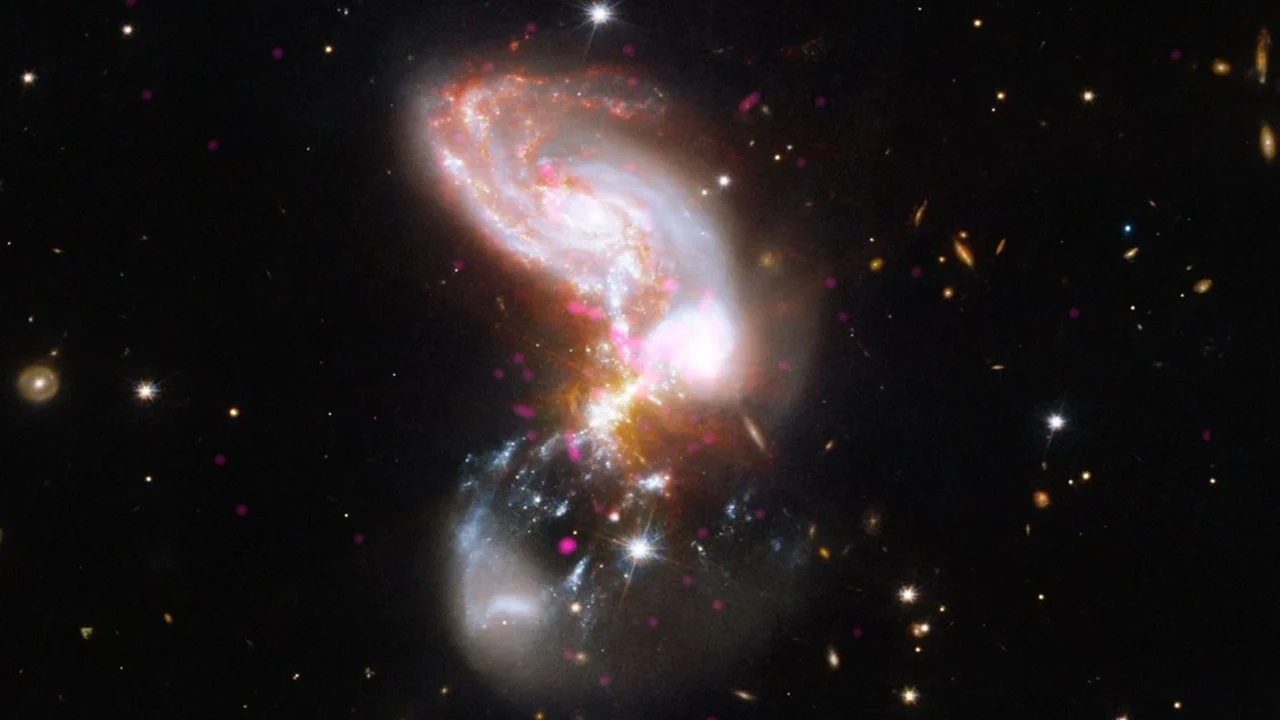
NASA’s Chandra X-ray Observatory has captured striking new images of the galaxy system II Zw 096, where two galaxies are colliding at a furious pace. These observations reveal intense black hole activity and large stellar nurseries hidden behind thick clouds of interstellar dust, offering fresh insights into how galaxy mergers shape the cosmos.
What Happened
On August 25, 2026, NASA released multi-wavelength images of II Zw 096, combining data from Chandra’s X-ray observations with optical images from NASA’s Hubble Space Telescope and infrared imagery from the James Webb Space Telescope. Chandra’s X-ray data, displayed in magenta, pinpoint regions of powerful black hole activity and hot gas within the merging system. Meanwhile, Hubble and Webb reveal vast areas of star formation obscured at visible wavelengths by dust. This spectacular snapshot marks a significant step in understanding the energetic processes underway during such galactic collisions.
Key Facts
The II Zw 096 system consists of two galaxies violently merging, a process confirmed through overlapping observations:
- Chandra’s X-ray data highlight sources of extreme energy from black hole accretion and energized hot gas.
- Optical data from Hubble show star clusters and galactic structures in visible light.
- Infrared imaging by the James Webb Space Telescope uncovers stellar nurseries hidden behind thick layers of dust, invisible to optical telescopes.
- The synergy of these three observatories allows astronomers to study the complex dynamics and physical conditions of galactic mergers comprehensively.
What This Means
The detailed multi-wavelength view of II Zw 096 is crucial for understanding cosmic history. Galaxy mergers like this one played a fundamental role in the early universe’s evolution, triggering bursts of star formation and feeding supermassive black holes at their centers. By seeing both the energetic black hole activity and the hidden stellar nurseries, scientists can better model how these collisions influence galaxy growth and morphology over billions of years.
For the wider public, this research highlights how violent and transformative such cosmic events are. While the collisions occur millions of light-years away, the physical processes involved give context to how galaxies, including our own, reached their present state. Additionally, the collaboration between different space telescopes sets a precedent for future astronomy, showing how combining X-ray, optical, and infrared data leads to a much richer understanding of the cosmos than any single source alone.
Background
Past observations have shown that galaxy mergers are common across the universe and often result in the activation of central black holes and bursts of star formation. II Zw 096 is a particularly bright and active example, making it a valuable target for coordinated observations from NASA’s fleet of space telescopes. The Chandra X-ray Observatory, launched in 1999, has a strong record of detecting hot gas and energetic phenomena in distant galaxies, complementing the optical perspective of Hubble and the infrared sensitivity of the recently launched James Webb Space Telescope.
What Comes Next
Scientists will continue analyzing the combined data sets from Chandra, Hubble, and Webb to understand the detailed physical processes driving the intense activity in II Zw 096. Follow-up studies will assess how the black hole activity correlates spatially and temporally with star formation regions, deepening theories about galaxy evolution through mergers. Additional observations may expand to other similar galactic systems to compare these dynamics across different environments and stages of merging.
Sources
This article is based on reporting and publicly available information from the following sources:
Read more Space & NASA stories on Goka World News.