
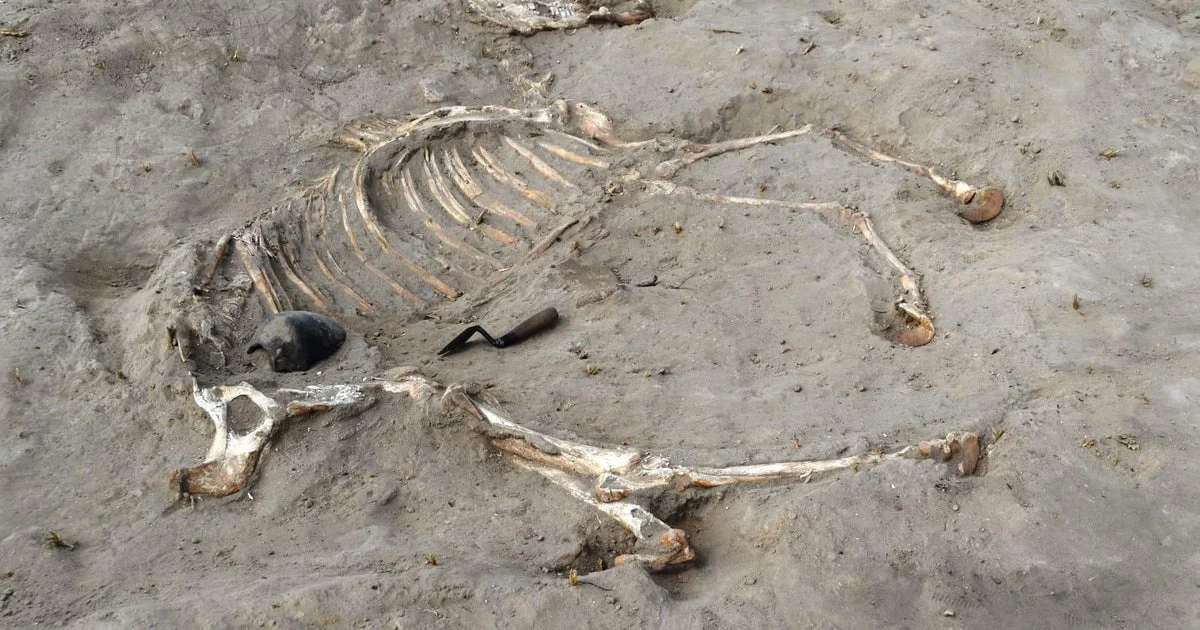
Archaeologists in Egypt have revealed the discovery of a complete warhorse burial dating back more than 3,000 years, at a New Kingdom military fortress in the Nile Delta. The find provides new insights into Egypt’s military organization and urban planning during a period marked by conflict and territorial defense.
What Happened
At the archaeological site of Tell Al-Abqain, located in northern Egypt’s Beheira province within the Nile Delta, researchers uncovered the full remains of a young male horse, deliberately buried with honor. The fortress where this was found dates to Egypt’s New Kingdom period (1570-1069 B.C.), a time when Egyptian authorities fortified the northern borders to repel incursions from Libyan tribes.
The excavation, conducted under the supervision of Egypt’s Ministry of Tourism and Antiquities, has also exposed extensive fortification structures and artifacts indicating a well-organized military settlement, including a large mudbrick residential complex, streets, grain storage silos, and pottery ovens. Several limestone stelas and alabaster remains related to chariot harnesses were found as well, supporting the site’s military function.
Key Facts
The burial of the horse was systematic: its body and head were positioned carefully, signifying an honorific status. Mohamed Abdel-Badie, head of the Egyptian Antiquities Sector, identified the horse as a medium-sized breed prized for speed and agility, likely used to pull war chariots during the New Kingdom era. Near the burial, alabaster and limestone artifacts believed to be chariot harness components bolstered the military connection.
The team also discovered a limestone stela depicting a Libyan prisoner in submission, consistent with the fortress’s role in guarding against Libyan tribes. Additional finds include religious amulets symbolizing protection and renewal, pottery vessels, ostraca for food and perfume storage, tools, and jewelry.
Dr. Hisham El-Leithy, secretary general of the Supreme Council of Antiquities, remarked the site’s urban planning and resource management reflect a precise and organized administration inside the fortress.
What This Means
This discovery offers a rare glimpse into the military logistics and societal values of New Kingdom Egypt, particularly the significance attributed to warhorses as vital assets in warfare and symbols of power. The honorific burial underscores the respect and value Ancient Egyptians placed on these horses, paralleling that of high-status humans.
Moreover, the well-preserved fortress layout and associated artifacts illuminate how ancient Egyptian authorities managed frontier defense against external threats such as Libyan incursions, highlighting a level of administrative sophistication. Understanding these arrangements deepens our knowledge of ancient Egyptian military strategy, urban development, and interactions with neighboring groups.
For historians and archaeologists, these findings help bridge gaps in the record about daily life and military practices during a pivotal era of Egyptian history, potentially providing context for other archaeological sites and military campaigns documented in ancient texts.
Background
The Tell Al-Abqain site was part of a network of military fortresses built during Egypt’s New Kingdom to secure the northern division of the kingdom. This period involved extensive territorial expansion and consolidation of borders to counter Libyan tribal raids. Chariots and horses were key components of Egypt’s military prowess, often depicted in reliefs and inscriptions as symbols of royal and military strength.
Sources
This article is based on reporting and publicly available information from the following source:
Read more Science Discoveries stories on Goka World News.