
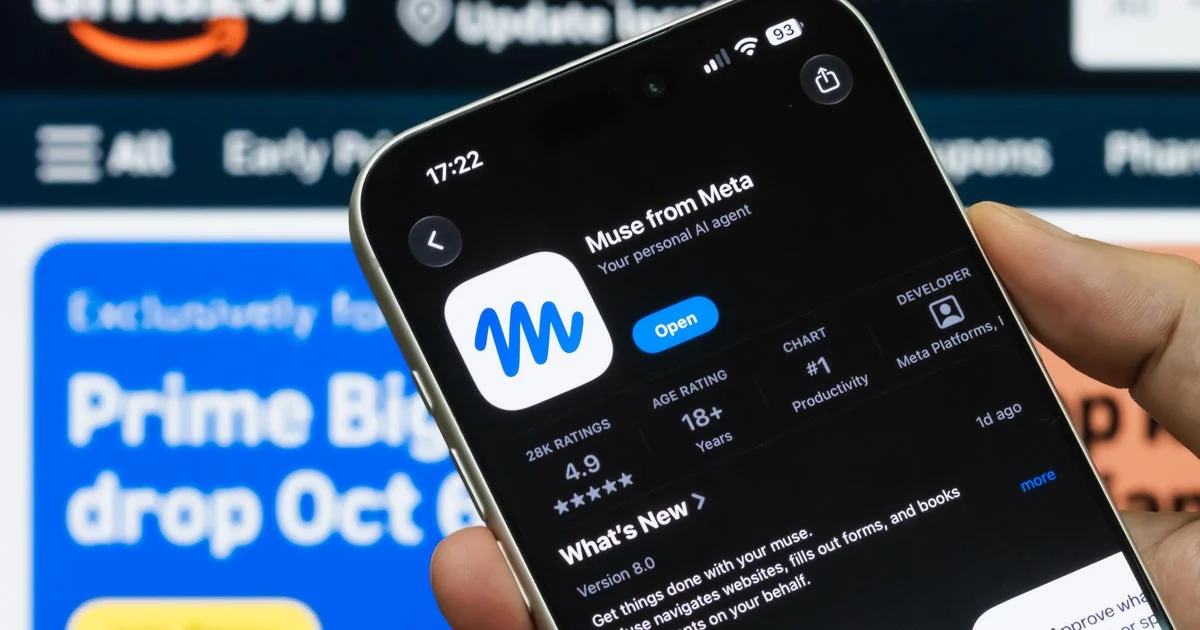
Meta’s new artificial intelligence shopping assistant, Muse, has quickly climbed to the top of Apple’s App Store chart, surpassing popular AI apps like ChatGPT in downloads, as more consumers adopt AI tools to simplify and speed up their shopping decisions.
What Happened
Launched just two weeks ago, Meta’s Muse app has amassed more than 2.5 million global downloads according to Sensor Tower data shared with CBS News. The app now ranks first in the Apple App Store, ahead of OpenAI’s ChatGPT, which had 3.1 million downloads in the same period, and Anthropic’s Claude AI, which recorded 200,000. Meta positions Muse as a personal AI agent that assists consumers with diverse tasks, including booking flights, organizing inboxes, tracking price drops, and shopping effectively across platforms.
Reflecting the growing influence of agentic AI—tools capable of taking actions on behalf of users rather than just responding to queries—companies like Expedia and PayPal have partnered with Muse to integrate AI-powered travel deal searches and payment capabilities. Meanwhile, Amazon has blocked Muse from accessing its e-commerce platform, citing concerns over security and user experience.
Key Facts
According to IBM, 41% of consumers currently use AI assistants for product research and 31% for deal searching. A recent survey by Coresight involving over 1,000 consumers found 30% willing to use AI tools specifically for comparing holiday shopping prices and finding promo codes. Neil Saunders, managing director at GlobalData Retail, emphasizes that Muse’s success illustrates the acceleration of agentic shopping, a sector poised for continued growth despite persistent consumer caution. The widespread adoption trajectory was highlighted by John Mercer, head of global research at Coresight, who noted that AI shopping agents are evolving beyond “glorified search engines” to handle practical, real-world tasks, including deal comparison and purchase facilitation.
What This Means
Muse’s rapid adoption underscores a significant shift in consumer behavior toward AI-driven commerce, where shoppers increasingly rely on intelligent agents to streamline purchasing decisions and optimize savings. For consumers, this translates into less time spent navigating multiple websites to find the best prices or promotions, as the AI consolidates and customizes recommendations. More broadly, the rise of AI shopping assistants like Muse signals the potential transformation of e-commerce interactions—from passive searching to active agent-driven purchasing—reshaping how companies market products, manage customer engagement, and compete in digital retail.
However, the blocking of Muse on Amazon’s platform highlights ongoing industry tensions as retailers balance innovation with concerns about security, user experience, and control over their sales channels. Furthermore, while enthusiasm for AI agents is growing, consumer hesitancy persists due to early AI errors, which have sparked wariness over relinquishing control to automated purchasing agents.
Brands that integrate with AI tools early may find advantages in customer reach and personalized sales, while those resisting such platforms risk losing market share as consumer preferences evolve. For the average shopper, the integration of AI could mean smarter, more convenient holiday shopping seasons ahead but also growing questions about privacy and transaction security.
Background
Agentic AI represents an advancement beyond traditional chatbots, as these tools execute tasks autonomously and personalize experiences. Meta’s Muse is among the first movers aggressively capitalizing on this trend, leveraging Meta’s broad technological infrastructure to enter a sector previously dominated by manual search and comparison tools. The app’s alliances with established payment and travel companies reflect a strategic push to embed AI into multiple facets of consumer life.
What Comes Next
As Muse continues to grow in popularity, its development and partnership strategies will be closely watched by industry analysts. Consumer acceptance and regulatory scrutiny of AI agents performing transactions may influence future expansions. The evolving landscape will likely prompt increased collaboration between AI providers and retailers, alongside an ongoing debate about standards for security and user control.
Sources
This article is based on reporting and publicly available information from the following source:
Read more Major Tech Companies stories on Goka World News.