
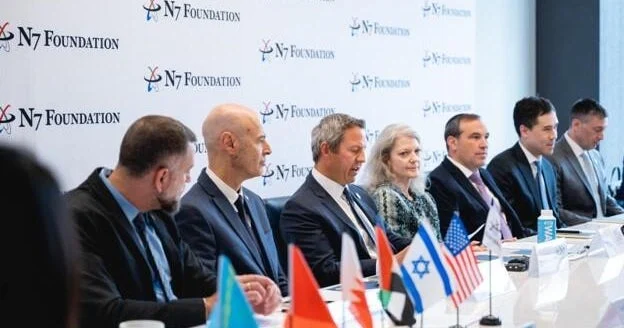
On September 24, 2026, representatives of the Abraham Accords countries gathered in New York City for their first official meeting since the Hamas attacks on Israel on October 7, 2023, which had disrupted the agreement’s expansion. The meeting marked a renewed effort to strengthen diplomatic ties among the United States, Israel, the United Arab Emirates, Bahrain, Morocco, and the newly interested party, Kazakhstan.
What Happened
The meeting took place quietly from the 43rd floor of a midtown Manhattan office building near the United Nations General Assembly. Senior U.S. State Department officials, led by Under Secretary of Political Affairs Allison Hooker, participated alongside representatives from the original Abraham Accords countries and Kazakh officials expressing their intent to join. The event was convened and chaired by Jeffrey Talpins, founder of the N7 Foundation, a U.S.-based nonprofit that has organized Abraham Accords multilateral gatherings since 2021.
During the session, participants discussed concrete next steps to deepen existing relationships and identified opportunities for cooperation across sectors such as technology and transportation. The meeting also reaffirmed commitment to expanding the Abraham Accords following the disruptions caused by the October 2023 Hamas attacks and subsequent regional conflicts in Gaza, Lebanon, and Iran.
Key Facts
The Abraham Accords began with normalization agreements first signed in 2020, brokered by then-President Donald Trump during his first term. The initial agreements involved Israel’s diplomatic recognition by the UAE and Bahrain, with Morocco joining soon after.
Before the 2023 Hamas attacks, momentum was building for additional countries in the Middle East, Africa, and Asia, including Saudi Arabia, to join the Accords. Kazakhstan publicly announced its intention to join in November 2025 during a meeting between President Trump and Kazakhstan’s President Kassym-Jomart Tokayev in the Oval Office.
An official from the Kazakhstan embassy highlighted their enthusiasm for joining, noting interest in technology and transport collaborations as key areas to amplify collective capacity. The U.S. delegation underscored that the Biden administration’s Secretary of State Marco Rubio and White House Special Envoy Steve Witkoff have placed high priority on advancing the Abraham Accords initiative.
What This Means
This meeting signals the reactivation and potential expansion of a crucial diplomatic framework aimed at fostering peace and economic integration between Israel and several Muslim-majority countries. After a multi-year pause caused by violence in the region, the resurrection of formal dialogue highlights a shared interest in stability and cooperation despite ongoing regional tensions.
The inclusion of Kazakhstan broadens the geographic scope of the Abraham Accords beyond the Middle East and North Africa, potentially linking Central Asia into new economic and political partnerships. For the countries involved, such agreements can open avenues for trade, security collaboration, and innovation partnerships that might bolster regional prosperity.
For ordinary citizens, this diplomatic renewal could translate into increased economic opportunities and reduced conflict risks if the Accords achieve deeper integration and more widespread support. The meeting also reaffirms U.S. diplomatic efforts to sustain and expand peace-building frameworks, which remain a critical element in Middle Eastern and broader international relations.
Background
The Abraham Accords are a series of agreements first signed in 2020 under President Trump that normalized relations between Israel and several Arab nations, a historic shift in regional diplomacy. The UAE and Bahrain were the earliest signatories, with Morocco joining soon after. These accords represented a strategic alignment around shared interests such as security, trade, and innovation.
The October 7, 2023 Hamas attack on Israel disrupted the momentum, stalling ongoing talks to incorporate other countries like Saudi Arabia. Subsequent conflicts involving Gaza, Lebanon, and Iran further complicated diplomatic expansion efforts.
What Comes Next
Participants indicated plans to announce an official signing ceremony to formalize Kazakhstan’s accession and are exploring further expansions. U.S. and international officials will likely continue coordinating follow-up meetings and advancing sector-specific collaborations among member countries. No specific dates for future summits have been confirmed.
Sources
This article is based on reporting and publicly available information from the following source:
Read more World News stories on Goka World News.