
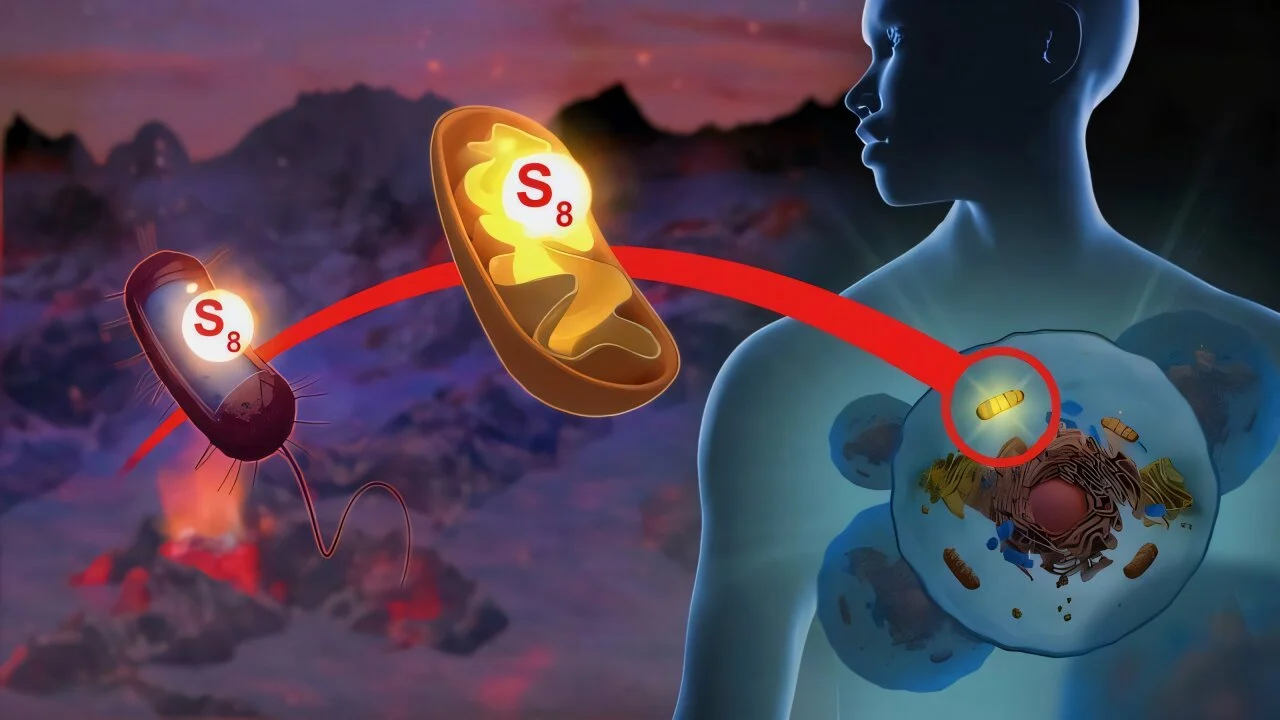
An international team of researchers has identified a second critical role for the enzyme endothelial nitric oxide synthase (eNOS), widely known for regulating blood pressure. Beyond producing nitric oxide, the team demonstrated that eNOS also synthesizes cyclooctasulfur (S₈) rings within mammalian cells. These sulfur rings act as a store of elemental sulfur, a key precursor for antioxidants that protect cells from oxidative damage.
What Happened
The study, led by Professor Takaaki Akaike at Tohoku University and Dr. Uladzimir Barayeu of the Max Planck Institute for Polymer Research, was published in the journal Science in 2026. The researchers discovered that eNOS catalyzes the formation of cyclooctasulfur (S₈), a molecule consisting of eight sulfur atoms arranged in a ring. This is the first demonstration that eNOS has a dual function: besides producing nitric oxide (NO) to regulate vascular dilation, it controls the cellular storage of sulfur in the form of S₈ rings.
Using biochemical and imaging techniques, the team found the highest accumulation of these sulfur rings in mitochondria—cellular organelles responsible for energy production and oxygen metabolism—as well as in lipid droplets. They proposed that from these sulfur reserves, cells generate hydropersulfides, oxidant-neutralizing compounds critical for mitigating lipid peroxidation and ferroptosis, processes implicated in cellular aging and disease.
Key Facts
The research revealed several important details:
- Mammalian cells synthesize and store elemental sulfur primarily as cyclooctasulfur (S₈).
- The eNOS enzyme, previously known for nitric oxide synthesis, produces S₈ rings as a sulfur reservoir for antioxidant biosynthesis.
- These sulfur rings are highly concentrated in mitochondria and lipid droplets, organelles linked to oxygen metabolism and fat storage respectively.
- The stored S₈ serves as a precursor to hydropersulfides, sulfur-based antioxidants that help suppress oxidative damage.
- The findings connect modern mammalian antioxidant mechanisms to ancient sulfur-utilizing metabolic pathways, underscoring sulfur’s evolutionary importance.
What This Means
This discovery reveals an unexpected chemical role for eNOS that could reshape understanding of cellular antioxidant defenses. By producing cyclooctasulfur, cells maintain a reserve of elemental sulfur essential for forming hydropersulfides, compounds known to mitigate oxidative stress and prevent lipid damage. Such antioxidant functions are crucial in protecting DNA and cell membranes from reactive oxygen species, which are linked to aging and neurodegenerative diseases.
These insights link mitochondrial sulfur metabolism to primordial biochemistry, suggesting that this system represents an evolutionary adaptation to oxygen-rich environments. The findings open new research directions into how cells regulate redox balance and handle oxidative insults, with implications for diseases involving ferroptosis, a form of programmed cell death tied to oxidative lipid damage.
While the practical medical applications remain to be explored, understanding eNOS’s dual function may guide future therapies aimed at enhancing cellular antioxidant capacity or targeting oxidative damage pathways in disorders like Alzheimer’s and Parkinson’s.
Background
Antioxidants such as vitamins C and E are well-known for neutralizing free radicals to protect cellular components. However, cells also synthesize antioxidants internally using sulfur-based compounds. Prior to this work, the mechanisms for storing and mobilizing elemental sulfur remained largely unknown. Sulfur metabolism has ancient origins, with sulfur playing a fundamental role in early microbial life and energy processes.
Mitochondria, as descendants of bacteria, retain biochemical pathways reflecting this legacy. Demonstrating that mammalian mitochondria contain sulfur rings indicates a conserved metabolic function, linking sulfur’s ancient bioavailability to modern cellular physiology.
What Remains Unclear
Although the presence and production of cyclooctasulfur by eNOS are established, the detailed biochemical pathways converting S₈ to active antioxidant compounds require further elucidation. Additionally, the regulation of sulfur ring synthesis relative to cellular oxidative stress levels has yet to be defined. The translational potential for targeting this system therapeutically is still theoretical and needs extensive clinical research.
What Comes Next
The research team plans to investigate the molecular mechanisms controlling sulfur ring formation and utilization in cells, as well as the impact on diseases involving oxidative stress and ferroptosis. Further studies may clarify how manipulating eNOS’s sulfur-synthesizing activity could enhance antioxidant defenses.
Sources
This article is based on reporting and publicly available information from the following sources:
Read more Science Discoveries stories on Goka World News.