
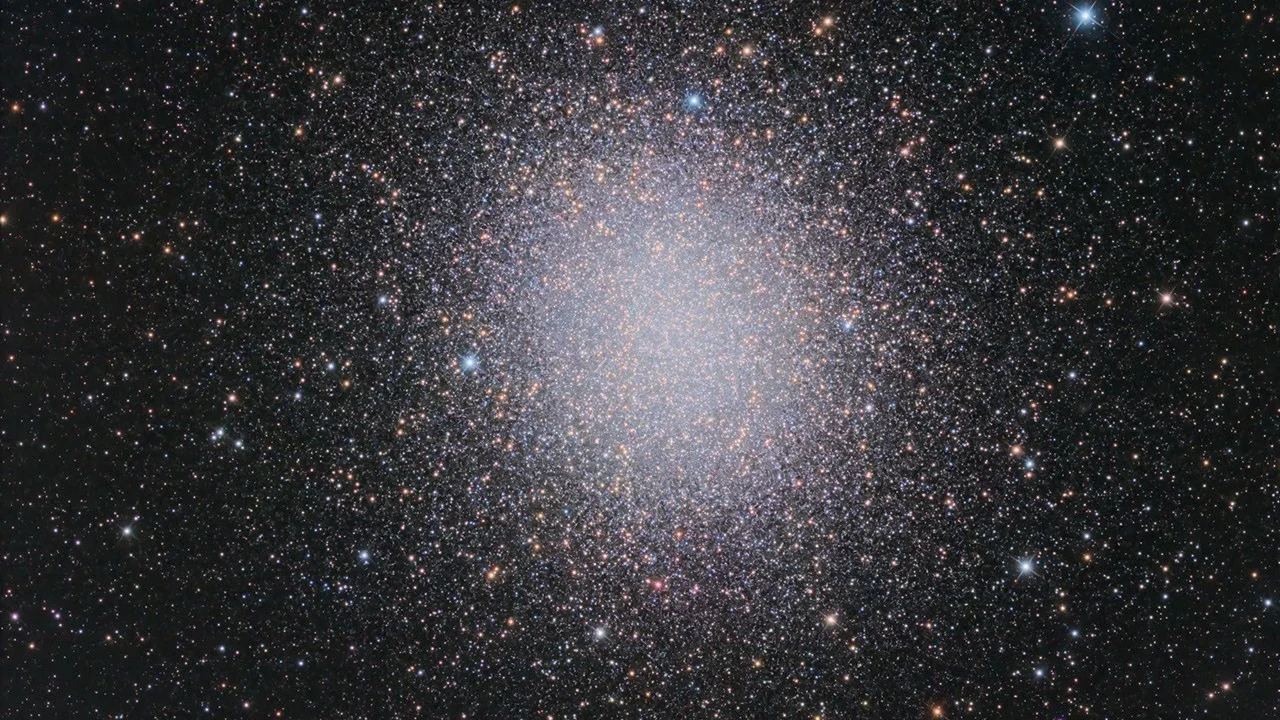
Omega Centauri, also catalogued as NGC 5139, stands out as the largest and brightest globular star cluster orbiting the Milky Way, containing roughly 10 million stars within a diameter of about 150 light-years. Positioned approximately 15,000 light-years from Earth, this cluster has been the subject of extensive Hubble Space Telescope studies, revealing unusual features that suggest it might be the core remnant of a dwarf galaxy assimilated by our galaxy.
What Happened
This iconic globular cluster has long fascinated astronomers, but recent insights have emerged from a two-decade observational campaign using the Hubble Space Telescope. These detailed studies have detected multiple stellar populations within Omega Centauri, indicating a varied history of star formation and chemical enrichment uncommon among typical star clusters. Most notably, the data has uncovered evidence pointing to a massive black hole residing near the cluster’s core, a finding that suggests a more complex evolutionary background than previously assumed.
Key Facts
- Distance from Earth: roughly 15,000 light-years
- Diameter: around 150 light-years
- Number of stars: about 10 million
- Cluster type: globular, with heterogeneous stellar populations
- Galaxy halo location: a halo cluster orbiting the Milky Way
- Instrumentation: Hubble Space Telescope observations over twenty years
- Discovery: evidence for a central massive black hole within Omega Centauri
What This Means
Omega Centauri’s status as more than a simple star cluster challenges traditional models of galactic structure and star cluster evolution. The presence of diverse stellar ages and chemical signatures implies it is likely the stripped core of a dwarf galaxy absorbed by the Milky Way, rather than a homogeneous globular cluster. This discovery shapes our understanding of how large galaxies grow through hierarchical mergers.
Furthermore, the finding of a massive black hole within the cluster provides a rare nearby laboratory to study black hole formation and dynamics in dense stellar environments. This could help astronomers investigate the role such black holes play in galaxy evolution and cluster dynamics, offering valuable clues about the seeds of supermassive black holes found in galactic centers.
Background
Globular clusters like Omega Centauri are dense, spheroidal assemblies of stars that typically contain populations of stars born at roughly the same time. Omega Centauri is exceptional in that it shows multiple generations of star formation, with varied chemical compositions, hinting at a more violent and complex history. Previous research suspected its unusual properties indicated a galactic origin, a theory reinforced by the Hubble findings.
What Remains Unclear
While the evidence for a central massive black hole is strong, details about its exact mass and influence on the cluster’s evolution remain under analysis. Ongoing data processing aims to refine these measurements and better understand the black hole’s role within the cluster’s dynamics and star formation history.
Sources
This article is based on reporting and publicly available information from the following sources:
Read more Space & NASA stories on Goka World News.