
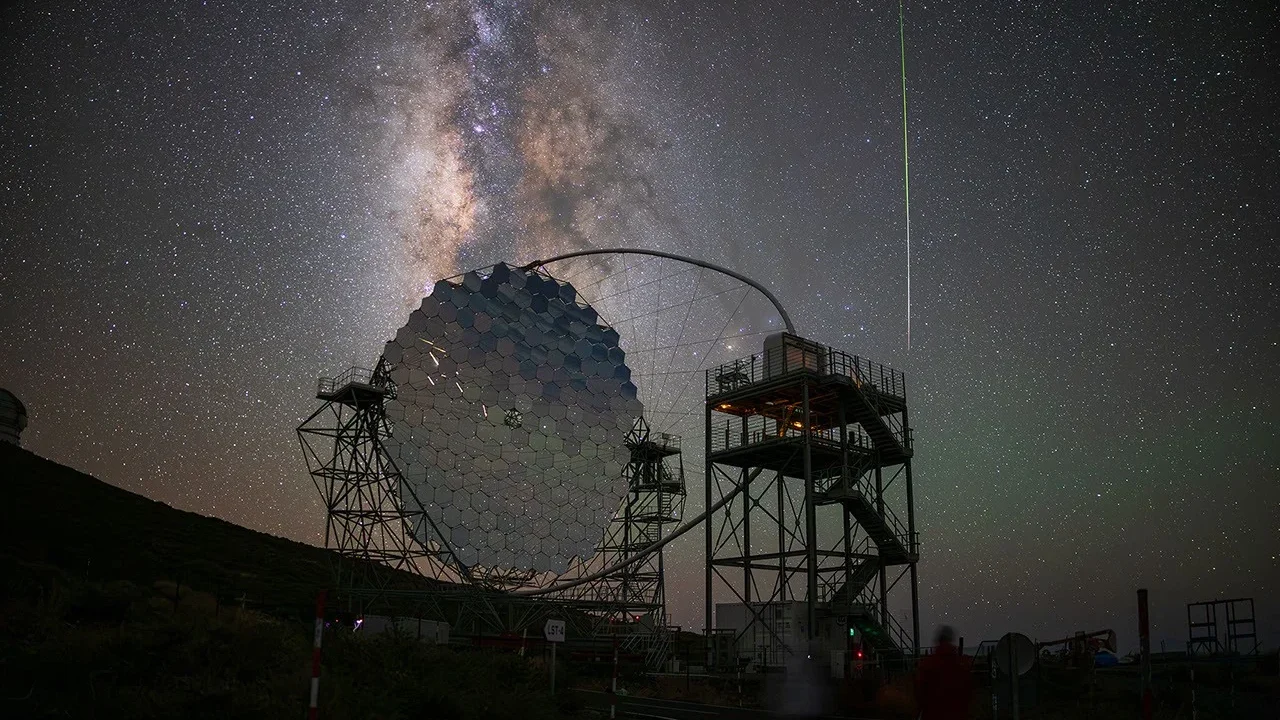
On August 15, a bright Perseid meteor streaked across the night sky above the Observatorio del Roque de los Muchachos at La Palma in the Canary Islands, creating a striking visual alongside the central band of the Milky Way and the scientific landmark Large-Sized Telescope (LST-1). This vibrant scene captures both the beauty of the cosmos and advances in high-energy astrophysics instrumentation.
What Happened
The Perseid meteor, known for its annual August showers, was photographed traversing the atmosphere near the LST-1 telescope at the northern site of the Cherenkov Telescope Array Observatory. This prototype telescope, located at La Palma, is designed to detect faint, ultra-brief flashes of visible light—each lasting roughly a billionth of a second—produced by gamma rays entering Earth’s atmosphere from energetic cosmic sources such as distant active galaxies and gamma-ray bursts. The image also shows reflections of the meteor’s bright flash on segments of the 23-meter diameter LST-1 mirror, complementing the stunning backdrop of the interstellar dust and stars of the Milky Way.
Key Facts
The LST-1 telescope consists of 198 hexagonal mirror segments forming a large primary mirror with a diameter of 23 meters. It is equipped with a high-efficiency, pixelated camera specifically designed to detect Cherenkov radiation flashes induced by cosmic gamma rays. The observatory is situated at an altitude above the horizon where the dark dust lanes and luminous starlight of the Milky Way are clearly visible. The Perseid meteor was captured near this location on August 15, 2026.
What This Means
This image underscores the dual marvels of night sky phenomena and the cutting-edge astronomical tools now in operation to study the universe’s highest energy processes. The LST-1’s capability to capture fleeting atmospheric flashes triggered by gamma rays allows scientists to probe powerful and distant cosmic events that are otherwise invisible with conventional telescopes. Observations like these contribute to our understanding of extreme astrophysical phenomena, including black holes, neutron stars, and gamma-ray bursts, shedding light on the energetic universe beyond visible light. For the public, such photographs ignite curiosity and appreciation for the complex technology enabling discoveries far beyond our atmosphere.
Background
LST-1 is the first of its kind built for the Cherenkov Telescope Array, the next-generation observatory for very-high-energy gamma-ray astronomy. The Canary Islands site was chosen for its excellent atmospheric conditions and altitude, providing an ideal vantage point for atmospheric light detection. The Perseid meteor shower itself is a well-known annual event caused by Earth passing through debris left by comet Swift-Tuttle.
What Comes Next
Following the construction of LST-1, ongoing commissioning and calibration efforts will continue to enhance the telescope’s sensitivity and operational readiness for full scientific data collection. The Cherenkov Telescope Array Observatory plans to use its network of telescopes to map the gamma-ray sky in unprecedented detail in the coming years.
Sources
This article is based on reporting and publicly available information from the following sources:
Read more Space & NASA stories on Goka World News.