
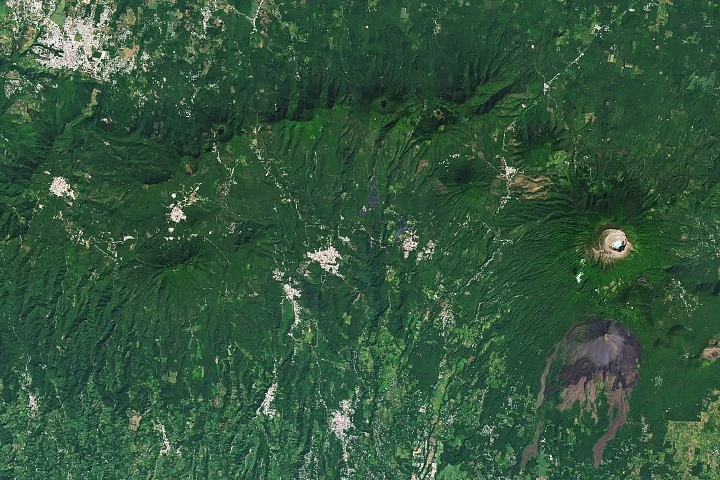
The volcanic terrain surrounding Ahuachapán in western El Salvador features significant geothermal activity that supports a major power plant while sitting amid historically active volcanoes. This region forms part of the Central American Volcanic Arc, a chain of volcanoes stretching more than 1,000 kilometers along the Pacific coast from Guatemala to Panama.
The Santa Ana volcano, standing at 2,381 meters (7,812 feet), is the tallest in El Salvador and remains active. Since the 16th century, it has produced small to moderate explosive eruptions. Its most recent notable eruption occurred in 2005, emitting a dense column of gas and ash and triggering lahars down its slopes.
On Santa Ana’s southern flank lies Izalco, a steep stratovolcano that formed in 1770. Izalco’s frequent eruptions during the 18th and 19th centuries, including lava fountains and Strombolian activity, earned it the nickname “Lighthouse of the Pacific” for its visible glow at night to sailors offshore. The volcano’s last eruption was recorded in 1966, and it has since been dormant.
A chain of forested stratovolcanoes known as the Apaneca Range lies nearby. These volcanoes have no recorded eruptions during the Holocene epoch (last 11,700 years), but geothermal phenomena such as fumaroles, hot springs, and steam vents are common. Sudden steam explosions have occurred here, including an October 1990 blast near Laguna Verde volcano, and more recently, a 2025 steam eruption near a hot springs resort that caused evacuations and infrastructure damage.
The geothermal heat underpinning this volcanic region has been harnessed for energy production. The Ahuachapán Geothermal Power Plant, operational since 1975, utilizes groundwater heated to around 250 degrees Celsius (480 degrees Fahrenheit) by subterranean volcanic activity and local fault systems. By the early 1980s, it generated approximately 40 percent of El Salvador’s electricity.
Why it matters
Harnessing the geothermal energy of this volcanically active region provides El Salvador with a substantial portion of its electricity, demonstrating an effective use of natural resources amid volcanic hazards. The Ahuachapán plant’s operation highlights the balance of leveraging volcanic heat for sustainable energy while managing associated risks such as steam explosions and eruptions.
Background
The Central American Volcanic Arc is a major geological feature formed by subduction of the Cocos Plate beneath the Caribbean Plate. It hosts numerous active and dormant volcanoes contributing to the region’s geothermal potential. El Salvador’s volcanic zone has shaped local geography and energy strategies, with continued monitoring essential due to the region’s volcanic activity and associated hazards.
Sources
This article is based on reporting and publicly available information from the following source:
Read more Science & Technology stories on Goka World News.