
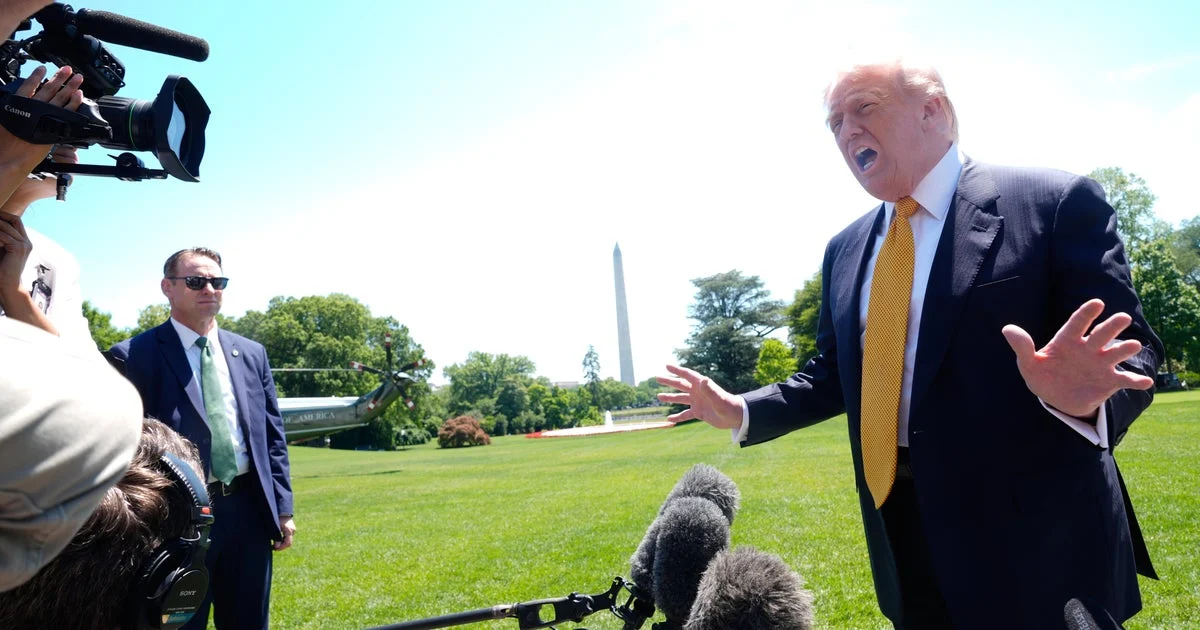
President Donald Trump stated on May 12, 2026, that his primary focus in negotiations with Iran is to prevent the country from developing nuclear weapons, dismissing concerns about the financial impact on Americans. Speaking to reporters before departing for a meeting with Chinese President Xi Jinping in Beijing, Trump said, “I don’t think about Americans’ financial situation” in making a deal with Iran, emphasizing, “The only thing that matters… they can’t have a nuclear weapon.”
When pressed about whether Americans’ financial struggles motivated his approach, Trump responded, “Not even a little bit,” adding that the Iranian nuclear threat outweighs economic factors, including fluctuations in the stock market, which he noted recently reached an all-time high.
Economic Strain Amid Rising Inflation and Gas Prices
The U.S. is currently experiencing significant financial strain: inflation rose to an annual rate of 3.8% in April 2026, reaching the highest level since 2023. Additionally, CBS News/YouGov polling found that 51% of Americans reported higher gasoline prices as a cause of financial hardship. As of May 12, the national average price for gas was $4.50 per gallon, according to AAA. Petroleum analyst Patrick De Haan predicted that if the Strait of Hormuz remains closed, gas prices could rise to $5 per gallon by June.
Strategic Concerns Over Iran’s Nuclear Capability
Trump has maintained throughout the ongoing conflict that allowing Iran to obtain nuclear weapons would worsen conditions for Americans. Secretary of State Marco Rubio also highlighted the strategic dangers, saying a nuclear-armed Iran could manipulate oil markets and raise gas prices significantly by controlling the Strait of Hormuz. Rubio warned that high gas prices could reach $8 or $9 per gallon if Iran decided to close the strait, and the U.S. would have little recourse due to Iran’s nuclear capability.
The Strait of Hormuz remains largely closed, with no immediate resolution to tensions in the Middle East. The situation has contributed to political challenges for Trump, whose economic support has declined amid inflationary pressures and higher fuel costs caused in part by regional instability.
Why it matters
Trump’s remarks underline a clear prioritization of national security concerns over economic pressures facing American consumers, signaling that U.S. foreign policy will continue to focus on preventing nuclear proliferation in Iran despite domestic financial hardships. This stance may affect ongoing negotiations and the strategic balance in the Middle East, with potential implications for global oil markets and inflationary trends in the United States.
Background
The U.S.-Iran conflict has heightened geopolitical tensions, with the Strait of Hormuz—a strategic oil transit chokepoint—partially blocked. U.S. officials warn that Iran’s potential nuclear development poses significant risks, including market manipulation and military threats. As inflation and gas prices rise domestically, these geopolitical dynamics complicate economic recovery efforts.
Sources
This article is based on reporting and publicly available information from the following source:
Read more Politics stories on Goka World News.