
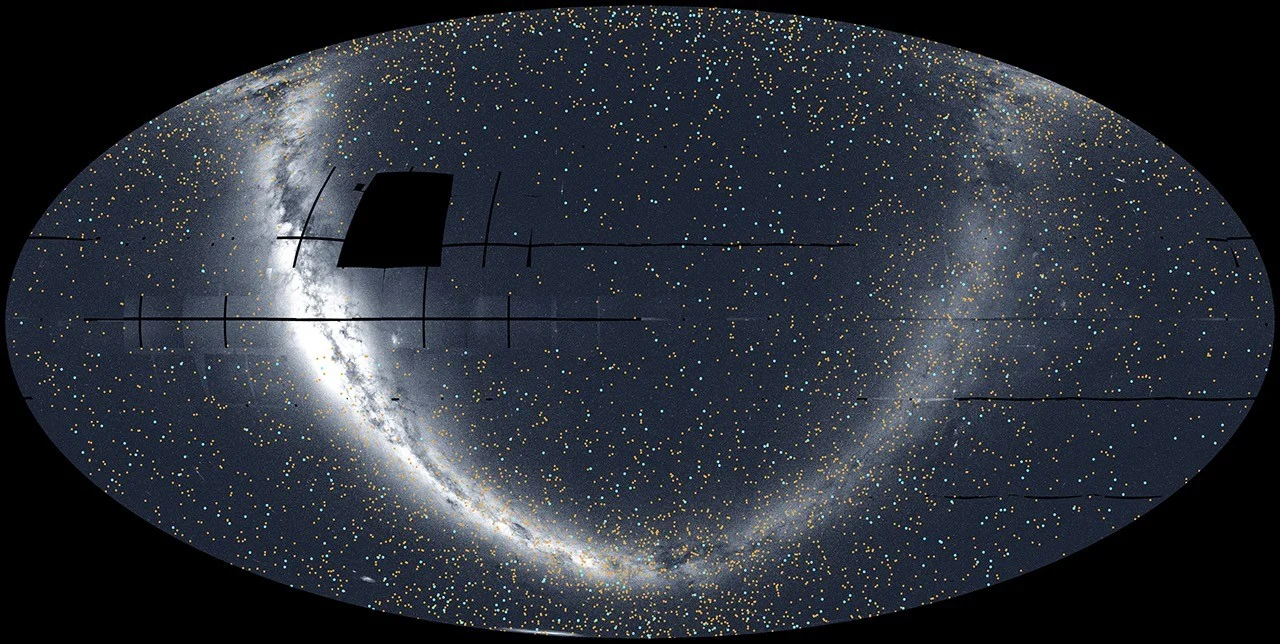
NASA’s Transiting Exoplanet Survey Satellite (TESS) has unveiled its most comprehensive map of the night sky to date, highlighting nearly 6,000 confirmed and candidate exoplanets discovered during its mission through September 2025. This new all-sky mosaic fills observational gaps from previous surveys and showcases the scope of TESS’s planet-hunting achievements.
Since its launch in April 2018, TESS has surveyed the sky in 96 sectors, each monitored for approximately one month using its four onboard cameras. This method enables the spacecraft to detect slight brightness dips in stars, which can indicate the transit of a planet. The resulting mosaic compiles these observations into a full-sky view, marking exoplanet locations with nearly 700 confirmed planets shown as blue dots, and more than 5,000 candidate planets represented by orange dots.
The confirmed exoplanets span a wide range of sizes and characteristics, from small, Mercury-sized worlds to gas giants larger than Jupiter. Some orbit within their stars’ habitable zones—regions where liquid water might exist—making them of interest in the search for life beyond Earth. Among the diverse planetary systems identified are those featuring volcanic worlds, planets being destroyed by their parent stars, and those orbiting binary stars, resulting in double sunrises and sunsets.
The mosaic also captures notable features of our galaxy, including the bright plane of the Milky Way, seen as a glowing arc across the center, and the Large and Small Magellanic Clouds—satellite galaxies approximately 160,000 and 200,000 light-years away, respectively.
Allison Youngblood, TESS project scientist at NASA’s Goddard Space Flight Center, emphasized the mission’s broader scientific impact: “In addition to planets, TESS has helped us study rivers of young stars, observe dynamic galactic behavior, and monitor asteroids near Earth.” Researchers continue to use automated algorithms to analyze the large TESS dataset, revealing ongoing surprises and discoveries.
Why it matters
The TESS mission has significantly expanded the known population of exoplanets, contributing over 6,270 confirmed discoveries when combined with other projects like NASA’s Kepler Space Telescope. Its detailed all-sky map aids astronomers in targeting future observations and improves understanding of planetary system diversity and formation. Identifying planets in habitable zones advances efforts to find potentially life-supporting worlds.
Background
TESS operates by continuously monitoring star brightness to detect periodic dimming caused by planetary transits, a key method in exoplanet detection. Following the successes of the Kepler mission, which focused on a smaller patch of sky, TESS’s wide-field survey approach covers 85% of the sky, prioritizing nearby, bright stars. This strategy enables follow-up studies with powerful ground- and space-based telescopes to confirm and characterize new planets.
Citizen science initiatives like the Planet Hunters TESS project invite the public to participate by analyzing light curves and identifying transit signals, contributing to ongoing discoveries.
Sources
This article is based on reporting and publicly available information from the following source:
Read more Space & NASA stories on Goka World News.