
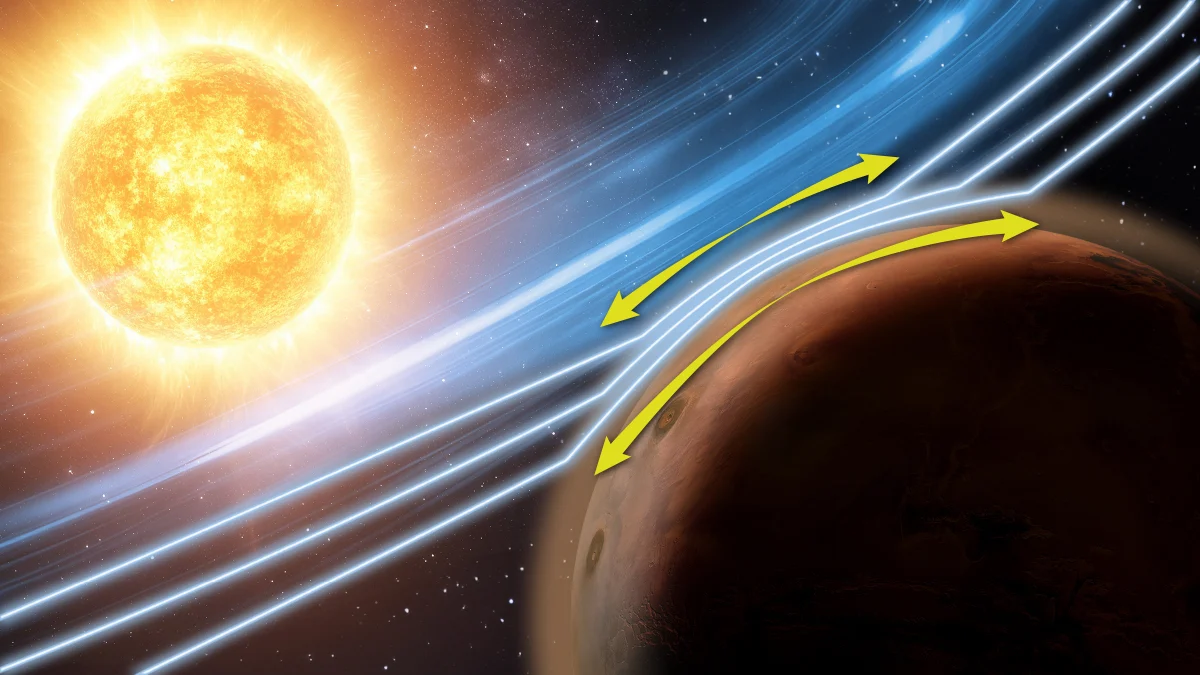
NASA’s Mars Atmosphere and Volatile Evolution (MAVEN) spacecraft has made the first observation of the Zwan-Wolf effect in Mars’ atmosphere—an atmospheric phenomenon until now only detected in Earth’s magnetosphere. This discovery, based on data collected during a strong solar storm, sheds new light on how solar wind interacts with the Martian environment.
Discovery of the Zwan-Wolf Effect on Mars
In December 2023, scientists analyzing MAVEN’s measurements detected unusual fluctuations in the magnetic field and charged particle behavior deep within Mars’ ionosphere, located below 200 kilometers altitude. These “wiggles” indicated charged particles being compressed and redistributed along magnetic structures known as flux tubes—hallmarks of the Zwan-Wolf effect. First identified in Earth’s magnetosphere in 1976, this effect helps deflect solar wind around our planet but had never been observed inside a planetary atmosphere until now.
Christopher Fowler, lead author of the study published in Nature Communications, explained that the effect appeared amplified during a large solar storm impacting Mars, making it detectable by MAVEN’s instruments. He noted this was an unexpected finding because Mars lacks a global magnetic field like Earth’s, instead possessing an induced magnetosphere created by the solar wind’s interaction with its ionosphere. The effect likely occurs regularly at levels too subtle to detect in quieter conditions.
Mars’ Unique Magnetic Environment
Unlike Earth’s protective global magnetic field, Mars experiences variable space weather interactions due to its induced magnetosphere, which changes size and shape drastically during solar events. These interactions influence the ionosphere’s charged particles and can drive atmospheric loss. Observing the Zwan-Wolf effect on Mars provides new understanding of these dynamics, revealing a previously unknown process by which solar wind and space weather shape the Red Planet’s upper atmosphere.
The MAVEN spacecraft, launched in 2013 and orbiting Mars since 2014, has long studied atmospheric escape mechanisms to understand Mars’ climate history and past habitability. This new discovery adds a layer to how solar and space weather events impact Mars’ atmospheric environment.
Broader Implications for Solar System Science
The identification of the Zwan-Wolf effect in Mars’ ionosphere also suggests that similar effects could exist on other unmagnetized or weakly magnetized bodies such as Venus or Saturn’s moon Titan. Understanding these processes is important for future exploration and protecting orbiters or landers from space weather impacts.
Why it matters
This finding advances knowledge of how Mars’ atmosphere responds to solar activity, influencing atmospheric loss and planetary evolution. It emphasizes the significance of continued monitoring of space weather at Mars, which affects both scientific understanding and the safety of current and future missions operating in the Martian environment.
Background
The MAVEN mission focuses on studying how Mars’ atmosphere interacts with the Sun and solar wind, which drives gradual atmospheric loss shaping the planet’s climate over billions of years. Before this, the Zwan-Wolf effect was known only as a magnetospheric phenomenon observed at Earth, linked to the planet’s strong global magnetic field. Mars’ discovery marks the first evidence of this effect occurring within a planetary atmosphere, opening new avenues for space physics research.
Sources
This article is based on reporting and publicly available information from the following source:
Read more Space & NASA stories on Goka World News.