
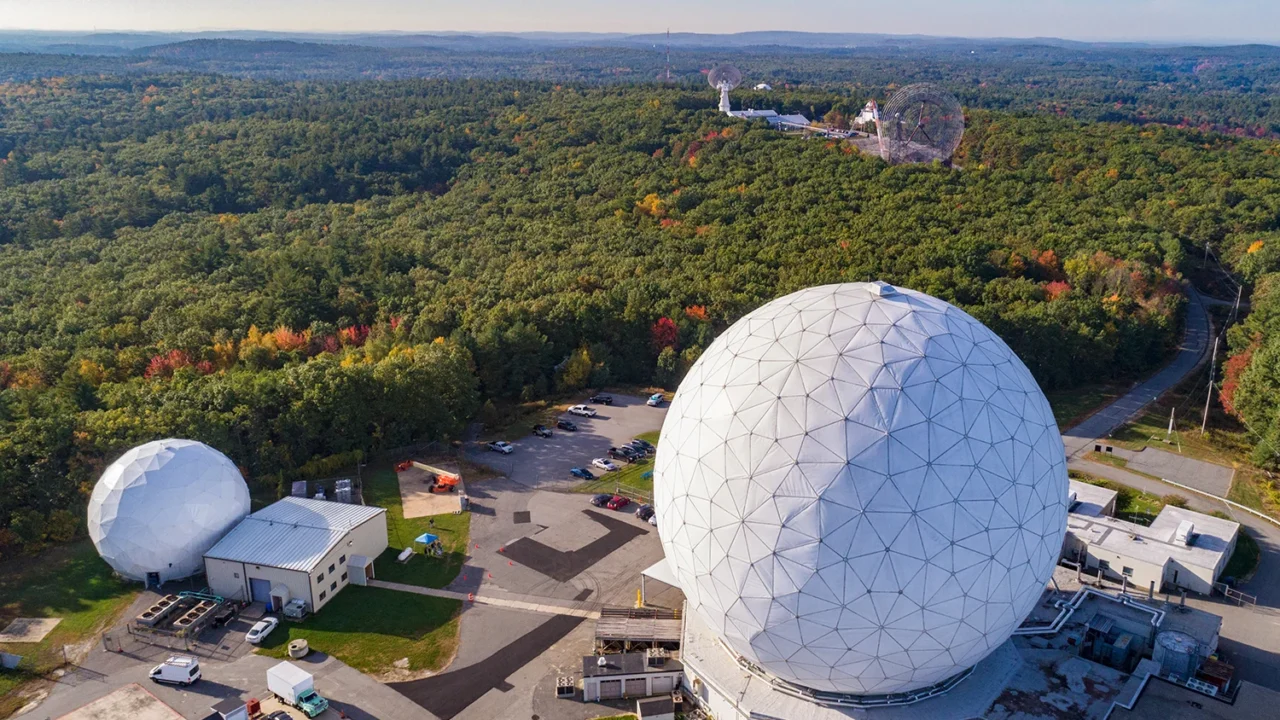
The Haystack 37m Telescope at MIT’s Haystack Observatory in Westford, Massachusetts, has resumed advanced astrophysical research following a decade-long upgrade effort. On December 8, 2025, the telescope participated in high-resolution observations of the supermassive black hole system at the center of galaxy Messier 87 (M87), marking its return to scientific prominence.
Observing the M87 Black Hole Jet
Using very long baseline interferometry (VLBI), which links radio telescopes across continents, the Haystack 37m Telescope joined the Very Long Baseline Array (VLBA) and the Greenland Telescope (GLT) to investigate the large-scale jet emitted by M87’s central black hole, known as M87*. This jet, powered by a black hole roughly six-and-a-half billion times the mass of the sun, stretches thousands of light-years into intergalactic space and is one of the universe’s most energetic features.
While previous international initiatives like the Event Horizon Telescope have captured images of the black hole’s “shadow,” Haystack’s observations focused on the extended jet structure. Understanding how energy from the black hole transports across such vast distances is crucial to explaining the influence of supermassive black holes on their host galaxies. Paul Tiede, principal investigator of the M87 study, highlighted that Haystack’s sensitivity enhances the array’s ability to detect faint emissions, enabling the creation of multifrequency movies of the jet that advance black hole physics research.
Broader Research and Educational Roles
Beyond black hole studies, the upgraded Haystack 37m Telescope is set to support other scientific initiatives at MIT. Researchers in the Department of Earth, Atmospheric and Planetary Sciences (EAPS), including Saverio Cambioni and Richard Teague, plan to use it within MIT’s Planetary Defense Project to measure sizes and shapes of asteroids, contributing both to planetary defense and solar system formation studies.
Associate Professor Brett McGuire from the Department of Chemistry intends to use the telescope for detecting complex organic molecules in space, addressing questions related to the chemical precursors to life.
Jens Kauffmann, principal investigator of the Haystack 37m Telescope Astronomy Program, emphasized the importance of the telescope not only for research but also as a hands-on training platform for emerging astronomers. Undergraduate interns have already engaged in developing control systems and data analysis tools, underscoring Haystack’s role in workforce development amid a global scarcity of advanced research telescope access.
Decade-Long Upgrades and Future Plans
The telescope underwent a major overhaul from 2010 to 2014, enhancing its millimeter-wavelength capabilities to support space radar missions. Following this period, astronomy took a secondary role, but continuous efforts to restore scientific use persisted.
Starting in 2015, the National Science Foundation (NSF) supported modernization of data processing and radio signal systems. Additional upgrades funded in 2019, linked to the Next Generation Event Horizon Telescope (ngEHT) program, advanced receiver and computing technologies. More recent improvements in 2025, aided by MIT’s Jarve Seed Fund for Science Innovation and support from the Smithsonian Astrophysical Observatory, addressed remaining technical challenges and enabled the December 2025 observations.
MIT Haystack Observatory is seeking further federal and private funding to continue telescope enhancements through the Haystack 37m Telescope Astronomy Program.
Why it matters
The Haystack 37m Telescope’s return enhances the capabilities of U.S. radio astronomy by providing access to a sensitive, world-class instrument for both cutting-edge research and student training. Its participation in VLBI observations helps scientists probe the physics of supermassive black holes and their impact on galaxy formation. Additionally, its role in planetary defense and astrochemistry research expands knowledge of solar system hazards and the origins of life’s building blocks. Resuming such capabilities at a time when few telescopes are accessible for hands-on use represents a significant boost for the astrophysics community and the training of future scientists.
Background
Commissioned in 1964, the Haystack 37m Telescope has a rich history, supporting NASA’s Apollo missions, radar mapping of Venus, tests of general relativity, and very long baseline interferometry developments. Its recent upgrades restore and extend this legacy, positioning it again at the frontier of radio astronomy and radar science.
Sources
This article is based on reporting and publicly available information from the following source:
Read more Space & NASA stories on Goka World News.