
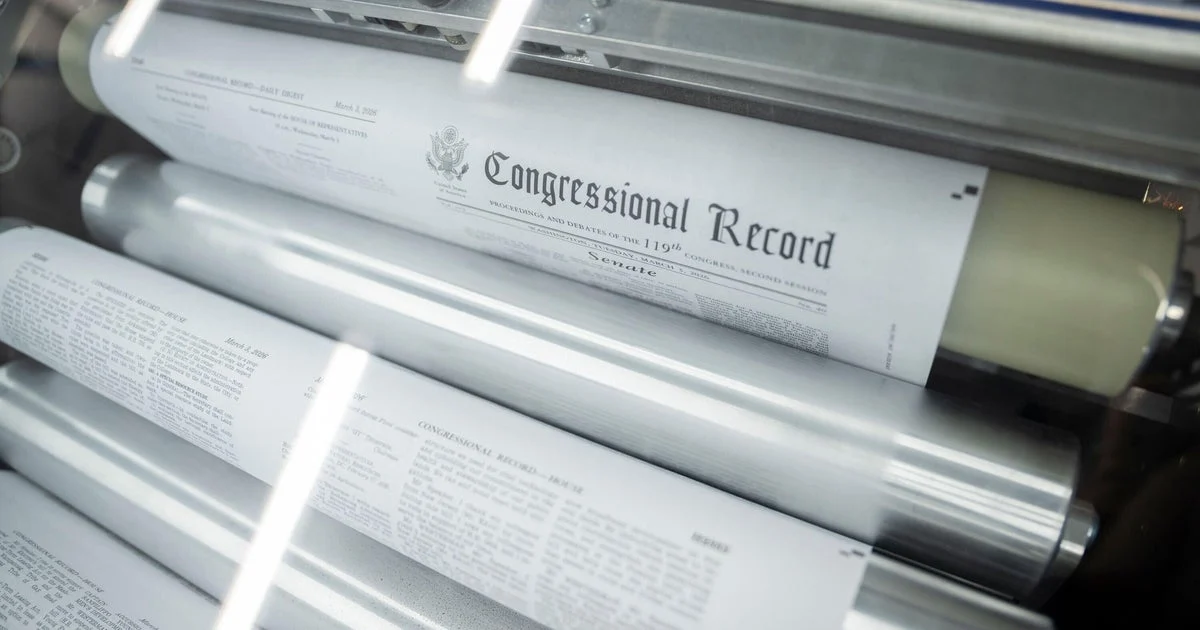
Every night that Congress is in session, the Government Publishing Office (GPO) in Washington, D.C., undertakes the vital but little-known task of producing the Congressional Record, the official documentation of the day’s congressional activities. This process captures a nearly verbatim account of speeches, debates, and votes from both the House and Senate, creating a comprehensive historical record for lawmakers, researchers, and the public.
The Congressional Record’s Origins and Importance
Before the Congressional Record’s establishment in 1873, public information about Congress’s internal proceedings was limited and often partisan, relying on newspaper coverage. Growing demand for a reliable and formal account led to the GPO beginning to publish the Record, which chronicles the exact words and actions taken on the floors of the Senate and House.
Former Senate Majority Leader Lyndon B. Johnson emphasized the Record’s significance in 1956, noting it contains debate, bills, resolutions, and petitions vital to the legislative process and judicial decisions. The Record’s size varies with congressional activity, ranging from dozens to hundreds of pages in four sections, including a “Daily Digest,” verbatim floor proceedings, and “extensions of remarks,” which allow members to add statements not spoken aloud.
The inclusion of such added remarks has occasionally sparked controversy, underscoring the Record’s role in documenting not only spoken words but also official submissions to the congressional record.
Daily Compilation and Production Process
The process starts each day inside the Capitol, where floor reporters transcribe every word spoken during sessions using shorthand and stenotype machines, working in rapid, 15-minute shifts. Their notes are then edited for clarity by scopists to produce polished transcripts, a process that can take up to several hours for every 15 minutes of floor time.
After initial editing at the Capitol, the transcripts, committee reports, votes, and other congressional documents are sent—both digitally and in paper form—to the GPO headquarters, a large Romanesque Revival building near the Capitol. Paper copy is considered the “source of truth” over digital files in the event of discrepancies, as emphasized by GPO Director Hugh Halpern.
At the GPO, about 70 employees work primarily overnight to finalize the Record. Proofreaders and editors compare paper copies with electronic files, applying strict formatting rules using red marks and stamps. This detailed work continues well into the early morning hours to ensure accuracy and timeliness.
Following editing, the content is posted online and sent to printers—large, noisy machines that produce the final physical copies. The completed Congressional Record is delivered to the Capitol by the morning, ready for use by legislators and the public.
Why it matters
The Congressional Record serves as the definitive and legally significant archive of congressional actions, debates, and decisions, influencing legislation, legal precedent, and historical research. Its timely and accurate publication ensures transparency and accountability in the American legislative process.
Despite modern technologies, the Record’s reliance on paper and rigorous manual editing illustrates the importance of maintaining an authoritative, stable record of government proceedings.
Sources
This article is based on reporting and publicly available information from the following source:
Read more Politics stories on Goka World News.