
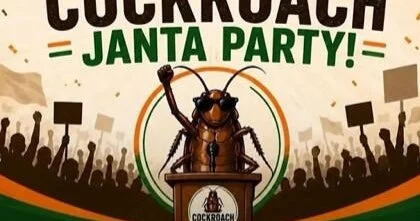
India’s online political landscape has been shaken by the rapid rise of the “Cockroach Janta Party” (CJP), a satirical digital movement that has attracted millions of young followers in less than a week. The movement emerged in response to controversial remarks reportedly made by India’s chief justice, Surya Kant, regarding unemployed youth.
The CJP, launched on May 16 by Indian public relations student Abhijeet Dipke from Boston University, parodies India’s ruling Bharatiya Janta Party (BJP). Using AI-generated images of a cockroach-man as its virtual leader, the group describes itself as a “political front of the youth, by the youth, for the youth” and brands itself as the “Voice of the Lazy & Unemployed.” Within days, the party’s Instagram account amassed more than 20 million followers, surpassing the BJP’s social media reach and that of the main opposition, the Indian National Congress.
The movement was sparked after Chief Justice Kant was widely reported to have called unemployed youth “cockroaches” and “parasites” during a hearing. Kant later clarified that his criticism targeted individuals who secured jobs through fake degrees, not the youth in general. Nonetheless, the online backlash grew swiftly.
Government Response and Social Media Censorship
The surge of the CJP online movement alarmed Indian authorities, prompting the shutdown of its account on X (formerly Twitter). According to an anonymous government official cited by The Indian Express, the Ministry of Electronics and Information Technology acted on intelligence inputs that the CJP’s content posed a threat to the country’s sovereignty and national security due to allegedly inflammatory posts.
Dipke reported attempts to hack the movement’s Instagram account and revealed receiving death threats, with concerns extending to his family in India. He has called on authorities to protect those targeted by threats. Meanwhile, some politicians view the government’s censorship measure as counterproductive. Opposition leader Shashi Tharoor described the account’s blocking as “disastrous and deeply unwise,” acknowledging the movement’s resonance with youth frustrations.
Youth Unemployment and Political Discontent
India’s youth population, approximately 367 million between ages 15 and 29, faces persistent employment challenges. While the overall unemployment rate stands at 5.2%, recent research by Azim Premji University highlights that nearly 40% of graduates aged 15-25 and 20% aged 25-29 remain unemployed, indicating a disproportionate impact on educated youth.
The CJP’s satirical content targets these issues with memes and mock campaigns emphasizing joblessness, corruption, and political dysfunction. Despite its humorous tone, the movement articulates serious demands through a five-point agenda, including banning judges’ post-retirement rewards, reserving half of parliamentary and cabinet seats for women, protecting voting rights, ensuring press independence, and prohibiting politicians from switching parties for two decades.
Dipke has stated that the CJP has no plans to participate in elections but aims to hold politicians accountable and shift political discourse. The movement echoes previous youth-driven protests in the region, such as those in Nepal, which resulted in governmental change amid similar economic frustrations.
Why it matters
The Cockroach Janta Party exemplifies the growing use of social media and digital satire by young Indians to express political discontent and mobilize public opinion. Its rapid growth and subsequent government crackdown highlight increasing tensions between youth activism and state censorship in a democratic society with substantial youth unemployment. The movement’s success underscores the power of digital platforms to challenge established political narratives and demands attention from policymakers addressing India’s socio-economic challenges.
Sources
This article is based on reporting and publicly available information from the following source:
Read more Politics stories on Goka World News.