
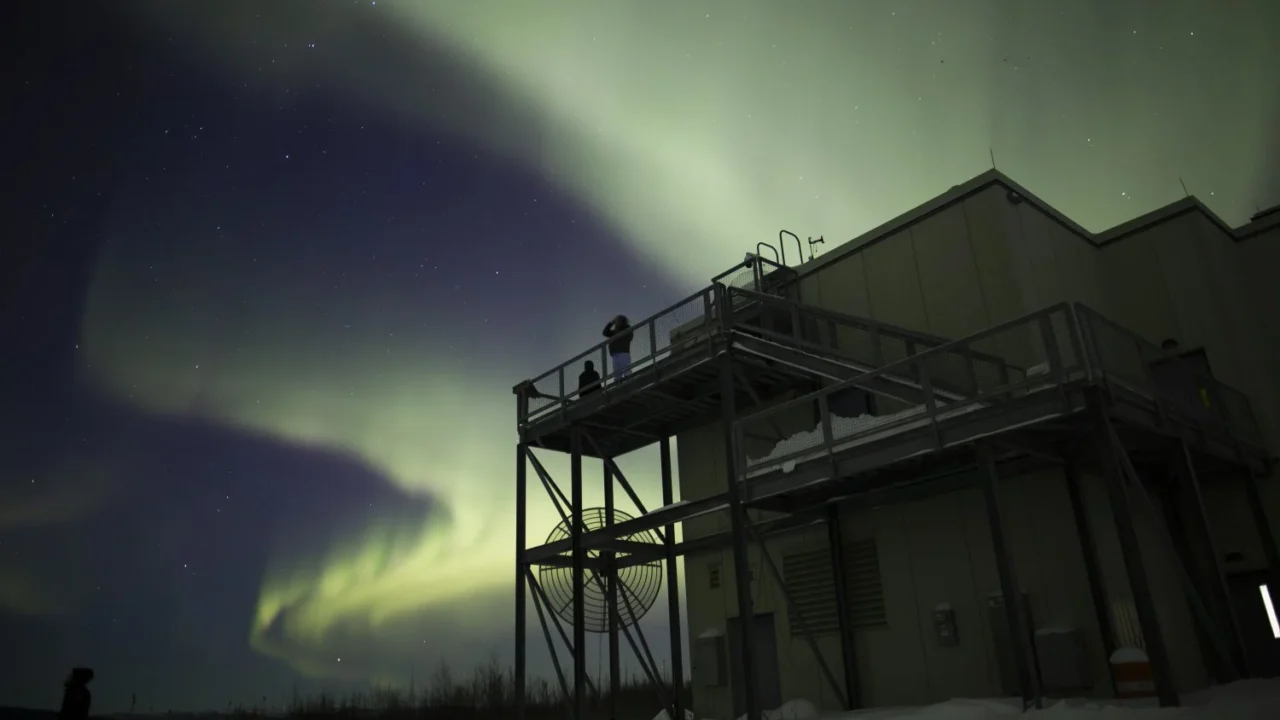
A team of graduate students from the Massachusetts Institute of Technology (MIT) traveled to Fairbanks, Alaska, to study plasma phenomena produced by the aurora borealis, using the natural spectacle as a large-scale laboratory. Their research focused on capturing how charged particles interacting with Earth’s magnetic field create visible auroral structures, especially during intense solar activity.
The students faced extreme cold conditions during the expedition, with temperatures dropping to -25 degrees Fahrenheit and daylight lasting less than three hours. Due to the frigid environment, electronic equipment such as laptops rapidly lost power, complicating data collection. Participants navigated challenging terrain with snow depths and used cross-country skis to access remote observation sites several miles from roadways.
During their stay, the group witnessed the strongest solar storm in two decades, which dramatically illuminated the aurora. They deployed multiple all-sky camera systems that capture 360-degree images of the night sky, positioning them up to 100 miles apart to enable simultaneous observations of auroral changes across space. These cameras were complemented by magnetometers measuring fluctuations in Earth’s magnetic field.
By combining visual and magnetic data, the researchers aim to develop three-dimensional models of auroral structures. This year’s campaign also included muon detectors to investigate potential correlations among visible auroral events, magnetic variations, and high-energy particle activity in the upper atmosphere.
The team observed rare phenomena such as the pulsating aurora, characterized by light strips blinking multiple times per second. Their innovative, low-cost instrumentation, designed and constructed by the students themselves, has contributed to expanding capabilities in aurora research.
The project is part of the Geophysical Plasma Observation Expedition (GPOE), a student-led initiative launched in 2023 by MIT’s Plasma Science and Fusion Center and affiliated departments. Each year, a new cohort travels to Alaska to conduct hands-on research, managing everything from instrument development to data analysis within a compressed timeline of several months. The 2024 group included students from MIT’s physics, nuclear science, Laser Interferometer Gravitational-Wave Observatory (LIGO), and astrophysics programs.
Collaboration with the University of Alaska Fairbanks Geophysical Institute granted access to specialized observation facilities, enhancing the expedition’s scientific scope. The program also expanded its outreach by engaging high school students worldwide in designing and building some of the camera systems used in the field.
Findings from the expedition have been presented at professional conferences and published in peer-reviewed journals. Furthermore, the team’s all-sky camera and magnetometer designs are being adopted by other research projects and community science programs.
Why it matters
Understanding auroral plasma behavior improves knowledge of space weather effects, which can impact satellite operations, communication networks, and power grids on Earth. The GPOE’s student-driven approach accelerates innovation in plasma diagnostics while fostering educational experiences that integrate theoretical physics with real-world observation.
Background
The aurora borealis forms when charged solar particles collide with atoms in Earth’s upper atmosphere, producing glowing plasma displays aligned with magnetic field lines. Despite decades of study, many fine-scale dynamics of aurora remain poorly understood due to difficulties capturing simultaneous spatial and magnetic variations. The peak of the solar cycle intensifies auroral activity, creating prime conditions for research such as that undertaken by the MIT team.
Sources
This article is based on reporting and publicly available information from the following source:
Read more Science Discoveries stories on Goka World News.