
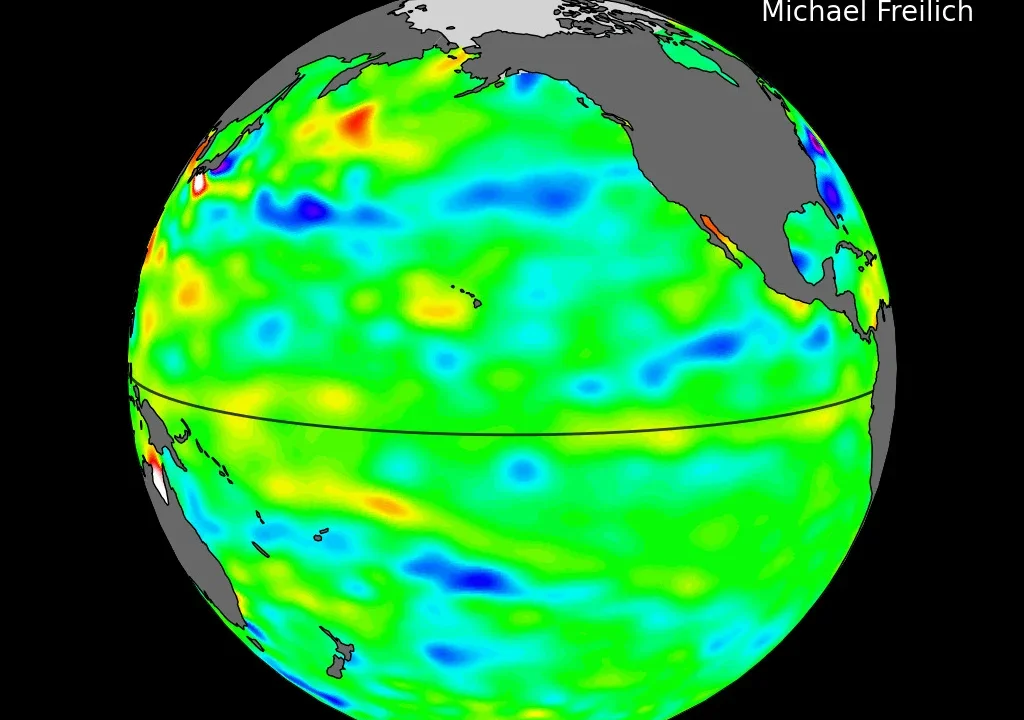
The joint NASA and European Space Agency (ESA) satellite, Sentinel-6 Michael Freilich, has observed a large swell of warm water off the coast of South America, signaling the likely emergence of an El Niño event later this year. This rise in ocean height corresponds to warmer water temperatures in the tropical Pacific, a key indicator of El Niño development.
What happened
Sentinel-6 Michael Freilich, launched in 2020 under the ESA-led Copernicus program with NASA partnership, measures global sea level every 10 days with high precision. The satellite tracks Kelvin waves—warm water pulses that travel eastward across the Pacific after changes in tropical wind patterns.
In early 2023, Sentinel-6 detected a Kelvin wave forming around Micronesia that dissipated by mid-February, followed by another wave emerging in March. By mid-May, sea levels near Peru were elevated by approximately 15 centimeters (5.9 inches) above long-term averages, indicating significant ocean warming. Such warm water accumulations off South America are characteristic of El Niño, which develops over several months as multiple Kelvin waves propagate east.
NASA scientists, including Josh Willis, project scientist for the mission, noted that this year’s El Niño onset started later than major events in 2015 and 1997 but is currently progressing steadily.
Why it matters
El Niño influences global weather patterns by altering atmospheric circulation and the jet stream, often causing heavy rainfall and flooding in some regions and drought in others. The event typically peaks between November and January, with effects that can disrupt agriculture, fisheries, and economies worldwide.
Monitoring with satellites like Sentinel-6 improves forecasting and early warning capabilities for weather extremes, allowing communities to better prepare for potential impacts such as coastal hazards, flooding, or drought.
Background
El Niño is a natural climatic phenomenon named by fishermen centuries ago for its tendency to appear near Christmas. It involves periodic warming of sea surface temperatures in the central and eastern tropical Pacific.
Sentinel-6 Michael Freilich continues a legacy of sea level monitoring satellites dating back to 1992’s TOPEX/Poseidon mission. The satellite was developed jointly by ESA, NASA, NOAA, and other partners to provide continuity in precise ocean measurements vital for climate research and weather prediction.
Sources
This article is based on reporting and publicly available information from the following source:
Read more Space & NASA stories on Goka World News.