
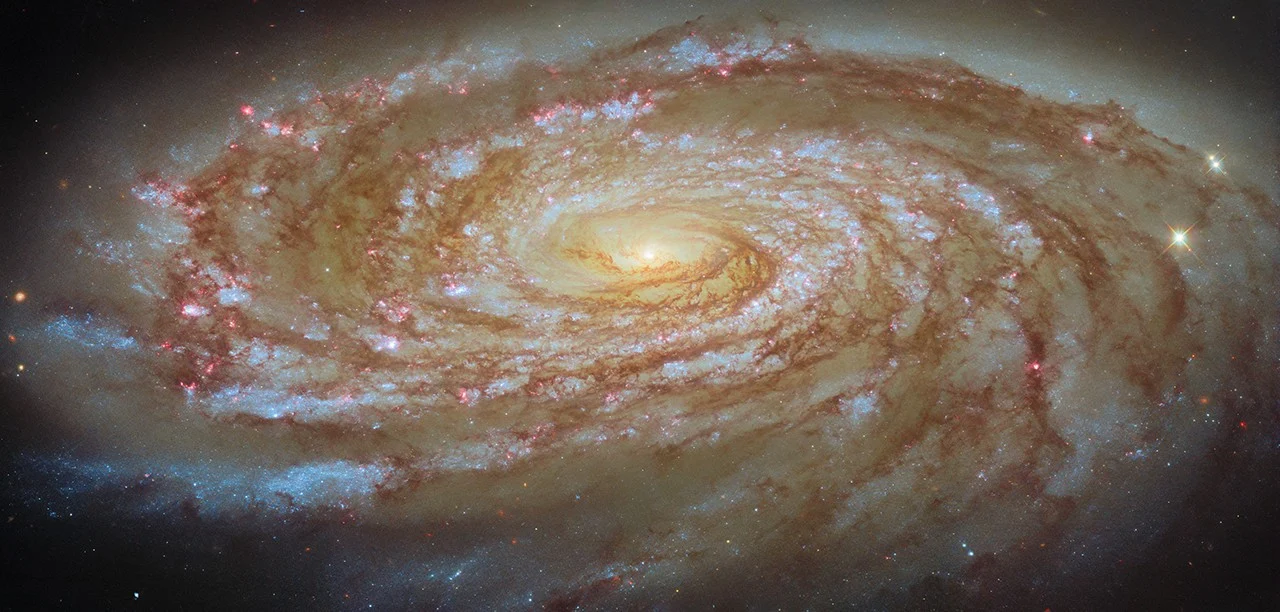
The Hubble Space Telescope has captured detailed images of the spiral galaxy Messier 88 (M88) as it moves toward the center of the Virgo Cluster, a massive group of more than a thousand galaxies. This journey, which is expected to last hundreds of millions of years, is already influencing the galaxy’s structure and star formation capability.
What happened
M88, located approximately 63 million light-years away in the constellation Coma Berenices, is an active spiral galaxy with a supermassive black hole at its center estimated to be around 100 million times the mass of the Sun. This black hole is consuming gas and dust, powering outflows from the galaxy’s core. The galaxy’s tightly wound spiral arms contain numerous star clusters and clouds of dust, visible as sparkling pink and blue regions.
As part of an observation program using Hubble’s Wide Field Camera 3, astronomers are studying M88 to understand how galaxies evolve in dense cluster environments. M88 is currently on a trajectory toward the Virgo Cluster’s center and will pass close to Messier 87 (M87), the cluster’s dominant elliptical galaxy, in 200 to 300 million years.
During this approach, M88 experiences ram pressure stripping—a process where the galaxy’s gas is swept away as it moves through the intracluster medium. This effect is visible as compression and truncation of M88’s gas disk, especially at its leading edge. Consequently, M88 has significantly less cold gas in its outer regions than typical for a galaxy of its size, limiting star formation potential.
Why it matters
The observed ram pressure stripping in M88 highlights how galaxies are physically transformed by their environment within galaxy clusters. Loss of cold gas will reduce M88’s ability to form new stars, changing its evolutionary path. By observing these processes in detail, astronomers gain insight into the mechanisms shaping galaxy development and star formation in crowded cosmic environments.
Background
The Virgo Cluster is one of the nearest galaxy clusters to Earth and serves as a natural laboratory for studying galaxy interactions and evolution. M88 belongs to this cluster and provides a valuable example of a spiral galaxy being influenced by gravitational forces and environmental effects as it moves inward. The Hubble observing program (#18103, PI: D. Thilker) aims to analyze the lives of spiral galaxies in such busy, complex regions of space to better understand their long-term evolution.
Sources
This article is based on reporting and publicly available information from the following source:
Read more Space & NASA stories on Goka World News.