
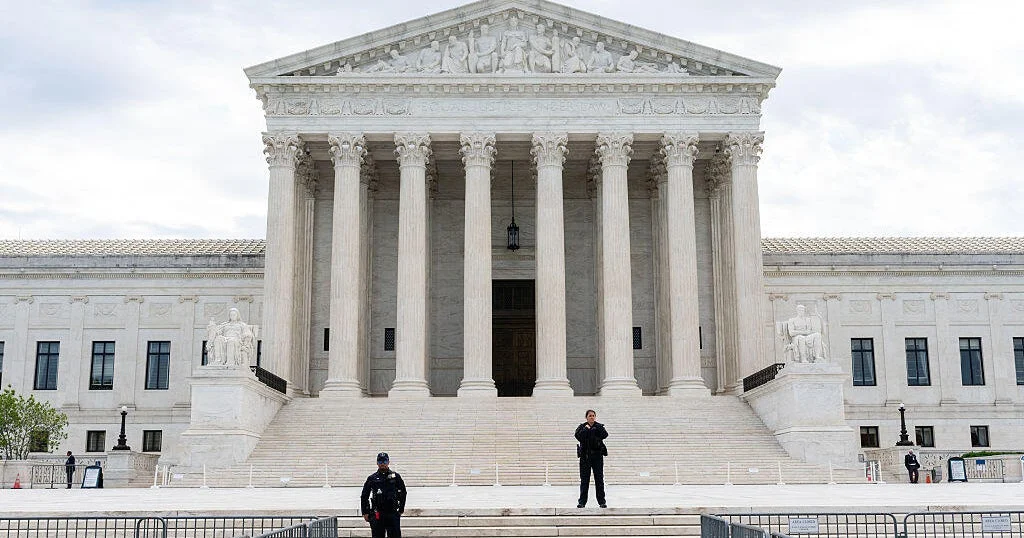
The U.S. Supreme Court ruled 5-4 on May 28, 2026, in favor of Terry Pitchford, a Black death row inmate from Mississippi claiming racial discrimination during jury selection in his capital murder trial. The decision clears the way for review of Pitchford’s conviction, highlighting ongoing scrutiny of racial bias in legal proceedings.
What happened
The case stems from a 2004 armed robbery in Grenada, Mississippi, where Pitchford, 18 at the time, and Eric Bullins, 16, robbed a grocery store resulting in the death of the store owner, Reuben Britt. Bullins fired the fatal shots but was ineligible for the death penalty due to his age, receiving a 20-year sentence instead. Pitchford was charged with capital murder and faced the death penalty.
During jury selection, the prosecutor, then-District Attorney Doug Evans, used peremptory strikes to exclude four of five Black prospective jurors. Pitchford’s legal team challenged these strikes under Batson v. Kentucky, a 1986 Supreme Court ruling prohibiting racial discrimination in jury selection. Evans cited reasons such as tardiness, family criminal history, and demographic similarities to Pitchford, which the trial judge accepted as race-neutral. However, Pitchford’s lawyers argued they were not allowed to rebut these reasons as potentially pretextual, violating Batson’s procedural requirements.
The jury convicted Pitchford with 11 White jurors and one Black juror and sentenced him to death. Pitchford’s conviction was first upheld by Mississippi courts but overturned by a federal district court, which criticized the trial judge for rushing the Batson process. The U.S. Court of Appeals for the 5th Circuit later reinstated the conviction. The Supreme Court’s majority opinion, authored by Justice Brett Kavanaugh, found that the trial court failed to properly evaluate the Batson claim, warranting relief.
Chief Justice John Roberts and Justices Sonia Sotomayor, Elena Kagan, and Ketanji Brown Jackson joined the majority. The dissent, by Justice Neil Gorsuch and joined by Justices Clarence Thomas, Samuel Alito, and Amy Coney Barrett, argued Pitchford did not meet the legal standard for overturning his conviction.
Why it matters
This ruling underscores the Supreme Court’s vigilance over racial discrimination in the criminal justice system, particularly during jury selection. It reinforces the Batson framework, signaling that courts must rigorously examine claims of racial bias and cannot dismiss them without thorough review. The decision may prompt additional scrutiny of jury selection practices nationwide, particularly in capital cases where racial disparities have been historically problematic.
Pitchford’s case also draws renewed attention to Doug Evans, the former Mississippi prosecutor criticized for repeatedly striking Black jurors, including in the earlier high-profile Curtis Flowers case overturned by the Supreme Court in 2019.
Background
Batson v. Kentucky established in 1986 that exclusion of jurors solely based on race violates the Equal Protection Clause of the Fourteenth Amendment. It created a three-step process for courts to evaluate claims of discriminatory peremptory strikes:
- First, the defendant must show the strike was race-based.
- Second, the prosecutor must provide a race-neutral explanation.
- Third, the court must decide whether the explanation was a pretext for discrimination.
Mississippi’s jury practices have been under scrutiny due to repeated allegations of racial discrimination. Doug Evans served as district attorney in multiple cases involving such claims. Curtis Flowers, another defendant prosecuted by Evans, had his convictions repeatedly overturned for similar jury-selection issues before the Supreme Court ruled in his favor in 2019.
Sources
This article is based on reporting and publicly available information from the following source:
Read more Politics stories on Goka World News.