
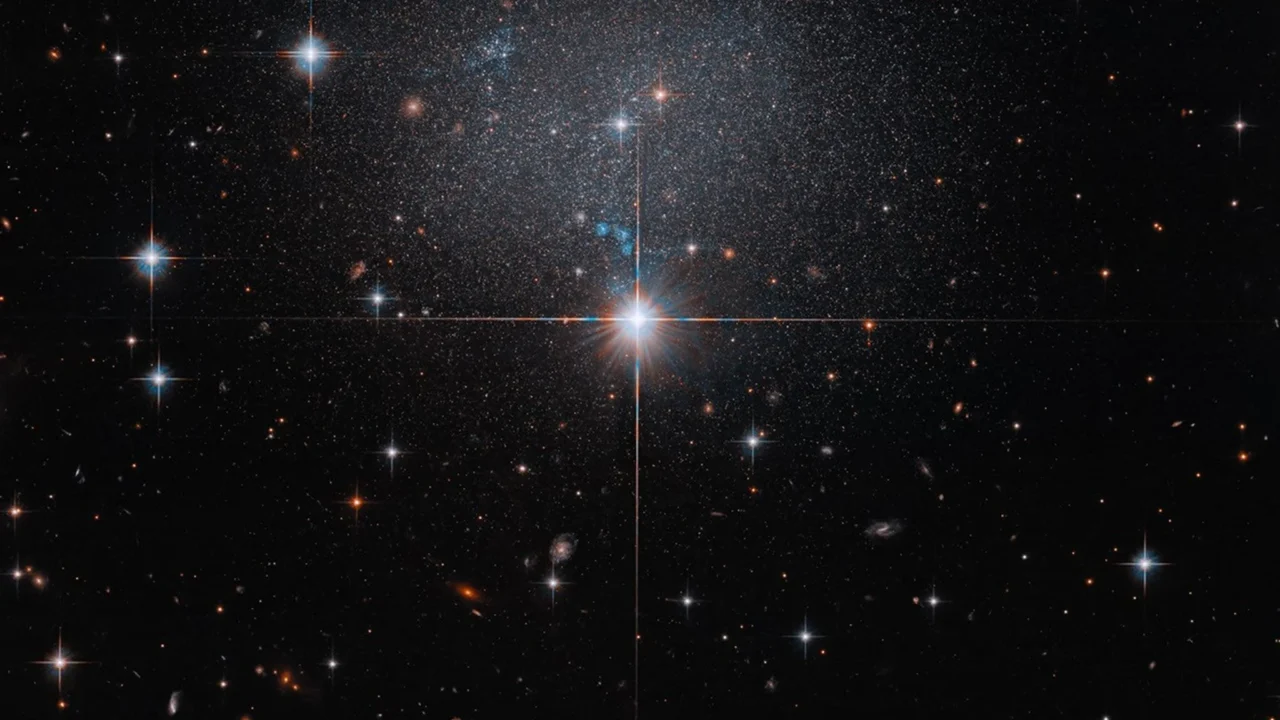
The NASA Hubble Space Telescope has captured a detailed image of the dwarf irregular galaxy ESO 490-017, located approximately 23 million light-years away in the constellation Canis Major. This faint galaxy, measuring about 12,000 light-years across, appears as a low surface brightness object embedded in a star-filled background.
What happened
The newly released Hubble image, issued on May 27, 2026, reveals ESO 490-017 as a subtle, irregular galaxy with a diffuse glow amid brighter foreground stars, which are identifiable by their diffraction spikes. The image also shows numerous distant galaxies in the background, many with noticeable spiral structures displayed as red, orange, and beige dots. The data was collected during a Hubble observing program aimed at studying the movement of galaxies and galaxy clusters.
Why it matters
ESO 490-017 provides insight into the characteristics of low surface brightness dwarf irregular galaxies, which are challenging to observe due to their faint appearance. Understanding such galaxies helps astronomers map the uneven distribution of matter in the universe. These mass variations influence the gravitational forces governing the “cosmic flow,” or the movement of large-scale structures across space. Studies like this enhance knowledge of galactic behavior and cosmic evolution.
Background
Dwarf irregular galaxies like ESO 490-017 are small, faint galaxies that lack defined shapes and often exhibit irregular star formation patterns. Located in the Canis Major constellation, ESO 490-017’s study contributes to the broader effort to understand galaxy dynamics and distribution. The Hubble Space Telescope’s advanced imaging capabilities allow scientists to observe these faint objects and their environments in unprecedented detail, advancing research on cosmic structure and motion.
Sources
This article is based on reporting and publicly available information from the following source:
Read more Space & NASA stories on Goka World News.