
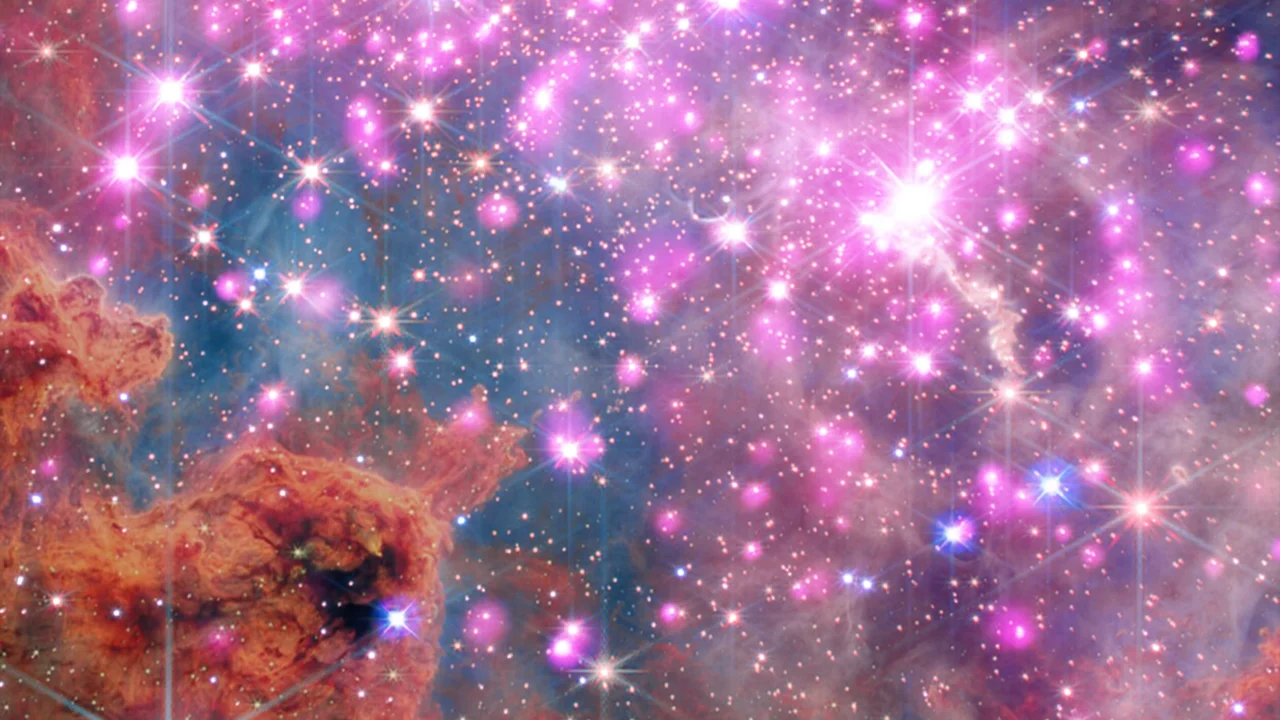
NASA has released a striking composite image of the Westerlund 2 star cluster, combining X-ray observations from the Chandra X-ray Observatory with infrared data from the James Webb Space Telescope (JWST). Located 20,000 light-years from Earth in the constellation Carina, Westerlund 2 showcases a vibrant region of active star formation.
What happened
The new image highlights hundreds of young stars, aged between one and three million years, glowing brightly and surrounded by neon pink hues derived from X-ray emissions detected by Chandra. Infrared data from JWST is shown in red, orange, green, cyan, and blue tones, revealing intricate details of the stellar environment. Below the cluster, dense brick-orange dust clouds mark the raw materials fueling ongoing star formation.
Westerlund 2 is situated within Gum 29, a highly dynamic stellar nursery notable for its intense starbirth activity. This combined data view offers unprecedented insights into the early stages of star cluster development by capturing both energetic X-rays and cool infrared emissions.
Why it matters
The composite image advances astronomers’ understanding of young star clusters by providing a clearer picture of how stars interact with surrounding gas and dust. Identifying the ages and properties of stars in Westerlund 2 helps clarify stellar evolution processes in environments where massive stars are forming. This knowledge improves models of star formation and the dynamics within dense stellar nurseries.
Background
Westerlund 2 was discovered in the 20th century and has been studied extensively due to its youth and size. The Chandra X-ray Observatory has previously contributed to understanding the high-energy phenomena in such clusters, while the James Webb Space Telescope, launched in 2021, offers powerful infrared capabilities to peer through obscuring dust clouds. This collaboration showcases the complementary strengths of space observatories across different wavelengths.
Sources
This article is based on reporting and publicly available information from the following source:
Read more Space & NASA stories on Goka World News.