
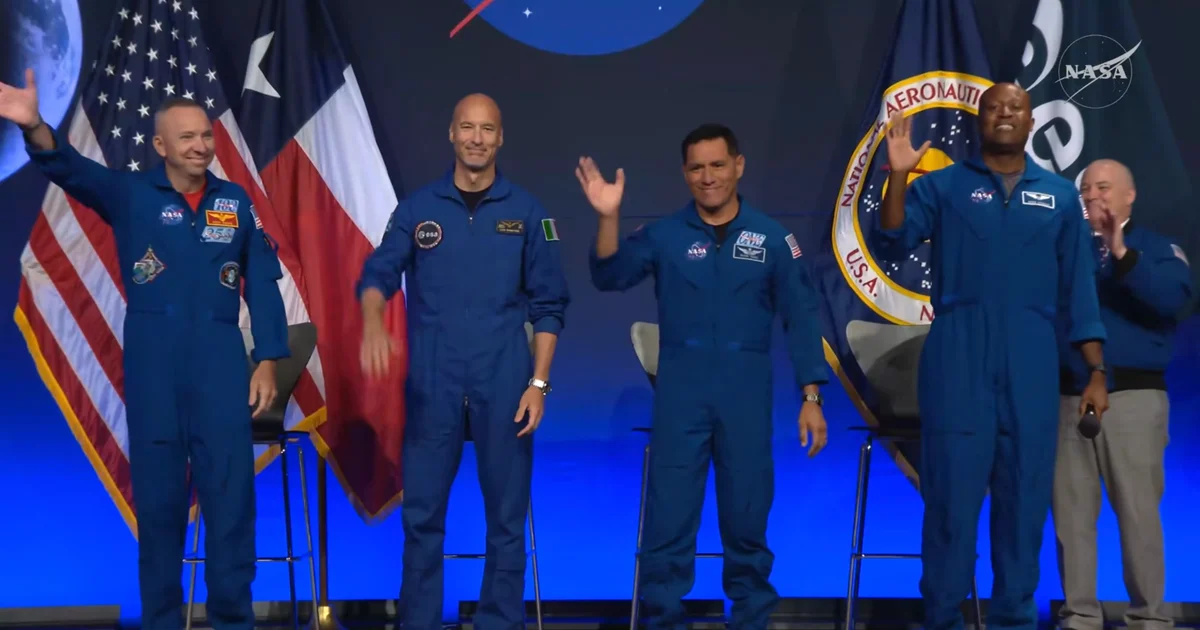
NASA has announced the four astronauts selected for the Artemis III mission, a pivotal crewed flight designed to test rendezvous and docking maneuvers with future lunar landers in Earth orbit. This mission sets the stage for NASA’s goal of returning astronauts to the moon’s surface by 2028.
What Happened
On June 9, 2026, NASA introduced the Artemis III crew at a press event at the Johnson Space Center in Houston. The mission, slated for launch next year, will focus on testing critical docking procedures with moon landers developed by commercial partners SpaceX and Blue Origin. The crew will launch aboard NASA’s Space Launch System rocket in an Orion capsule, conducting a high-stakes mission preceding any lunar landing attempt.
Key Facts
- The Artemis III crew consists of Commander Randy Bresnik, Pilot Luca Parmitano, and mission specialists Frank Rubio and Andre Douglas.
- Backup astronaut Bob Hines was also named.
- The mission aims to validate complex multi-vehicle operations and docking processes in Earth orbit before lunar orbit rendezvous in future missions.
- Commercial partners SpaceX and Blue Origin are developing the lunar landers critical for the mission.
- Artemis III parallels the Apollo 9 mission, which tested lunar module operations in orbit before the first moon landing in 1969.
Why It Matters
This mission is a crucial technical milestone in NASA’s Artemis program, directly impacting the feasibility and safety of a human moon landing planned for 2028. Successfully demonstrating docking with lunar landers in orbit will reduce risk in subsequent missions and pave the way for sustainable lunar exploration.
Background
Artemis III follows Artemis II, which completed a successful crewed flight around the moon earlier in 2026. NASA’s broader goal is to establish a long-term human presence on the lunar south pole by 2029–2030, leveraging lunar resources and enabling scientific research. The Artemis program seeks to maintain U.S. leadership in space exploration amid growing competition, particularly from China.
Analysis
The Artemis III mission involves significant coordination among NASA and its commercial partners to execute multiple launches and tightly scripted maneuvers in space. Challenges include timing launches in sequence and ensuring hardware compatibility across different contractors. Delays in readiness of lunar landers due to recent setbacks, such as Blue Origin’s launch pad explosion and ongoing SpaceX Starship development issues, could impact mission schedules but NASA plans adaptive mission options if needed.
Who Is Affected
The success of Artemis III is critical for NASA, its commercial partners, and the broader space exploration community. Astronauts and mission teams face rigorous training and high operational demands. The mission also has implications for global space leadership and future lunar economy development.
Reactions / Official Statements
Commander Randy Bresnik expressed humility and pride as the crew “being the unifying link” between previous and future Artemis missions. Other astronauts highlighted the honor and tough sacrifices involved in spaceflight. NASA officials emphasized that Artemis III’s data will inform all subsequent Artemis missions and help manage mission risks.
What Remains Unclear
The exact timeline for the readiness of the commercial lunar landers remains uncertain. Whether Blue Origin and SpaceX will have tested and operational lunar landers in time for Artemis III is pending, given recent technical and launch pad setbacks. NASA’s contingency plans will determine mission adjustments if landers are delayed.
What Comes Next
The Artemis III crew will undergo over a year of mission-specific training leading to the planned orbital test flight next year. Following this, NASA aims to proceed with the first human lunar landing under Artemis by 2028, contingent on lander availability and system readiness. Future Artemis missions will develop lunar infrastructure, including a moon base near the south pole, supporting extended human presence.
Sources
This article is based on reporting and publicly available information from the following source:
Read more Space & NASA stories on Goka World News.