
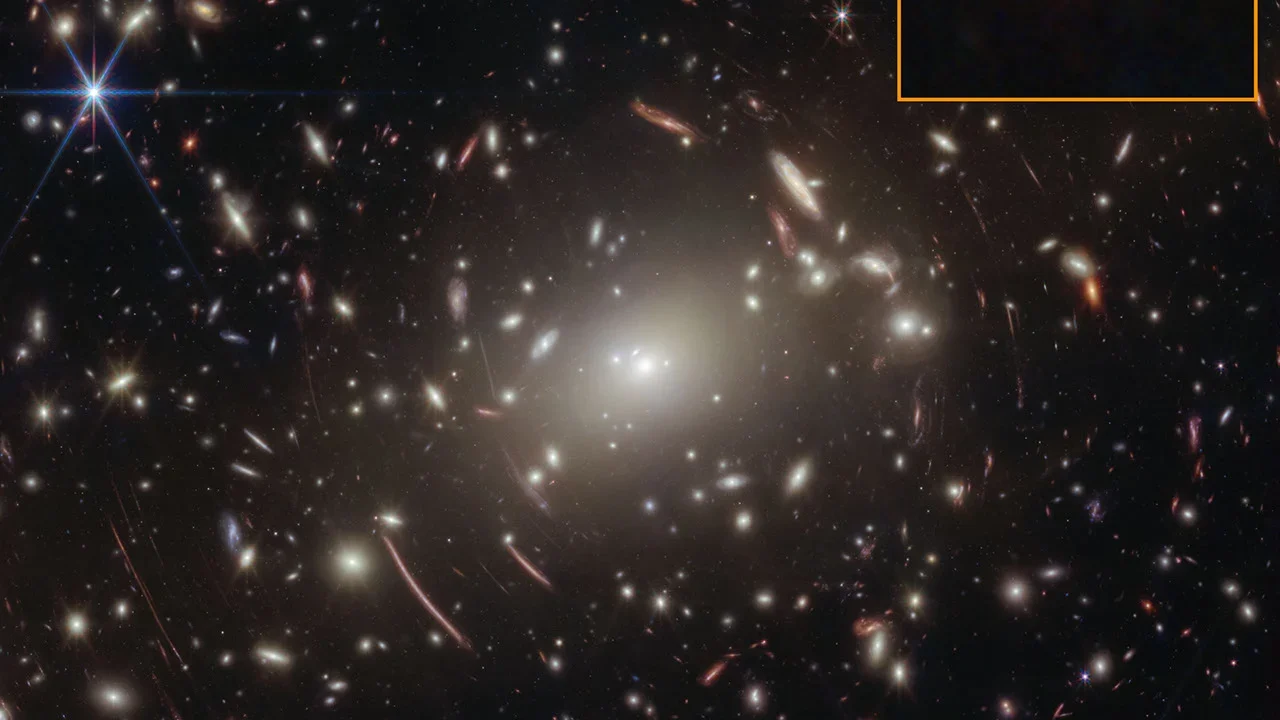
NASA’s James Webb Space Telescope has produced the deepest ever spectral analysis of a faint, distant object known as a “little red dot,” providing the strongest evidence to date that such objects are black hole stars—supermassive black holes surrounded by dense cocoons of gas. This breakthrough advances understanding of mysterious early-universe phenomena first observed by Webb.
What Happened
Astronomers led by Vasily Kokorev at the University of Texas at Austin examined the detailed infrared spectrum of the object GLIMPSE-17775 captured by Webb. This small red dot lies about 1.8 billion years after the big bang and was gravitationally lensed by galaxy cluster Abell S1063, amplifying its light. Webb’s 30-hour spectrum, effectively 80 hours due to lensing, revealed more than 40 spectral lines. The data strongly support the interpretation that GLIMPSE-17775 is a rapidly growing black hole enshrouded in dense, partially ionized gas, consistent with the black hole star (BH*) model.
Key Facts
- GLIMPSE-17775 has a cosmological redshift of 3.5, placing it 1.8 billion years after the big bang.
- Webb’s spectrum includes hydrogen, oxygen, helium, and a complex “iron forest” of 16 iron lines.
- Electron scattering effects in spectral lines indicate a dense, layered gas cocoon around the object.
- The object’s faint X-ray emission aligns with the BH* model, suggesting absorption by surrounding gas.
- Complementary Hubble Space Telescope data show a massive host galaxy, which contributes blue light and explains weaker than usual Balmer breaks.
Why It Matters
This discovery addresses the nature of “little red dots,” mysterious sources from the early universe first detected by Webb in 2022. Confirming these as black hole stars provides crucial insights into black hole growth and galaxy evolution during cosmic dawn. It resolves debates about how early black holes acquire mass and how early galaxies emit light, fitting well within existing cosmological models.
Background
Since Webb’s early science operations, little red dots have posed an enigma: faint, abundant red objects from roughly 600 million years after the big bang, with poorly understood origins. Competing theories existed, but none fully explained all observed features. The black hole star hypothesis suggests these objects are black holes cloaked in gas, reprocessing intense radiation into distinctive spectral signatures.
Analysis
The detailed spectrum of GLIMPSE-17775 reveals multiple independent clues confirming the BH* scenario. The “iron forest” spectrum and electron scattering effects cannot be replicated by simpler gas cloud models. Helium absorption and fluorescence indicate dense gas layers. These spectral fingerprints converge to present a self-consistent picture of a supermassive black hole actively accreting matter and embedded in a thick gas envelope that absorbs much of its high-energy output.
Who Is Affected
This discovery primarily impacts astronomers and cosmologists studying black hole formation, early galaxy evolution, and the epoch of reionization. It also informs models used by space agencies and observatories interpreting high-redshift universe observations.
Reactions / Official Statements
Lead scientist Vasily Kokorev expressed optimism about the convergence of evidence supporting black hole stars and looked forward to future observations that may definitively determine the power sources of these objects. NASA highlights Webb’s unprecedented infrared sensitivity combined with gravitational lensing as key to this advance.
What Remains Unclear
This information was not confirmed in the reviewed sources.
What Comes Next
The research team plans to conduct even deeper studies of similar objects to further test the black hole star model and investigate alternative theories. Ongoing observations by Webb and complementary telescopes may soon provide a definitive explanation for the nature and evolution of little red dots.
Sources
This article is based on reporting and publicly available information from the following source:
Read more Space & NASA stories on Goka World News.