
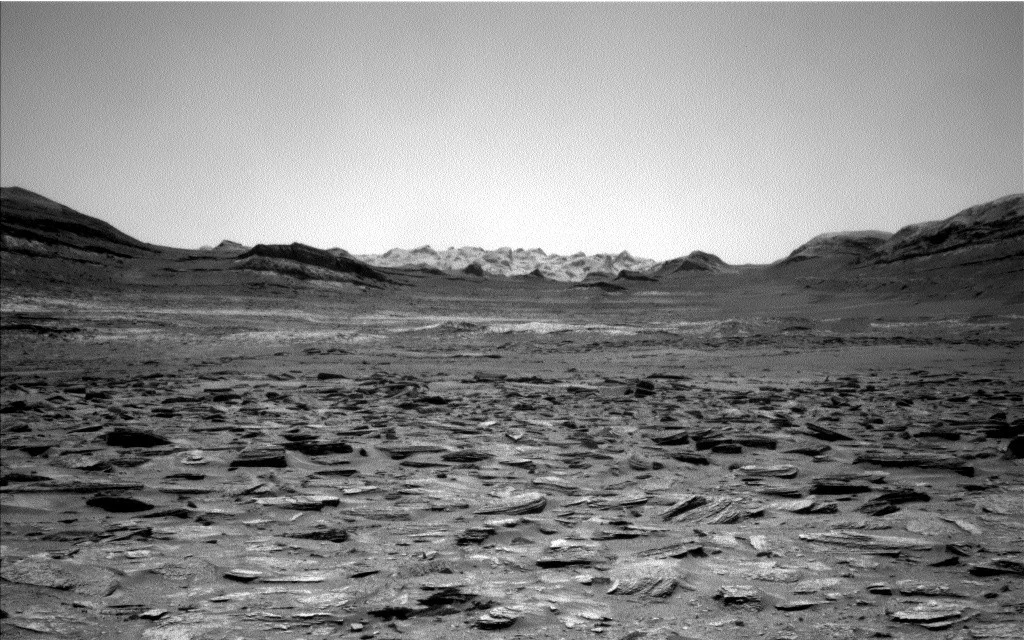
NASA’s Curiosity rover is currently traversing Gale Crater on Mars, heading toward an intriguing geological feature called the Yardang unit. Over the week of sols 4913 to 4919 (early June 2026 Earth time), the rover has been conducting scientific analyses and environmental observations while navigating this diverse terrain, according to the Mars Science Laboratory Mission Team.
What Happened
The Curiosity rover team reported that after completing its previous focused science campaign on a boxwork feature, the rover entered a more exploratory phase. It is driving toward the Yardang unit, a series of wind-sculpted, pale-colored hills visible in distant images. The rover has been traveling southward over varied laminated bedrock with alternating pale and dark layers while characterizing rock samples using onboard instruments. The drive incorporates stops to examine sites of interest and conduct scientific investigations.
Key Facts
- Mission: NASA’s Curiosity Mars Science Laboratory rover
- Period covered: Sols 4913-4919, around June 5, 2026 (Earth time)
- Terrain: Laminated bedrock with pale-colored rocks and interbedded dark layers
- Science targets: “Rio Bio Bio,” “Placilla de Caracoles” (dark materials), “La Primavera,” and “Los Quemados” (pale materials)
- Instruments used: Alpha Particle X-ray Spectrometer (APXS), Mars Hand Lens Imager (MAHLI), Chemistry and Camera complex (ChemCam), Mast Camera (Mastcam), ChemCam’s Long Distance Remote Micro Imager (LD-RMI)
- Environmental activities: Monitoring dust devils and atmospheric dust levels within Gale Crater
- Upcoming planned drive: Toward areas showing increased contrast between rock types and smooth surface regions
Why It Matters
This phase of Curiosity’s journey emphasizes planetary exploration between defined campaigns, allowing scientists to observe varied geological features and better understand Mars’ sedimentary history. Investigating the Yardang unit offers insight into erosional processes shaped by wind and possibly water activity, contributing vital data about Mars’ past environments and climate.
Background
The Yardang unit represents a new target following the completion of the previous boxwork campaign, during which the rover meticulously studied mineral features within Gale Crater. The current exploratory drive builds on Curiosity’s broader mission to analyze the composition and history of Mars’ surface, having explored diverse rock formations since its 2012 landing.
Analysis
The mission team members highlighted the contrast between the disciplined, campaign-focused science work and the more open-ended exploring style now underway. Catherine O’Connell-Cooper, APXS strategic planner and uplink/downlink lead, described the driving toward the Yardang unit as embodying the excitement of planetary exploration, offering opportunities to discover unexpected geological features. The team continues to use imaging and compositional instruments to characterize materials and sedimentary structures, aiming to distinguish between desert and lacustrine depositional environments.
Who Is Affected
This mission’s findings benefit the planetary science community by providing detailed geological and environmental data from Gale Crater, informing future Mars exploration strategies. NASA, researchers worldwide, and ultimately humanity’s understanding of Mars’ habitability and history are impacted by Curiosity’s ongoing work.
What Remains Unclear
- The precise nature of the smooth terrain area beyond the Yardang unit remains unknown.
- Further data analysis is required to determine the exact depositional environment represented by the sedimentary structures observed.
- Assessment of any new geological features discovered during the upcoming drives is pending.
What Comes Next
Curiosity’s upcoming drive will advance further into the Yardang unit region, focusing on contrasting rock layers and smoother bedrock areas. Continued environmental monitoring and combined instrument analyses are planned to build a comprehensive picture of the region’s geological and climatic history.
Sources
This article is based on reporting and publicly available information from the following source:
Read more Space & NASA stories on Goka World News.