
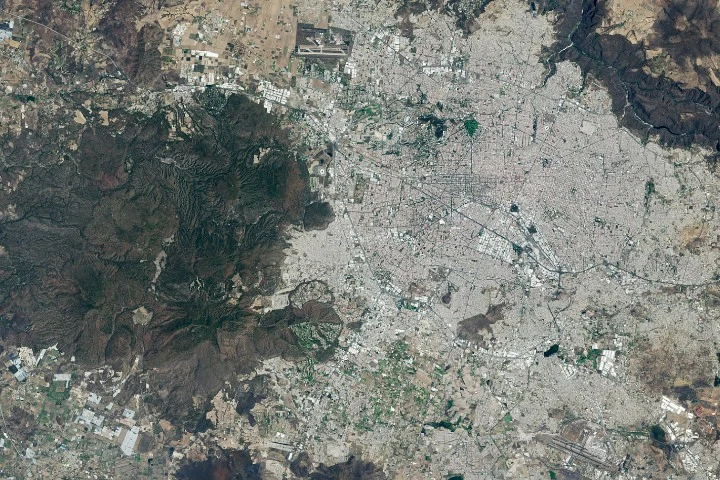
NASA’s Earth Observatory has captured dramatic satellite images revealing how Guadalajara, Mexico, has transformed over four decades ahead of its role as a host city for the 2026 FIFA World Cup. The images contrast the city’s landscape from 1986, when it last hosted World Cup matches, to 2026, highlighting urban growth around volcanic terrain and the modern Guadalajara Stadium.
What Happened
Guadalajara hosted the opening round of the 2026 FIFA World Cup matches in June 2026, including the game between South Korea and Czechia at Guadalajara Stadium, also known as Estadio Akron. This event marked the city’s third time hosting World Cup games, the first being in 1970 and then 1986. The 2026 matches took place in Zapopan, a rapidly growing municipality adjacent to Guadalajara, where the stadium was built in 2010 to host Club Deportivo Guadalajara’s home games.
Key Facts
- The Guadalajara metro population has grown from approximately 2.7 million in 1986 to over 5.5 million in 2026.
- Guadalajara Stadium (Estadio Akron) is located near the Sierra la Primavera volcanic complex, featuring lava domes and volcanic formations.
- The stadium’s design was inspired by the volcanic landscape, with a grassy berm mimicking a volcano’s flanks and a white roof resembling a volcanic cloud.
- The volcanic caldera near the stadium measures about 11 kilometers (7 miles) in diameter, formed roughly 95,000 years ago.
- Zapopan hosts Guadalajara Technology Park, a major industrial and technology hub visible in satellite imagery.
- Four group stage matches were scheduled in Guadalajara during the 2026 tournament, including Mexico vs. South Korea on June 18 and Uruguay vs. Spain on June 26.
Why It Matters
The shifting urban landscape around volcanic features reflects Guadalajara’s rapid development and economic growth, particularly in technology sectors. The NASA images provide a visual story of human expansion amid geological heritage, emphasizing how modern infrastructure like the Guadalajara Stadium integrates with natural terrain. The city’s multiple World Cup hostings illustrate its importance as a cultural and sporting hub in Mexico and globally.
Background
Guadalajara previously hosted World Cup matches in 1970 and 1986. In 1986, matches took place mostly at Jalisco Stadium, northeast of Guadalajara, including the historic France vs. Brazil quarterfinal. The Guadalajara Stadium in Zapopan was not yet built at that time and was constructed decades later, opening in 2010. The volcanic complex Sierra la Primavera has shaped the region for tens of thousands of years with eruptions creating domes and calderas now preserved as the La Primavera Biosphere Reserve.
Analysis
According to NASA Earth Observatory imagery experts and volcanologists, the stadium’s design intentionally reflects the volcanic history of the area to celebrate natural heritage. The urban growth around the volcanic region, captured in high-resolution satellite data, reveals the encroachment of development onto formerly farmland and natural zones, highlighting challenges and opportunities in balancing expansion with conservation.
Who Is Affected
Residents of the Guadalajara metropolitan area, especially in Zapopan, are directly impacted by urban expansion. The local government and businesses in technology and agriculture sectors are involved in the city’s growth. Additionally, football fans worldwide, players, and organizers involved in the World Cup experience the cultural and sporting significance of the event in this volcanic region.
What Remains Unclear
This information was not confirmed in the reviewed sources.
What Comes Next
Guadalajara continued hosting three additional first-round World Cup matches in June 2026, with ongoing monitoring of urban development and volcanic conservation efforts by local authorities and scientific institutions.
Sources
This article is based on reporting and publicly available information from the following source:
Read more Space & NASA stories on Goka World News.