
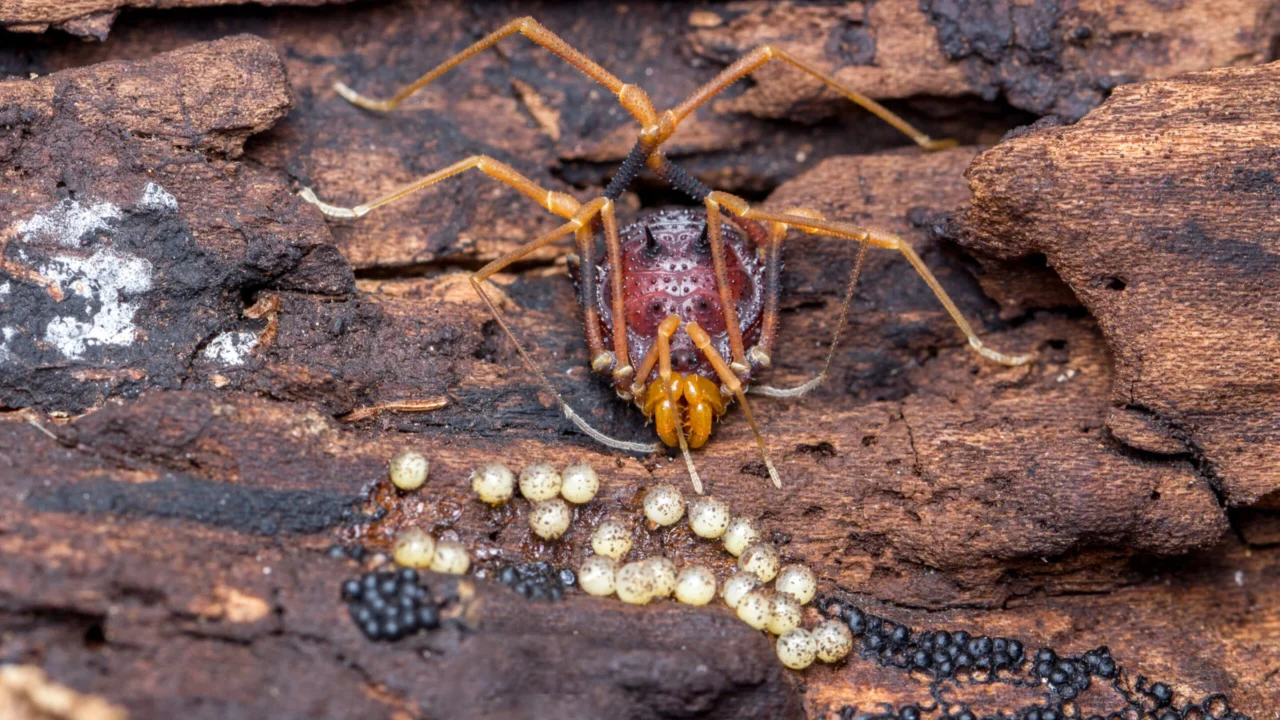
New research led by scientists at the University of São Paulo has uncovered the evolutionary history of parental care in harvestmen spiders by integrating nearly 30 years of field studies with citizen science data from the global platform iNaturalist. This approach more than doubled the number of documented cases of parental guarding behavior in these arachnids, expanding understanding of how maternal and paternal care evolved within the Gonyleptoidea superfamily.
What Happened
The study, published in the Zoological Journal of the Linnean Society in June 2026, combined existing peer-reviewed scientific literature with 62 parental care records collected from iNaturalist—an online database where users submit georeferenced wildlife observations. The team reconstructed the evolutionary patterns of parental guarding behaviors among harvestmen, revealing instances where care behaviors have evolved, disappeared, and reemerged multiple times during the group’s history.
Key Facts
- The research spanned data from 1936 to 2025, originally documenting parental care in 80 harvestmen species.
- The inclusion of iNaturalist data added 62 new records in only two days, more than doubling known cases.
- Harvestmen currently include over 6,900 species globally, representing a large and diverse order of arachnids.
- Parental care evolved independently multiple times, with maternal care arising exclusively from no care, whereas paternal care evolved from both no care and maternal care.
- The findings were published under DOI: 10.1093/zoolinnean/zlag061.
Why It Matters
This research provides a comprehensive view of parental care evolution in harvestmen, a group notable for frequent independent origins of paternal care—a rare trait in the animal kingdom. It offers insight into distinct evolutionary pressures shaping maternal versus paternal care strategies and highlights how sexually selected behaviors may influence paternal care. The study demonstrates the value of citizen science platforms in accelerating biological data collection and broadening research participation globally.
Background
Harvestmen are one of the most diverse arachnid groups and exhibit a variety of parental care behaviors that had previously been insufficiently documented. Paternal care is particularly rare in nature but occurs multiple times in this clade. Citizen science, defined as the public’s voluntary contribution of observations and data to research projects, has previously aided discoveries in areas like bird population monitoring and species rediscovery.
Analysis
Lead author Glauco Machado of the University of São Paulo emphasized the rarity and independent evolution of paternal care in harvestmen. He noted that in species where males care for offspring, this behavior often functions as a sexually selected trait favored by female choice. Machado further highlighted iNaturalist’s role in rapidly expanding data access, overcoming traditional fieldwork and museum visit constraints, which can be costly and time-consuming.
Who Is Affected
The new findings affect researchers studying arachnid evolution, behavioral ecology, and parental care. They also demonstrate how citizen scientists worldwide contribute to biodiversity and behavioral research, facilitating new discoveries especially valuable for scientists in regions with limited resources.
What Remains Unclear
- Sampling bias remains a limitation, as instances of parental care are easier to document than no care, which may skew the dataset.
- Further research is needed to confirm the specific selective pressures and ecological factors driving transitions between care types.
- The study does not yet assess the full global distribution or frequency of these behaviors across all harvestmen species.
What Comes Next
The research team encourages continued use of citizen science platforms like iNaturalist to further fill knowledge gaps across other animal groups exhibiting parental care diversity. Continued taxonomic expertise will be essential to validate species identification and behavioral observations. Prospective studies aim to explore similar evolutionary patterns in insects, amphibians, and other taxa.
Sources
This article is based on reporting and publicly available information from the following source:
Read more Science Discoveries stories on Goka World News.