
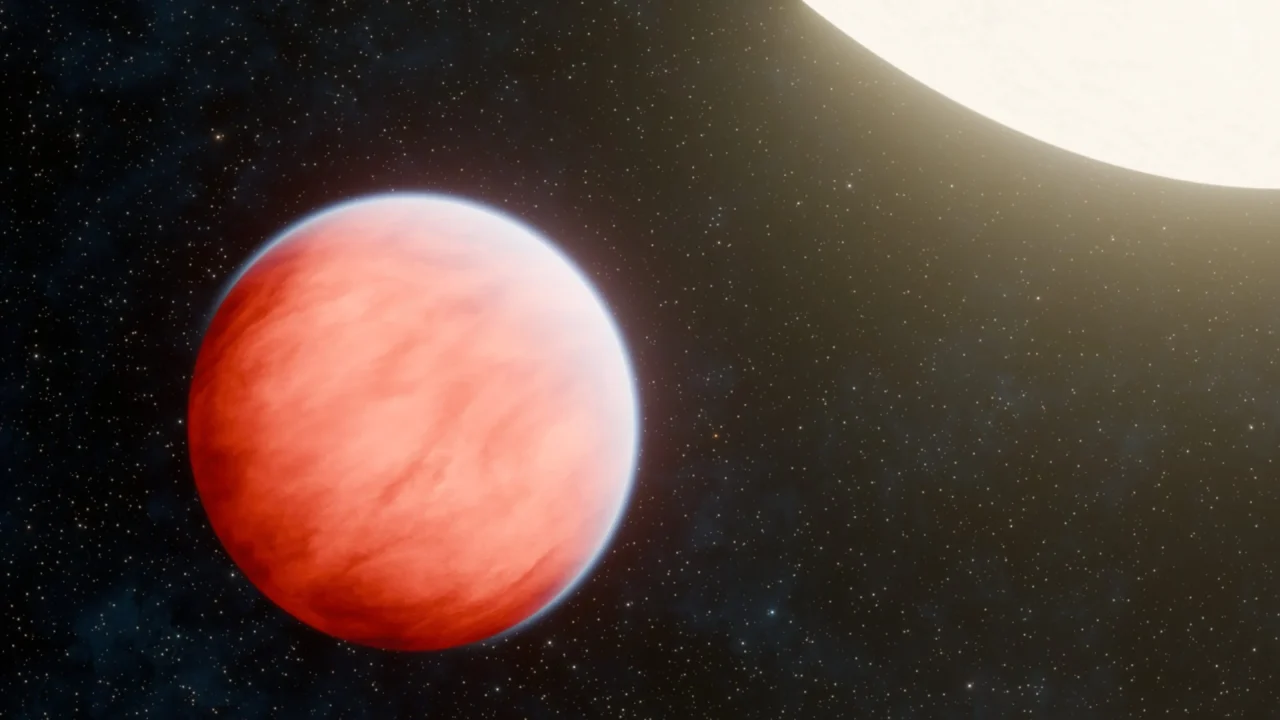
A study led by astronomers at the NASA Exoplanet Science Institute (NExScI) within Caltech’s IPAC science center has revealed that the hot Jupiter exoplanet CoRoT-2 b does not follow the standard tidal locking model expected for such planets. Published in The Astronomical Journal and presented at the 248th American Astronomical Society meeting in Pasadena, this research provides new insights into atmospheric dynamics and rotation of these gas giants.
What Happened
Using new phase-resolved emission spectroscopy from the Very Large Telescope (VLT) at the European Southern Observatory, Aurora Kesseli, a staff scientist at IPAC, and collaborators investigated CoRoT-2 b’s atmospheric properties. Their data support the hypothesis that the planet’s rotational period is slower than its orbital period, meaning it completes fewer rotations than orbits around its host star. This contrasts with the prevailing understanding that hot Jupiters are tidally locked, always showing the same face to their stars.
Key Facts
- CoRoT-2 b’s rotation period is approximately three Earth days.
- Its orbital period is about 1.5 Earth days, meaning it orbits its star twice for every single rotation.
- Data were collected using phase-resolved emission spectroscopy with VLT’s CRIRES+ and Gemini-South’s IGRINS instruments.
- The findings challenge the assumption that close-in gas giants are tidally locked due to gravitational interactions with their host stars.
- Research led by Aurora Kesseli was published in The Astronomical Journal in 2026 and was presented at the AAS meeting in Pasadena, California.
Why It Matters
The discovery that CoRoT-2 b rotates slower than it orbits its star has important implications for exoplanet atmospheric modeling and heat distribution. Many climate models for hot Jupiters assume tidal locking, which influences atmospheric circulation, temperature gradients, and potential magnetic field interactions. This new rotational dynamic indicates that planetary rotation can vary, impacting observed atmospheric “hot spots” that do not align with previous expectations.
Background
Hot Jupiters are gas giants that orbit very close to their stars, typically within a period of 1 to 10 days. Due to tidal forces, these planets have been widely assumed to be tidally locked, similar to how Earth’s moon always shows the same side to Earth. Previous work, such as that by collaborator Lisa Dang in 2018, had identified the unusual eastward-shifted hot spot on CoRoT-2 b and proposed three hypotheses: cloud cover effects, magnetic interactions, or asynchronous rotation.
Analysis
Aurora Kesseli used spectroscopic velocity measurements and calculations to favor the asynchronous rotation hypothesis. She noted, “Seeing the data pretty clearly pointing toward one of them was just really exciting.” The results underscore that different hot Jupiters may not fit a single model, thus necessitating refinements to climate simulations and assumptions about tidal locking in such environments.
Who Is Affected
The findings primarily affect astronomers and planetary scientists modeling exoplanet atmospheres and dynamics. Understanding the rotation and heat distribution on hot Jupiters also informs studies of planetary habitability around M dwarf stars where tidal locking can influence climate dramatically.
What Remains Unclear
- The specific reason why CoRoT-2 b rotates more slowly than expected remains unknown.
- Further spectroscopic data across more exoplanets is needed to determine whether asynchronous rotation is widespread among hot Jupiters.
- The roles of magnetic fields and atmospheric clouds in affecting the observed thermal patterns are still under study.
What Comes Next
Researchers anticipate using upcoming facilities such as the Habitable Worlds Observatory and the Extremely Large Telescope to conduct more in-depth atmospheric measurements on hot Jupiters and potentially habitable exoplanets. This next generation of telescopes aims to refine models by expanding the sample of well-characterized exoplanets.
Sources
This article is based on reporting and publicly available information from the following source:
Read more Science Discoveries stories on Goka World News.