
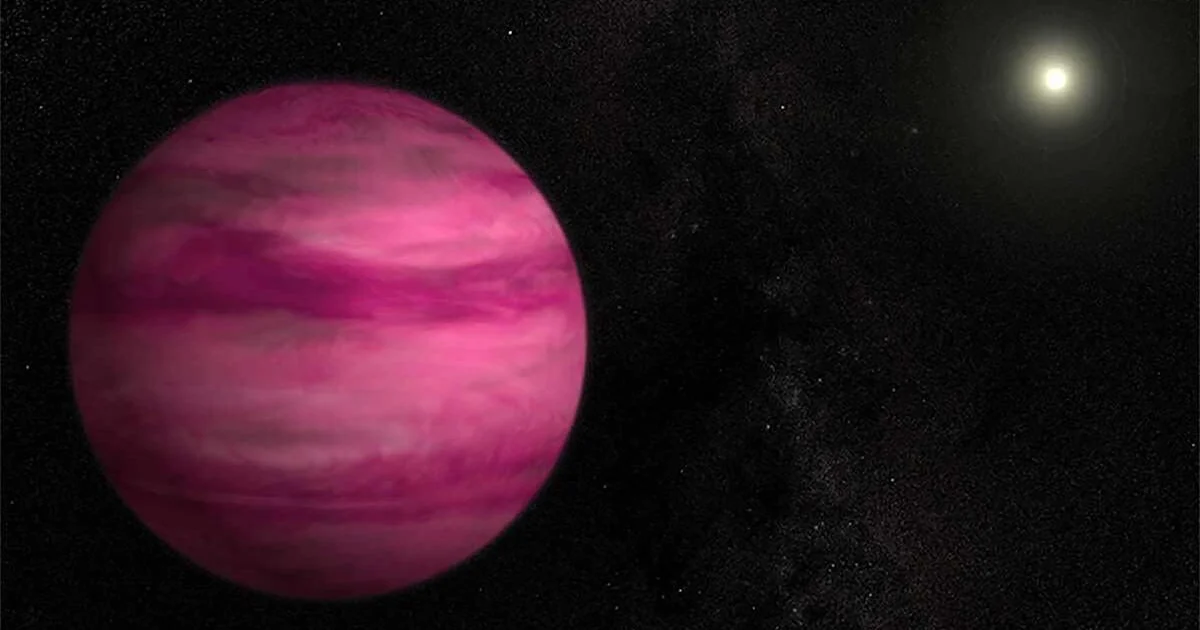
Astronomers from Northwestern University have uncovered an unusual atmospheric feature on GJ504b, popularly known as the “Pink Planet.” Using NASA’s James Webb Space Telescope, researchers identified clouds composed of salt enveloping this planetary-mass companion, an unexpected discovery in the study of extraterrestrial atmospheres.
What Happened
GJ504b, located approximately 57 light-years from Earth, was observed with the James Webb Space Telescope in a successful two-hour session. The observations took place recently and were led by Aneesh Baburaj, a postdoctoral associate at Northwestern’s Center for Interdisciplinary Exploration and Research in Astrophysics. The team analyzed the infrared light spectrum from GJ504b to detect chemical signatures within its atmosphere. This analysis revealed the presence of water vapor, methane, carbon dioxide, ammonia, and notably, salt clouds—an atmospheric component not previously confirmed in such environments.
Key Facts
The so-called Pink Planet, discovered in 2013, is classified as a planetary-mass companion rather than a typical planet, as it might also be a small brown dwarf. The object orbits a sun-like star and has a surface temperature near 550 degrees Fahrenheit, cooler than typical giant exoplanets whose temperatures range from 1,000 to 2,000 degrees Fahrenheit. GJ504b is estimated to have 25 times the mass of Jupiter and be between 2.5 and 4 billion years old, which accounts for its relatively lower temperature. This cooler temperature made detecting its atmosphere challenging prior to the Webb telescope’s infrared capabilities. The detection of salt clouds provides important insights into atmospheric processes in intermediate-temperature planetary bodies.
What This Means
This discovery expands our understanding of planetary atmospheres, especially in temperature ranges where traditional cloud compositions do not apply. On Earth, clouds consist of water vapor, while cooler gas giants like Jupiter have ammonia clouds, and hotter planets can have clouds made of silicates. GJ504b’s salt clouds demonstrate a transitional atmospheric chemistry where conditions are too hot for water or ammonia clouds yet too cool for silicate ones. This finding illustrates how diverse planetary atmospheres can be and highlights the remarkable sensitivity of the James Webb Space Telescope to detect such faint and cold atmospheric phenomena. It opens the door for further studies on similar substellar objects, potentially informing models of planetary formation and evolution.
Background
Prior attempts by various observatories to analyze GJ504b’s atmosphere were unsuccessful due to its faint light and cooler temperature. The James Webb Space Telescope’s infrared imaging and spectrometry capabilities finally allowed astronomers to study the planet’s atmospheric composition in detail. Published in The Astronomical Journal, these results mark a significant milestone in exoplanetary atmospheric research.
Sources
This article is based on reporting and publicly available information from the following source:
Read more Space & NASA stories on Goka World News.