
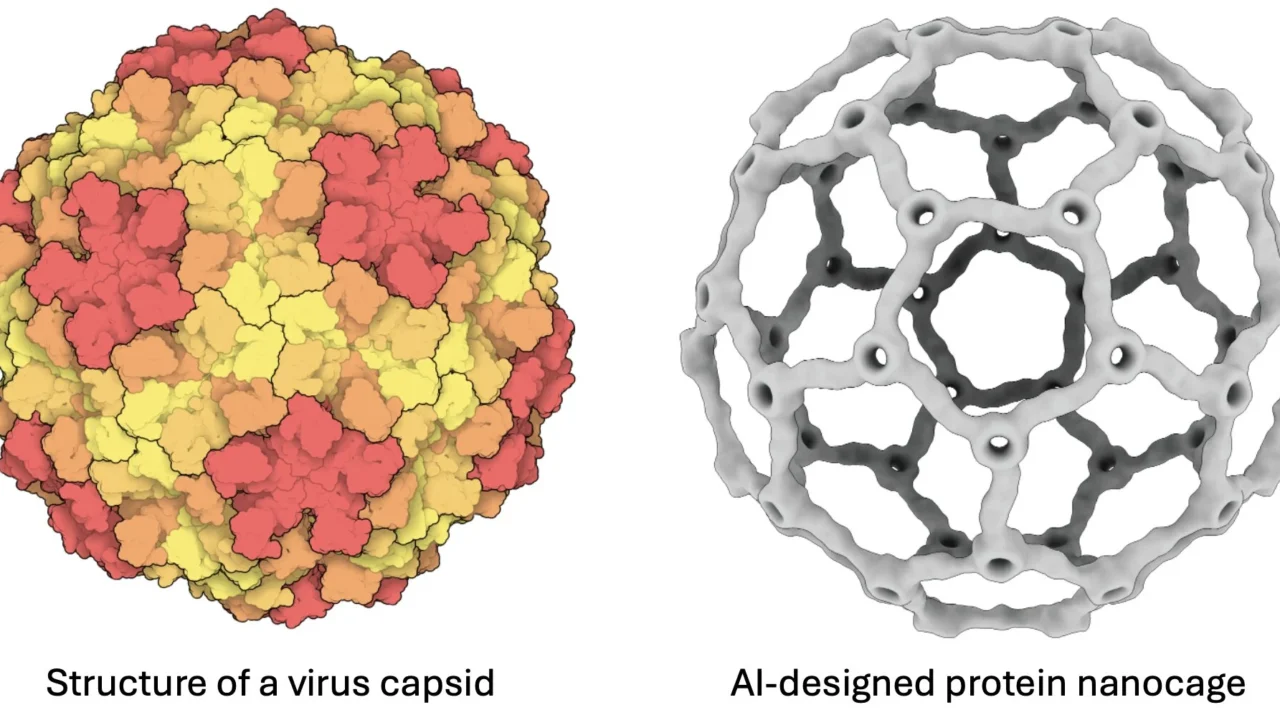
An international team led by Professor Sangmin Lee of Pohang University of Science and Technology (POSTECH) has used artificial intelligence to design single-component proteins capable of self-assembling into large, virus-like shells. This development replicates the natural quasisymmetric principle observed in viral structures, enabling advances in biomedical delivery systems.
What Happened
The research, published in the journal Nature, describes how the team engineered a single protein component to occupy both pentagonal and hexagonal configurations within a nanocage assembly. Using RFdiffusion, an AI-driven protein structure design tool, they created trimeric units—the building blocks—that assemble into dome-shaped shells ranging from 70 to 220 nanometers in diameter. These artificial proteins were produced with Escherichia coli and imaged using cryo-electron microscopy, confirming they self-assembled into spherical structures similar to natural viruses.
Key Facts
The structures generated by the team measured between 70 nm, resembling intricate “nano-soccer balls,” and up to 220 nm, more than three times larger. The design principle successfully balanced the curvature and angular relationships between protein subunits to close these large shells, a challenge unmet by prior computational methods relying on perfect symmetry. This quasisymmetric approach mimics natural viruses, where repeated protein units adjust locally to form expansive shells. Professor David Baker of the University of Washington, a Nobel laureate in Chemistry, collaborated on the project.
What This Means
This achievement marks a significant step in translating the structural complexity of viruses into customizable nanomaterials for medical use. Virus-like protein nanocages have potential as highly stable carriers capable of packing drugs, enzymes, or genetic material inside while displaying antigens on their surfaces for vaccine development. Unlike earlier methods limited to smaller or less complex structures, the AI-designed quasisymmetric proteins provide a template for large, controllable assemblies formed from a single protein type.
The ability to engineer both pentagonal and hexagonal arrangements within the same protein component introduces new flexibility in designing molecular containers, improving targeting precision and cargo capacity. Clinically, such platforms could enhance the stability and delivery efficiency of therapeutics, particularly for genetic medicines and next-generation vaccines.
Background
Previous protein nanocage designs depended mostly on computational models enforcing perfect symmetry, restricting achievable sizes and shapes. Natural viruses use quasisymmetry—a nuanced symmetry where identical proteins occupy slightly different local environments—to build expansive protective shells. This study is among the first to emulate that mechanism with fully artificial proteins, moving beyond repurposing viral proteins.
What Comes Next
The researchers plan to refine the size uniformity of these assemblies by incorporating internal scaffolds or nucleic acid templates. Additionally, a related study co-authored by Professor Lee and led by Professor Baker, published simultaneously in Nature, explores two-component quasisymmetric protein cages, further expanding the design possibilities for protein-based nanostructures.
Sources
This article is based on reporting and publicly available information from the following source:
Read more Science Discoveries stories on Goka World News.