
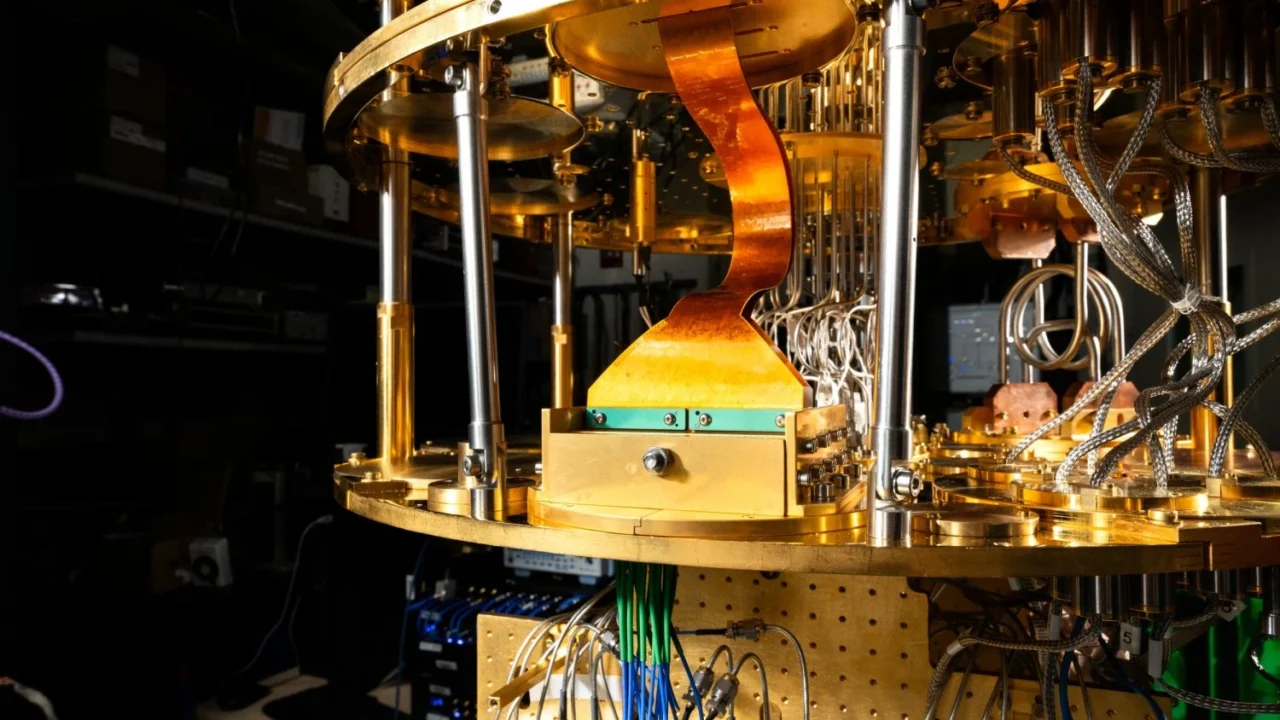
Researchers at MIT Lincoln Laboratory have developed flexible, ribbon-like cryogenic cables designed to operate at ultra-low temperatures essential for quantum computing hardware. Licensed by Maybell Quantum, these cables promise to simplify and improve the wiring infrastructure critical for stabilizing and scaling quantum systems.
What Happened
Quantum computers rely on superconducting qubits maintained at cryogenic temperatures near 5 to 10 millikelvins, colder than temperatures in space, requiring specialized wiring to transmit signals without introducing heat or noise. MIT Lincoln Laboratory’s team prototyped flexible, low-frequency ribbon cables that address these demands by supporting direct-current operation and high-speed signals while fitting within compact hardware setups.
Maybell Quantum, a Colorado-based quantum hardware supplier, licensed this design and is integrating it into their dilution refrigerators—the apparatus used for cooling quantum systems. The cables will initially serve functions such as thermometry, sensors, and heaters across all thermal stages of the refrigerators, with ongoing testing for broader applications within Maybell’s product line.
Key Facts
The cable design uses a stripline configuration—conductive layers embedded within flexible polymer layers—to shield against electromagnetic interference and maintain signal integrity. Unlike traditional coaxial cables, which are bulky and generate heat, this ribbon format is mechanically robust, easier to install, and compatible with commercial printed circuit board manufacturing, making it cheaper and scalable.
The research team published their findings as part of ongoing efforts under the Lincoln Laboratory Quantum-Enabled Computation Group, with John Cummings as a principal investigator on the project. Maybell Quantum officials, including CTO Kyle Thompson and operations lead Lasse Nielsen, emphasized the cables’ promise for accelerating industrial quantum computing development by enabling more reliable and scalable interconnects.
What This Means
This advancement tackles a critical bottleneck in quantum computer hardware: managing the wiring needed to maintain ultra-cold, noise-free environments for qubits. By providing a flexible, low-heat alternative to coaxial cables, these ribbonized cables reduce installation complexity and heat load—two major challenges in quantum system assembly and scalability.
For the broader quantum computing field, this development could lower costs and enhance production repeatability, allowing manufacturers to move from specialized lab setups to industrial-scale, modular quantum systems. Such hardware progress is necessary for quantum computers to realize their potential across scientific research, cybersecurity, finance, and medicine, where complex computations at unprecedented speeds could become routine.
Background
Quantum computing’s reliance on superconducting qubits necessitates dilution refrigerators to achieve millikelvin temperatures. Traditional coaxial wiring, essential for signal transmission, introduces heat and spatial inefficiencies that limit the growth of qubit arrays. The flexible stripline cable design addresses these constraints by enhancing electromagnetic shielding and minimizing thermal impact.
What Comes Next
Maybell Quantum plans to complete qualification testing before deploying the flexible cables across its entire product family. Further research will explore additional cable functions beyond low-frequency services, with the goal of integrating these cables into future quantum computing hardware to support large-scale chip arrays reliably.
Sources
This article is based on reporting and publicly available information from the following source:
Read more Science & Technology stories on Goka World News.