
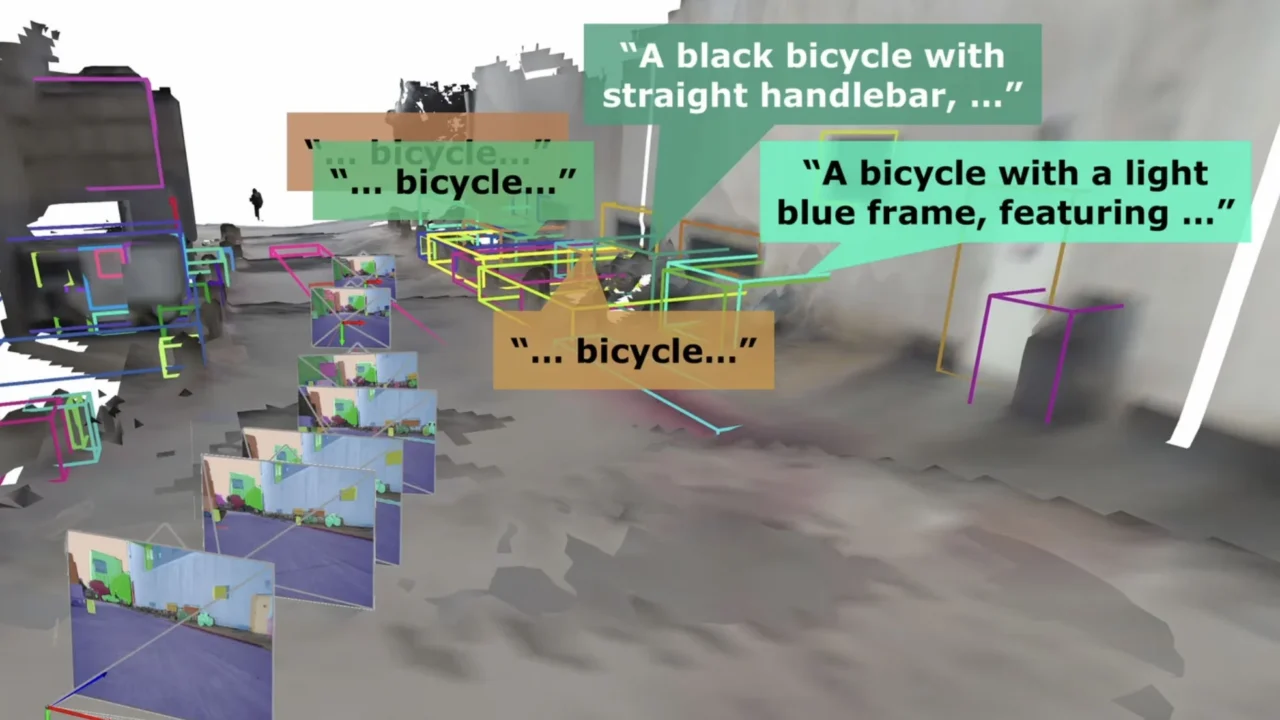
Researchers at the Massachusetts Institute of Technology (MIT) have developed a new long-term memory framework designed to enable robots to form and retrieve detailed mental models of their environments quickly and accurately. This advance could empower robots to assist humans in complex settings by answering questions about locations and objects previously encountered.
What Happened
The team led by Luca Carlone, an associate professor in MIT’s Department of Aeronautics and Astronautics and currently an Amazon Scholar, announced this framework after presenting it at the Conference on Computer Vision and Pattern Recognition (CVPR). The system, called Describe Anything, Anywhere, Anytime, at Any Moment (DAAAM), integrates detailed object descriptions into 3D maps to create a spatiotemporal memory that robots can access in real time. This method combines advances in computer vision and robotic mapping, allowing a robot to attach rich, aggregated descriptions to objects as it moves through its environment. The system can answer complex queries such as locating a particular item or describing features of the environment within seconds, outperforming existing techniques by 21 to 53 percent in accuracy depending on the question.
Key Facts
DAAAM builds a 3D spatial map enriched with linguistic annotations of objects, which are clustered into regions reflecting their physical locations. The method optimizes frame selection to speed up annotation, enabling real-time operation in large-scale environments. The framework leverages large language models combined with semantic search tools to reduce errors and hallucinations in responses. Funded partly by the U.S. Army Research Laboratory and the Office of Naval Research, the system has demonstrated potential uses in industrial robotics, augmented reality for maintenance, and navigation assistance.
What This Means
This development marks a significant step toward robots that better understand and interact with complex, changing human environments through natural language queries. By bridging spatial mapping with detailed, retrievable object information, robots could efficiently assist workers by locating items or guiding tasks without extensive human programming. In industrial settings, it could reduce manual labor and improve productivity by enabling robotic helpers to recall prior work locations or equipment conditions. Additionally, applications in augmented reality could provide enhanced situational awareness for maintenance personnel and commuters, offering contextual real-world information on demand.
For everyday users, such a memory system hints at future domestic or commercial robots capable of recalling where personal belongings like keys or wallets were last seen, enhancing convenience and reducing time spent searching. This convergence of AI, robotics, and language understanding could redefine human-robot collaboration in both professional and personal domains.
Background
Traditional robotic mapping systems create 3D spatial representations but lack rich descriptive detail or operate too slowly for real-time applications. Meanwhile, modern vision-based systems provide object descriptions but typically analyze one annotation at a time, limiting scalability. DAAAM’s innovation lies in combining these approaches for efficient, large-scale, and linguistically accessible spatiotemporal memory aimed at real-world environments.
What Remains Unclear
The precise extent to which DAAAM can incorporate and recall dynamic events over long periods remains under development. The researchers also plan to integrate confidence metrics in the system’s responses to improve reliability. The timeline for commercial applications or integration into widely deployed robotic platforms has not been disclosed.
Sources
This article is based on reporting and publicly available information from the following source:
Read more Science & Technology stories on Goka World News.