
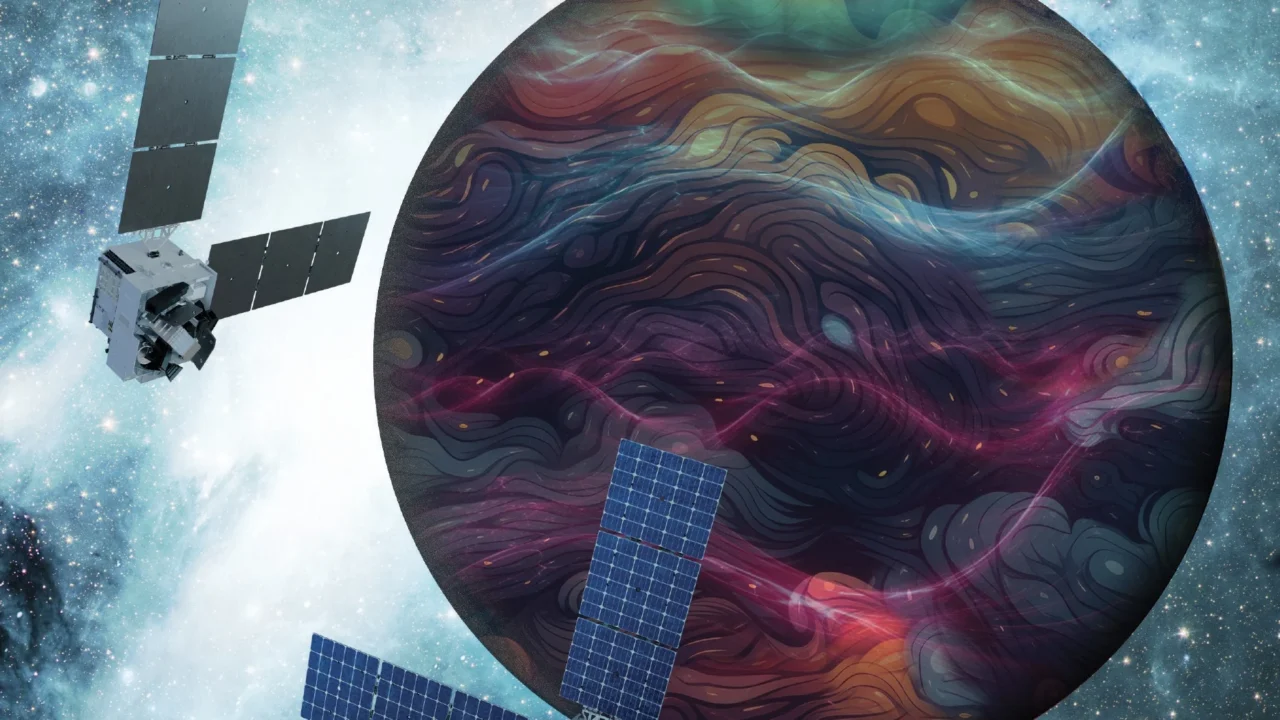
NASA has selected the Dynamic Atmosphere-Ionosphere Explorer (DAPHNE) mission to advance research into how space weather and Earth’s atmospheric dynamics shape the near-Earth space environment. This mission aims to improve forecasting of space weather effects on vital technologies like GPS and low Earth orbit satellites, as well as on astronauts operating beyond Earth’s magnetic protection.
What Happened
DAPHNE recently entered Phase B of development, during which NASA will focus on detailed planning and design for the mission’s flight hardware and operations. The mission will deploy twin identical satellites tasked with studying how fluctuations in the lower atmosphere influence the upper atmosphere — specifically the thermosphere and ionosphere where space weather phenomena become apparent. The mission concept is led by Aimee Merkel from the University of Colorado Boulder’s Laboratory for Atmospheric and Space Physics.
Key Facts
The twin satellites will carry instruments to measure neutral winds, temperature, and atmospheric composition within the thermosphere—a region marking the transition from Earth’s neutral atmosphere to the ionized plasma of space. These coordinated measurements will provide multi-point data essential for understanding interactions between solar activity and atmospheric dynamics.
DAPHNE’s mission launch is planned for no earlier than 2029, pending a confirmation review slated for 2027 that will evaluate mission progress and funding status. Excluding launch costs, the total mission budget is projected not to exceed $250 million (in fiscal year 2023 dollars). NASA’s Solar Terrestrial Probes program at Goddard Space Flight Center oversees funding and management.
What This Means
This mission represents a critical step in enhancing space weather prediction capabilities that directly affect everyday technology and safety in space exploration. By linking changes in Earth’s lower atmosphere to the conditions high above, DAPHNE will improve understanding of the physical processes behind space weather impacts. This is especially vital as NASA prepares for manned missions beyond Earth’s magnetic shield to the Moon, Mars, and beyond, where astronauts face increased exposure to solar and cosmic radiation.
More accurate predictions enabled by DAPHNE could help protect satellites that underpin global communications, navigation, and weather forecasting. For the broader public, this means enhanced reliability of GPS services and satellite-dependent infrastructure, minimizing disruptions caused by space weather events, which can affect everything from smartphones to power grids.
Background
DAPHNE was proposed in response to NASA’s DYNAMIC mission announcement of opportunity, emphasizing the coupling of the neutral atmosphere and ionosphere. It contributes to NASA’s ongoing heliophysics efforts to study space weather phenomena caused by solar activity and atmospheric dynamics.
What Comes Next
The mission team will continue designing and testing instruments through Phase B. The 2027 confirmation review will determine whether the project proceeds to full development. If approved, DAPHNE will progress toward its targeted launch window starting in 2029.
Sources
This article is based on reporting and publicly available information from the following source:
Read more Space & NASA stories on Goka World News.