
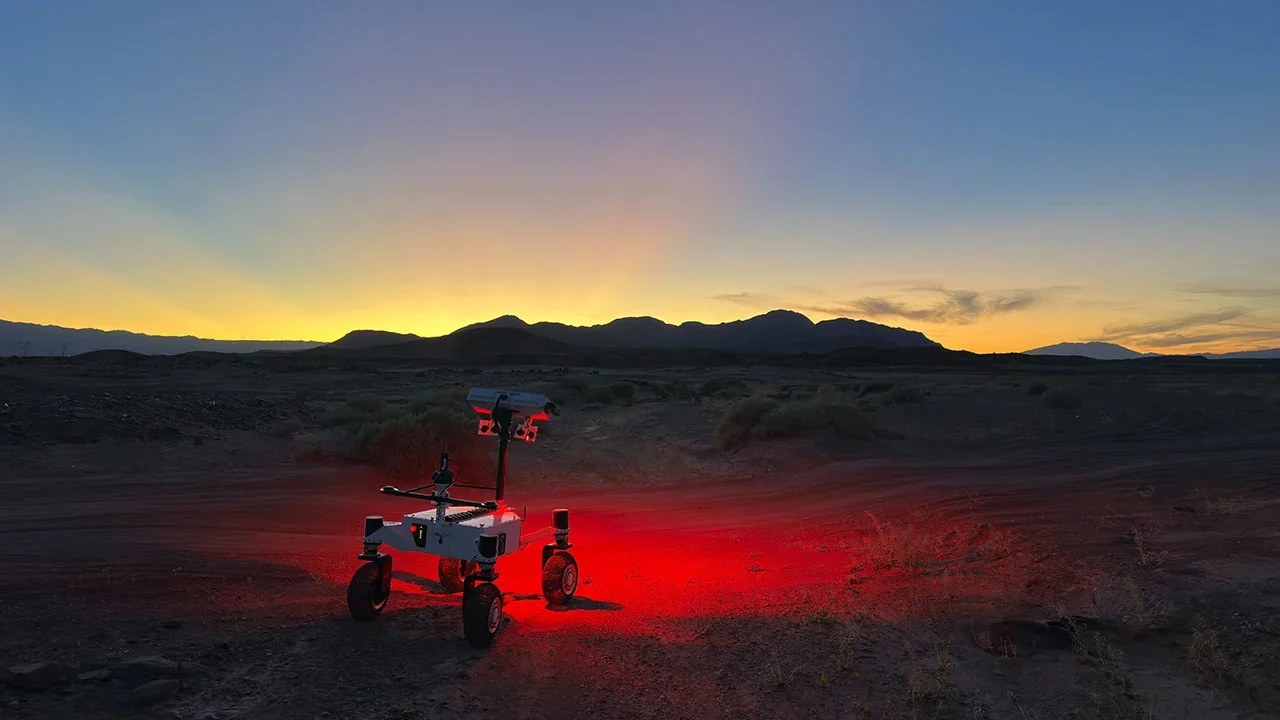
NASA’s Jet Propulsion Laboratory (JPL) recently completed a successful field test of its advanced rover prototype, ERNEST (Exploration Rover for Navigating Extreme Sloped Terrain), in the Colorado Desert near Plaster City, California. The test focused on demonstrating new autonomous driving software designed for potential future lunar missions that demand higher travel speeds and extended mileage than current Mars rovers.
What Happened
In March 2026, ERNEST maneuvered approximately 16 miles across rugged desert terrain over the course of 37 hours of active driving. This test involved traversing during various lighting conditions, including dusk, dawn, and nighttime, to simulate the complex shadow environments found in the Moon’s polar regions. Engineers closely monitored the rover as it tackled extreme terrain, including instances where one of its wheels climbed up over rocks, demonstrating its advanced mobility. The rover’s autonomy software enabled it to operate continuously with minimal intervention, at speeds more than ten times faster than NASA’s Perseverance rover currently achieves on Mars.
Key Facts
ERNEST is a four-wheel rover prototype developed over the past several years at JPL, beginning in 2022 with internal research funding. Today, its work is supported by NASA’s Mars Exploration Program and the Exploration Science Strategy Integration Office under the agency’s Science Mission Directorate. The rover successfully covered a 16-mile traverse during this multi-day test, demonstrating its capability to handle extreme slopes and diverse lighting conditions. The test was conducted near Plaster City, California, a site chosen for its challenging terrain similar to expected lunar environments. The rover used advanced autonomy software to drive at speeds far exceeding current planetary rovers.
What This Means
ERNEST’s performance marks a significant milestone in advancing robotic exploration for the Moon and potentially other celestial bodies. The rover’s ability to navigate slopes, cover greater distances quickly, and operate under limited lighting conditions addresses key challenges facing future missions aimed at the Moon’s shadowed polar regions. This capability will enhance scientific returns by allowing spacecraft to reach diverse and previously inaccessible sites within mission timeframes. For NASA, ERNEST represents progress toward establishing more efficient, long-range robotic explorers that can scout ahead, conduct extensive surveys, and assist astronauts during sustained lunar surface operations. The increase in driving speed and autonomy could reduce mission costs and increase operational flexibility, critical for upcoming Artemis missions and beyond.
Background
ERNEST’s development began in 2022 as part of JPL’s internal research initiatives aimed at creating next-generation planetary rovers with enhanced autonomy. The project later received funding from NASA programs focused on Mars exploration and broader exploration science goals. The rover draws on lessons learned from previous missions such as Curiosity and Perseverance on Mars, which operate at slower speeds and require frequent commands from Earth. ERNEST’s design targets more rapid traversal and independent operation suitable for the Moon, which demands robust handling of extreme slopes and shadowed terrain.
What Comes Next
Following this successful field test, NASA plans to analyze the data collected to refine ERNEST’s autonomy software and hardware systems. Future tests are expected to focus on further increasing the rover’s efficiency and reliability in varied simulated extraterrestrial environments. These developments aim to prepare ERNEST for integration into upcoming lunar mission architectures where its capabilities could be leveraged to expand exploration reach and support human activities on the Moon.
Sources
This article is based on reporting and publicly available information from the following sources:
Read more Space & NASA stories on Goka World News.